

MANNY MAUNG
Myanmar’s military is well versed in the art of obscuring language and manipulating narratives. More recently, it has moved to entrench its rule through the façade of a sham election to install a civilian government.
Elections held in late December 2025 have widely been condemned as neither free nor fair, and described by the United Nations Human Rights Council as a “unilateral convening by the Myanmar military of elections that excluded much of the country’s geographical territory and many political parties”. Most governments, including Australia, have rejected the election and its results as an orchestrated manoeuvre to place the military’s leader, Min Aung Hlaing, on the path to the presidency.
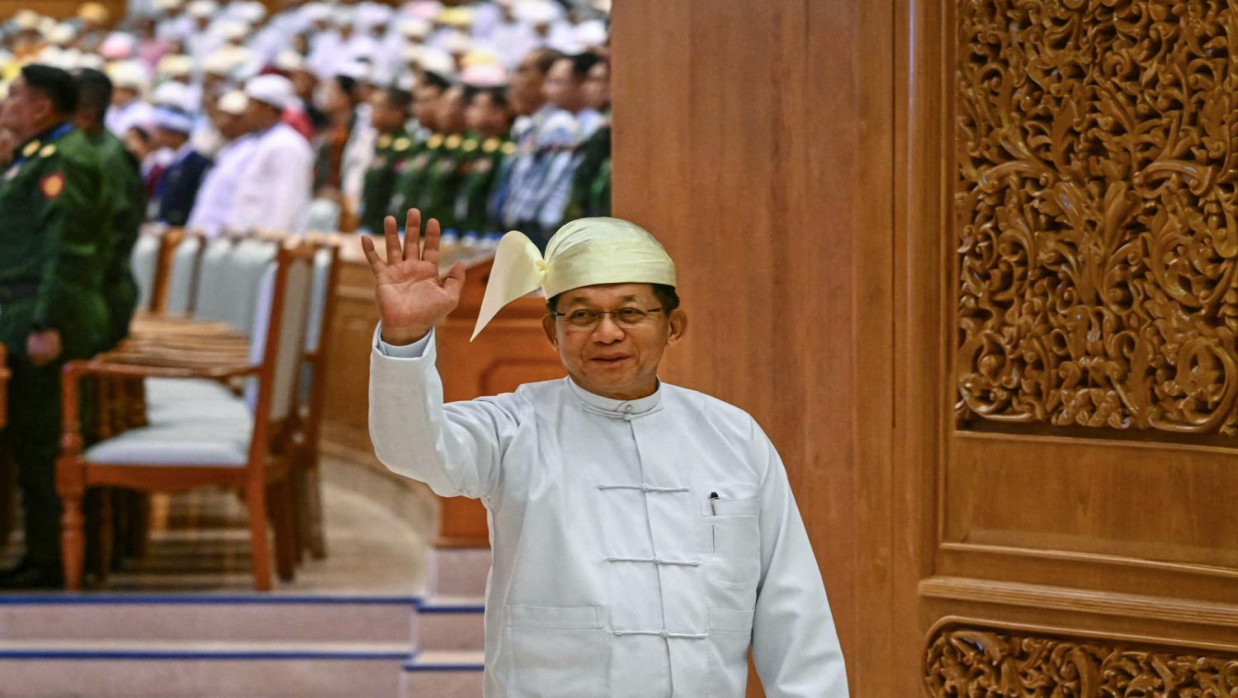
On 3 April, a junta-controlled parliamentary vote did just that, finally installing the former commander-in-chief in a role that he has long sought. Since the February 2021 coup that triggered country-wide protests and a civil war, human rights advocates and civil society groups have warned that the military would seek to manufacture legitimacy through superficial reforms, including tightly controlled elections. They also voiced concern that while any election would be inherently fraudulent and rejected by the people of Myanmar, the process itself would be mistaken as legitimate by other, external audiences. Their concern is beginning to play out in the language adopted to describe the regime.
The junta wants us to forget its crimes by accepting Min Aung Hlaing’s appointment as fait accompli.
An example of this appeared in an ABC News report this month referring to the “newly-elected President Min Aung Hlaing”, without mention of the highly contested nature of the claim. It added how the “president” had announced an amnesty for the mass release of thousands of prisoners the same day, including the previously democratically elected president, Win Myint, who was arbitrarily arrested alongside State Counsellor Aung San Suu Kyi and other members of parliament during the 2021 coup.
In reality, the amnesties are often timed and the releases staged. The coverage is a worrying illustration of how the military’s persistence in delivering its propaganda narratives is succeeding, where a seemingly innocuous reference to preceding events, albeit without critique, creates a sense of business as usual.
Meanwhile, the human rights and humanitarian situation is only worsening. The country is described as in “polycrises” stemming from the Covid-19 pandemic, the 2021 coup, the spread of civil war, and multiple disasters including a devastating earthquake last year. At least 16.2 million people – about a third of the total population – are in dire need of life-saving aid.
The sham elections and the junta’s questionable parliamentary process, held amid ongoing air strikes and attacks on civilian populations, have done nothing to demonstrate the military’s genuine interest in the well-being of its own people. If anything, it shows how far the military will go to consolidate power and avoid accountability.
The junta wants us to forget its crimes by accepting Min Aung Hlaing’s appointment as fait accompli, and to just move on. But this fails to reflect the wishes of the Myanmar people for a real, rights-respecting democracy. We would do well to remember this – siding with those who are pushing back against repression and countering military narratives more robustly.
News organisations have a responsibility to do more than others, particularly as they are often the gatekeepers of information dissemination. Otherwise, we risk lending credibility to perpetrators and giving a green light to the authoritarian creep that we’re seeing not just in Myanmar but globally.
The article appeared in the lowyinstitute
0 Comments
LEAVE A COMMENT
Your email address will not be published