

Nyein Chan Aye
When Chinese Foreign Minister Wang Yi arrives in Naypyitaw on Sunday, his visit will be about much more than protocol. It will be another visible step in China’s steady diplomatic rehabilitation of Min Aung Hlaing—a man Beijing handled with caution after the 2021 coup but now increasingly treats as the political center of gravity it must work through in Myanmar. During Wang Yi’s July 2022 trip to Bagan, his first post-coup visit to Myanmar, he attended the Lancang-Mekong meeting and met then-Foreign Minister Wunna Maung Lwin—but not Min Aung Hlaing. That restraint mattered: China did not break with the junta, but neither did it rush to embrace the coup leader as the unquestioned face of Myanmar.
From caution to sponsorship
The turning point came when Myanmar’s anti-junta resistance shifted from stalemate to strategic shock. Operation 1027, launched by the Brotherhood Alliance of three ethnic armed groups widely seen as close to China together with wider resistance offensives across the country, exposed the military’s weakness in a way no post-coup challenge had before. In late 2024, the junta suffered unprecedented losses: resistance forces captured the Northeastern Regional Command in Lashio in August, followed by the Western Regional Command in Rakhine just four months later.
Around that time, Burmese critics were already mocking Min Aung Hlaing and his deputy Soe Win as the “loser brothers of the army.” This mockery is backed by stark realities: Myanmar’s military has suffered severe manpower losses since the 2021 coup, through battlefield deaths, defections, surrenders, and other forms of attrition. The International Institute for Strategic Studies now estimates the armed forces at about 134,000 active personnel, far below pre-coup strength.
Having long tried to hedge its bets among the junta, border armed groups, and remnants of the old civilian order, Beijing now faced a new problem: not how to balance instability, but how to prevent collapse. That is when its policy began to harden in the junta’s favor.
In August 2024, Wang Yi met Min Aung Hlaing directly in Naypyitaw. Official accounts emphasized “political reconciliation” and cross-border stability, promising technical aid for the junta’s census and election plans. In November 2024, Min Aung Hlaing made his first post-coup trip to China, where Premier Li Qiang signaled support for Myanmar’s “political reconciliation and transition efforts.” In Beijing’s language, “political reconciliation within the constitutional framework” sounds neutral, but in Myanmar’s reality, it points back to the 2008 military-designed order that the anti-junta movement rejects.
The diplomatic lift became even more explicit in 2025, when Min Aung Hlaing met Xi Jinping in Moscow in May and again in Tianjin in August—a rare level of direct contact with the top leader of a major power for a putschist shunned by much of the world.
This month, after the junta’s heavily controlled election process elevated Min Aung Hlaing from junta chief to president in civilian clothes, Beijing quickly congratulated him.
The sequence matters. Wang Yi’s upcoming visit is the latest rung on a ladder from cautious contact to open engagement to political cover to regional normalization.
Beijing will say this is diplomacy in the service of peace; that is only half true. China is not a neutral mediator but the junta’s major diplomatic lifeline and arms supplier, as well as a power with direct geostrategic stakes in the outcome. According to UN reporting, China has been one of the Myanmar military’s principal foreign suppliers since the coup, providing fighter aircraft, drones, communications technology and industrial input that sustain the junta’s domestic weapons production.
Beijing’s approach is also selective. It wants stability where its interests are exposed—along border trade routes, around rare earths and pipelines, and around projects tied to the China-Myanmar Economic Corridor (CMEC). It is willing to pressure border armed groups, broker temporary ceasefires, and shore up the junta when needed. But it does not aim to comprehensively resolve Myanmar’s national political crisis.
Transactional peace
This selective stability serves distinct economic aims. As Beijing consolidates Min Aung Hlaing’s political status, it is also pushing to secure the stalled crown jewels of the Belt and Road Initiative (BRI). In early 2026, Chinese and junta officials explicitly accelerated plans for the CMEC, most notably the strategic Muse-Mandalay railway and the Kyaukphyu Deep-Sea Port, which aims to lock down China’s direct logistical route to the Indian Ocean.
In February 2026, deputy junta chief Soe Win used a Chinese New Year address to publicly assure Beijing that these strategic nodes were “being implemented.” On paper, these megaprojects promise connectivity; on the ground, the railway and port corridors cut directly through contested territories now mostly controlled by the Brotherhood Alliance and other anti-junta forces. For Beijing, the “peace” it brokers with its allies’ border armies is highly transactional: it demands temporary truces not to end the war, but to create a sufficient security cordon to lay tracks and pour concrete.
Why ‘made-in-China’ stability won’t last
Beijing can force a meeting. It can squeeze border armies by choking supplies, and it can help turn a failed coup into a semblance of civilianized order. But it cannot resolve the questions driving Myanmar’s decades-long wars: how power is shared, whether ethnic minorities achieve meaningful self-rule, and if the military can ever be permanently pushed out of politics. These are the constitutional core of the crisis.
Myanmar has seen this before. Borderland truces produce pauses but not permanent settlements. The Nationwide Ceasefire Agreement (NCA) never ended the wider war, and some China-brokered arrangements in northern Shan have proved just as fragile. Beijing’s influence, in other words, is real but not total: some groups bend, some stall, some comply selectively, and some keep fighting. China can shape the tempo of war and help the junta appear less isolated, but it cannot manufacture broad legitimacy at home or abroad. The more visibly Beijing props up the junta, the greater the risk of deepening anti-China sentiment among a public that already sees foreign backing as prolonging military rule. That is why China-brokered stability is short-lived—and why Min Aung Hlaing’s political makeover is unlikely to hold.
‘Made-in-China’ president
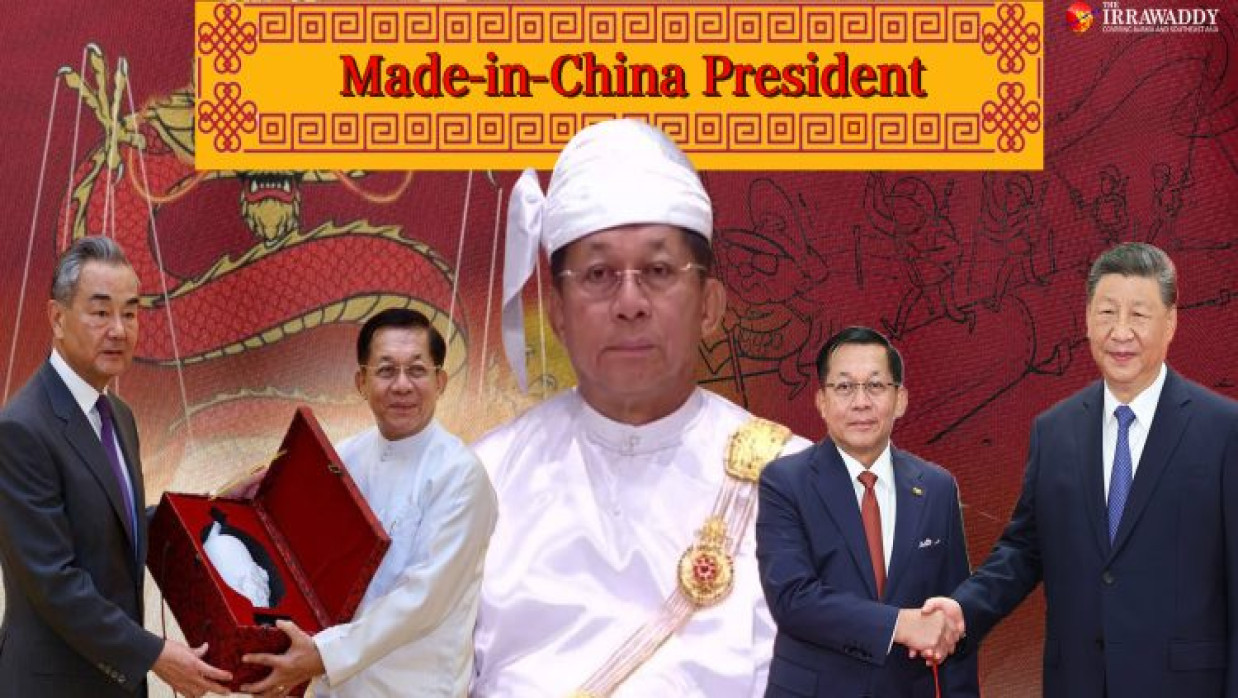
In Burmese historical memory, King Narathihapate of Bagan in the 13th century is remembered as “Taruk-Pyay-Min,” the king who fled from the “Taruk” or Chinese-Mongol invaders. Min Aung Hlaing is now similarly dubbed, but far from fleeing from China he leans on it. To many Burmese, he is therefore “Taruk-Loke-Min,” the “made-in-China president”, assembled overseas through coercive elections and diplomatic engineering. The problem for China is that a propped-up client is not the same as a stable order. A presidency may look more presentable than a bare-faced junta, but it is not more durable for that alone.
Chinese intervention, then, is serious, but it is not a destiny. The anti-junta movement still has agency, especially in the political and military heartlands of Sagaing, Magwe and Mandalay, and it is there that the war’s long-term outcome will be decided, not in any conference room in Naypyitaw or Kunming.
Wang Yi’s visit will be presented as diplomacy, peace-making, and good-neighborly partnership. In reality, it is a reminder of how far China has moved from post-coup caution to post-election sponsorship. Beijing may yet help impose another pause, another process, another façade of normality in Myanmar. But if that peace is built like many Chinese-made products sold in poor countries—shiny, flimsy, for immediate use only—then it will fail for the same reason. What is preventing lasting peace in Myanmar is not a lack of meetings but a lack of justice. Until it comes, no peace made in Beijing will last.
0 Comments
LEAVE A COMMENT
Your email address will not be published