

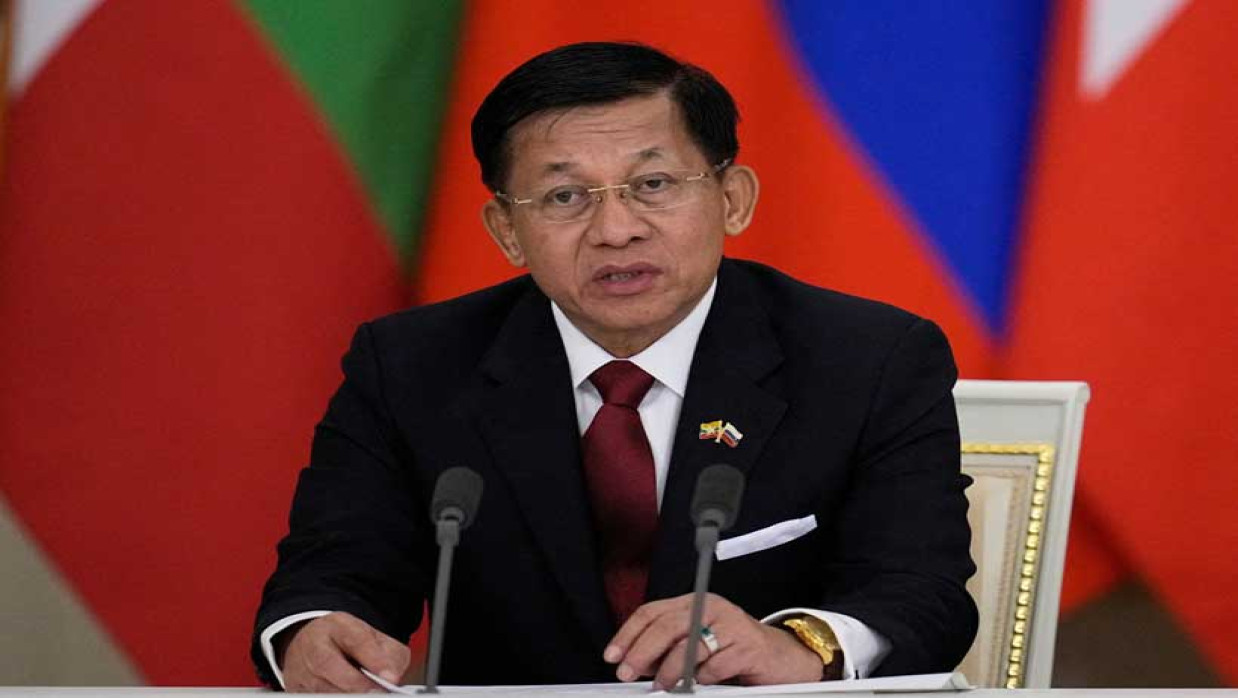
In April 2026, Min Aung Hlaing is set to officially become president of Myanmar. However, this will not mean a return to civilian rule but rather signify the completion of the military regime's transition to power since the February 2021 coup. Although this change in power is being portrayed as a constitutional amendment following the recently concluded December 2025-January 2026 elections, critics at home and abroad have denounced it as nothing more than a sham to keep the junta in power. It has significant consequences for security in Southeast Asia, the ASEAN response moving forward, and India's interests in the Bay of Bengal and its northeastern border.
In this article, we will discuss why Min Aung Hlaing's presidency will mean business as usual in Myanmar, Myanmar's military might, the continuing civil war, and its impact on Southeast Asia.
From Coup Leader to President
General Min Aung Hlaing’s political ascent began with the military coup of February 2021 that ousted the elected government of Aung San Suu Kyi. The military justified its takeover with unsubstantiated claims of voter fraud that were rejected by the international community. In the years since, the junta has suppressed dissent and presided over a deepening political and humanitarian crisis across Myanmar.
Opposition forces have since taken up arms against the junta's forces. What was once Myanmar's burgeoning economy is now in shambles, with millions internally displaced and in need of humanitarian aid.
Only boycotted by the opposition National League for Democracy (NLD), Myanmar's November elections were marred by continuing violence that left ballots unable to be cast in 263 of the country's 330 townships. While parliament is made up of representatives elected by the people, at least those who could safely vote, it is mostly pro-military, and it unanimously voted in Min Aung Hlaing as president.
Though Min Aung Hlaing technically handed in his resignation as commander-in-chief of Myanmar's armed forces to assume the presidency, as required by the nation's constitution, little power will change hands. Myanmar remains under military control politically, bureaucratically, and economically.
The Tatmadaw as a State Within a State
The military has long been an entity unto itself within Myanmar society. Operating semi-independently of civilian politics, the Tatmadaw took power in 1962 under General Ne Win and has since positioned itself as the protector of national sovereignty and the Buddhist ethnic majority, the Bamar.
That mindset has contributed to years of conflict between the military and ethnic minority groups like the Rohingya, Arakan Army, and other pro-democracy federal forces. From 2011 to 2020, Myanmar experienced a transition to limited democracy, but the military still controlled the ministries of defense, border affairs, and home affairs, as enshrined in the constitution.
Granting the military commander-in-chief, Min Aung Hlaing, the presidency cements that power dynamic. Instead of placing military power under civilian control, the country now places its commander-in-chief under the Tatmadaw's leadership.
Civil War Without Resolution
Burma/Myanmar remains mired in one of Southeast Asia's longest-running insurgencies. Nationwide protests erupted into armed conflict when security forces cracked down on peaceful demonstrators following last year's coup.
Resistance forces have since evolved into militias partnered with ethnic groups in various states across the country.
"There's no way anyone's going to accept this new president," said Khin Sandar Tun, a spokesperson for Myanmar's National Unity Government (NUG), which is in exile but has supporters on the ground. The group has denounced the legitimacy of the election result. "It would just further legitimize violence."
Junta forces have continued using airstrikes as a tactic of suppression. In just the first few months of 2025, over 1,000 airstrikes were confirmed.
Junta crackdowns have resulted in the imprisonment of thousands of political prisoners and close to 8,000 civilian deaths since the military seized power last year.
International Legal Pressure and ICC Proceedings
International criminal charges also remain something of a hallmark for Min Aung Hlaing. The ICC has been investigating him since 2024 for crimes against humanity over attacks on the Rohingya ethnic group.
ICC prosecutors are looking into the Myanmar military crackdown in Rakhine State in 2017 that saw over 700,000 Rohingya refugees flee to Bangladesh. Holding the title of president won't allow him to skirt responsibility in the eyes of the international community either. Rights groups have warned that the title change won't absolve leaders from criminal charges.
International sanctions have led Myanmar to turn more toward China and Russia for closer ties.
ASEAN's Limited Influence
ASEAN has been unable to agree on a collective response to the crisis in Myanmar. Despite agreeing to a Five Point Consensus last year, which included dialogue and humanitarian aid access, little progress has been made.
Groups like ASEAN Parliamentarians for Human Rights and others have cautioned that Min Aung Hlaing's ascension to civilian leader would further entrench military dictatorship rather than restore order. ASEAN has also been crippled by its inability to act without consensus, restricting its ability to apply effective pressure on Myanmar's junta.
Myanmar's road to civilian rule is more likely to deepen ASEAN fractures.
India's Strategic Calculus
India faces a similar challenge with Min Aung Hlaing poised to become president. India's efforts to balance principles with pragmatic security concerns date back decades along the India–Myanmar border.
Northeast India is home to several rebel groups operating in neighboring states such as Manipur and Nagaland. Insurgent outfits have routinely exploited Myanmar's porous border terrain for decades. Naypyidaw's cooperation is thus key for India's anti-insurgency operations.
Drug trafficking routes from the Golden Triangle also run into India's borderlands. Myanmar's cooperation has also been necessary to address this ongoing issue.
India has continued this transactional approach by choosing not to reject the legitimacy of Myanmar's junta. New Delhi is continuing business as usual with the generals.
China and Russia: Strategic Supporters
China and Russia remain Myanmar's strongest international allies. They have opposed Western sanction initiatives and maintained economic ties and arms deals with Naypyidaw.
For China, Myanmar is a key part of the China–Myanmar Economic Corridor that connects Yunnan Province to the Indian Ocean. Authoritarian stability, even flawed as it is in Myanmar, benefits Chinese interests by safeguarding investments.
Russia has notably increased arms sales to Myanmar as well as military-to-military exchanges. These deals secure rhetorical support for the junta at the UN and have allowed it to resist international pressure.
The Borderlands and Humanitarian Realities
Geopolitical considerations take center stage in diplomatic language, but humanitarian implications are felt most keenly at Myanmar's borders. Tens of thousands of Myanmar nationals have fled across the border into India's Mizoram State since last year's coup.
While the Government of India has not granted refugee status to these people, state officials and NGOs have been helping them however they can. People living along the border depend on trade between towns like Zokhawthar in India and Rihkhawdar in Myanmar.
The situation on the ground shows why developments in Myanmar are not just an internal affair but of regional humanitarian significance.
A Presidency Without Transformation
Min Aung Hlaing's ascent to the presidency is nothing more than the final step in the military's carefully crafted plan to hold on to power while maintaining a veneer of constitutionality. What we are witnessing is not the return of civilian rule but rather the entrenchment of the Tatmadaw power structure.
Conflict rages unabated in much of Myanmar, accountability at the international level is an ongoing question mark, and key players in the region are simply adjusting to the new normal.
Myanmar is not becoming stable under its new president. Across South and Southeast Asia, Myanmar is entrenched.


0 Comments
LEAVE A COMMENT
Your email address will not be published