

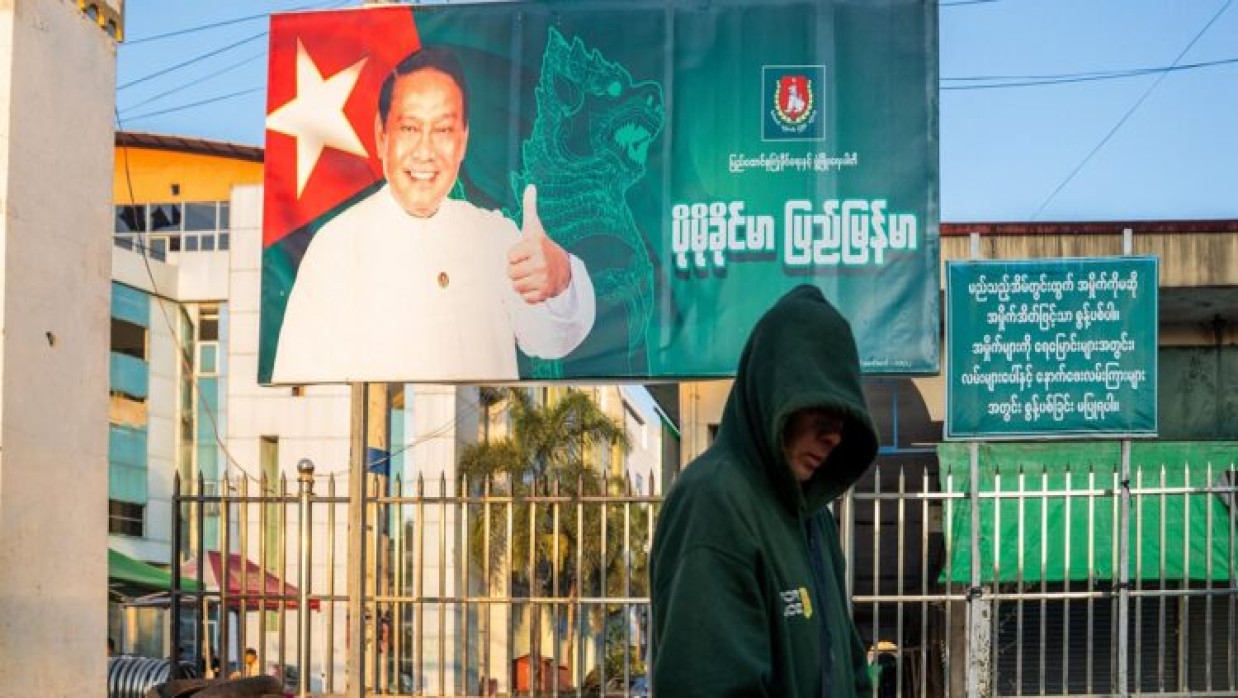
On 15 December, at a press conference in Yangon, Myanmar’s deputy minister for information, Major General Zaw Min Tun, said that the country’s upcoming election was intended for the country’s citizens and not a global audience. The junta was unconcerned about international recognition, he said.
Zaw Min Tun’s statement came soon after New Zealand parliamentarians described Myanmar’s impending election as “not a general election” but rather “a general’s election.” The remark captures precisely the nature and intent of the electoral process set to kick off on 28 December and running through to 25 January, designed not to restore the democracy smothered by Myanmar’s 2021 military coup but rather to entrench military control. Multiple intergovernmental bodies such as the European Union and the Association of Southeast Asian Nations have publicly signalled that they will not recognise the election, calling it neither free nor credible and refusing to engage with it as a legitimate democratic process.
Since seizing power in February 2021, the military has issued seven six-month extensions of a nationwide state of emergency under junta authority, with the last expiring on 31 July 2025. Hours after the lapse, Myanmar’s state television announced the reimposition of martial law and a state of emergency in nine of the country’s 14 states, citing concerns about armed violence. Legal analysts have pointed out that the initial declaration of the state of emergency failed to meet the procedural requirements of Myanmar’s 2008 constitution, which was drafted and imposed by the military. The coup was triggered by unsubstantiated allegations of fraud in the 2020 general election, which the National League for Democracy (NLD) had won decisively. While the public has consistently voted for the NLD whenever free elections have been held, the military has repeatedly wrested power from them under varied pretexts.
The upcoming election, orchestrated by the generals, is an attempt to legitimise the military’s grip on power. A closer look, however, reveals a repressive legal framework that entrenches military control and eliminates political opposition, making the whole process a sham. The election will not be truly representative, with 56 townships already excluded from the vote as large swathes of territory remain under the control of anti-junta armed groups resisting military rule. Maintaining the status quo of military dominance will also allow lawlessness to persist – particularly in cross-border online fraud and drug-trafficking operations – victimising both the people of Myanmar and others around the world.
THE PRIMARY AUTHORITY responsible for overseeing political parties and ensuring citizens’ rights to nominate and vote for legislative representatives is the junta-controlled Union Election Commission (UEC), which has largely been headed by former military officers. The current chair of the UEC is Than Soe, a former major general in the Tatmadaw – the armed forces of Myanmar. He was preceded by the former air force colonel Ko Ko and major general Thein Soe. Thein Soe oversaw the administration of the 2010 general election and was re-appointed UEC chairperson from 2021 until early 2024. The 2010 election was widely seen as neither free nor fair, with the political opposition alleging advance-voting fraud and coerced voting while the UEC turned a blind eye. It is clear that the UEC is not an independent body, but one firmly controlled by the military.
In January 2023, the military administration enacted the Political Parties Registration Law, authorising the UEC to regulate party registration, formation and dissolution. The UEC has repeatedly prevented genuine opposition involvement by dissolving or refusing to register numerous political parties under stringent new regulations, including the once-dominant NLD and other long-standing political groups. This has reduced electoral competition to a small number of parties aligned with the junta regime. The tighter party-registration requirements – such as minimum membership thresholds and mandated presence across townships – have also been employed to disqualify individual candidates and occasionally to remove names from the ballot after review. The provisions bar any party from contesting the election if it is accused of electoral fraud, unlawful conduct or engaging with “terrorist” individuals or organisations – a label the regime applies broadly to opponents of military rule. These provisions appear intended to block serious challengers and to ensure a legislature that is dominated by junta allies rather than reflecting authentic political competition.
In July 2025, the military junta enacted a harsh new electoral protection law that it claimed would shield the entire electoral process – including campaigning, candidate mobilisation, the free exercise of voting rights and the safety of election officials – from intimidation or interference. State-run and independent media have reported that 229 individuals have already been subjected to punitive action under this law. Certain incidents illustrate how the law is used to penalise civilians who dissent. For instance, a candidate was investigated and had his phone seized for mentioning in his campaign pamphlet the “Spring Revolution” – referring to the civil disobedience movement that began after the 2021 coup. Among those arrested was a 36-year-old who posted anti-election content on social media and received a seven-year prison sentence. Minors reacting to anti-election content with a “Love” emoji on Facebook have also been arrested under the law. While some of those arrested were members of opposition political parties or anti-junta armed groups, many civilians without any such ties have also been targeted.
In the 2025–26 election, the Pyithu Hluttaw, the lower house of Myanmar’s national legislature, will retain the first-past-the-post (FPTP) system. The Amyotha Hluttaw (the upper house), and also all state or regional Hluttaws, will adopt a mixed-member proportional system, blending FPTP with proportional representation and moving away from the simple FPTP system applied to them earlier. This newly established mixed electoral system is unfamiliar to many voters, and even to some candidates, and voter education is scarce.
In a campaign speech, Khin Yi, a former military general and the head of the Union Solidarity and Development Party (USDP) – an outfit made up of former generals – warned that any anti-military party that won would be dismantled the next day, and urged voters to back the pro-military party instead. The UEC has granted the USDP the ability to field candidates in every constituency for the 2025–26 vote, a benefit denied to most opposition groups.
On election day, every Hluttaw vote will be cast using the Myanmar Electronic Voting Machine (MEVM). According to James Rodehaver, the head of the Myanmar team at the United Nations Office of the High Commissioner for Human Rights (OHCHR), these machines could be used to monitor how people are voting. All these developments indicate that the military and its party will retain control of the country after this generals’ election, even as the civil war set off by the coup intensifies.
Despite repression, civilians in Myanmar are finding ways to protest the election. On 10 December, streets across Myanmar emptied as many observed a “silent strike” on International Human Rights Day, despite the junta’s efforts to ensure that business continued as usual. The protest revealed that the public continues to reject the election. A low turnout is expected – already, there have been few takers in advance voting among Myanmar’s citizens living overseas – despite threats and intimidation from the military.
MYANMAR STANDS in second place globally in terms of conflict intensity, outranked only by Palestine, according to the Armed Conflict Location & Event Data (ACLED) weekly conflict index published on 20 December 2025. Nearly 90 percent of Myanmar’s population of 54 million people has been exposed to political violence in the four years since the coup.
As the junta continues to lose territory to resistance forces, it has escalated tactics involving remote violence – airstrikes, drone attacks and artillery shelling – very often targeting civilian populations. On the night of 10 December, a military airstrike hit the general hospital in the township of Mrauk U, in the western part of Rakhine state, killing more than 33 people and wounding around 70 to 80 others, including patients, caregivers and hospital staff.
The junta’s victims include the country’s 3.5 million internally displaced people, and the 20 million now in need of humanitarian assistance. But the damage extends far beyond Myanmar and its own people too. The country’s scam industry, established in areas where the rule of law has collapsed, generates tens of billions of dollars in revenue, with the targets spread worldwide. Its workers, often trafficked and forced to work in so-called “cyber-scam” camps, come from across Asia and Africa.
These scam operations would not be possible without the involvement of the Myanmar military and militias under its command. A 2024 data-driven investigation by the non-governmental organisation C4ADS revealed frequent movements of mobile devices between major scam hubs and government buildings linked to the military junta in the capital, Naypyidaw, indicating ongoing contact and coordination between organised scam networks and the regime. These scam hubs have expanded rapidly since 2021, with satellite imagery showing the growth of their compounds averaging about 13.5 acres a month, according to a 2025 report by the Australian Strategic Policy Institute, a think tank. This growth is largely driven by the industry’s role in financing militia groups aligned with the junta, creating strong economic incentives for the regime to tolerate and protect these operations.
When international scrutiny intensified, the junta conducted “raids” on KK Park and other scam sites in 2025. But these appeared aimed primarily at managing reputational damage, as the underlying criminal networks have proved resilient. As of March 2025, at least 100,000 people, including many subjected to forced labour, were still working in compounds along the Thailand–Myanmar border. The junta, via the scam industry, has put huge numbers of foreign nationals in danger, both as victims and as forced labourers. This reflects only one aspect of the junta’s broader pattern of lawlessness and its global spillover effects.
The Myanmar Opium Survey 2025 from the United Nations Office on Drugs and Crime indicates that opium poppy cultivation is rapidly expanding, with the country’s opium–heroin economy valued at between USD 640 million and USD one billion. Myanmar’s part of the Golden Triangle – one of the world’s largest opium-producing areas – has long served as a major source for heroin, and has more recently also developed into a key hub for industrial-scale methamphetamine production.
The drug economy provides a significant financial lifeline for military units, state-connected enterprises and pro-junta militias that profit through taxation, protection schemes and control of trafficking corridors. Reports suggest that some captured Tatmadaw soldiers were found carrying drugs, with some military commanders even acknowledging that substances are locally distributed to frontline troops. As long as the military remains in power, these illicit activities will continue, leaving Myanmar’s citizens part of a broader, global victimhood.
Even as the junta ploughs ahead with the election, international condemnation is growing. Recently, Finland and Denmark announced plans to close their embassies in Myanmar in 2026, citing a lack of confidence in any near-term political improvement. Both countries indicated that maintaining a full diplomatic presence is becoming increasingly difficult due to security concerns, limited opportunities for diplomatic engagement and a shrinking space for international cooperation.
The silent strike on 10 December shows that the people of Myanmar have already rejected both the election and its outcome, despite Zaw Min Tun’s confident pronouncement that the election is for citizens. Given the repressive legislation aimed at suppressing political dissent, the lack of independent bodies to monitor the election process and the restrictive requirements that prevent the formation of a viable political opposition, the election result is neither free nor fair and must be rejected.
0 Comments
LEAVE A COMMENT
Your email address will not be published