

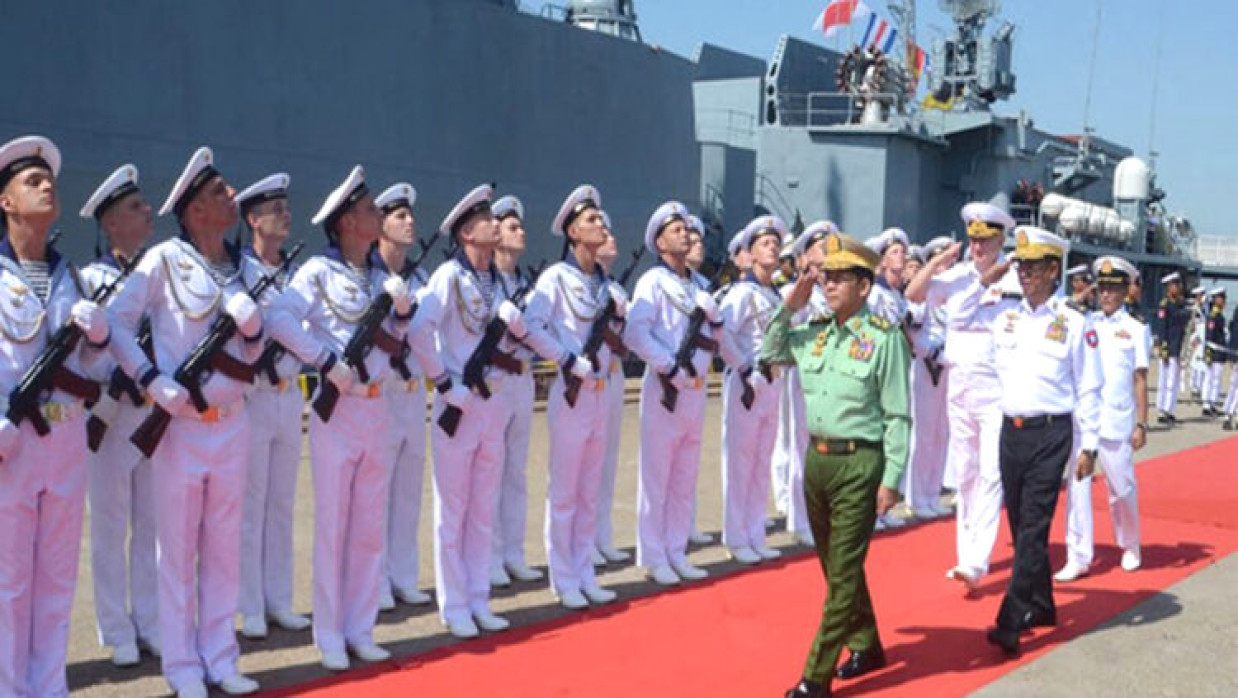
Three warships from Russia’s Pacific Fleet arrived in Yangon in the middle of last month to conduct joint exercises with Myanmar’s Navy. They carried out maritime security drills off the Myeik Archipelago, including surface, air and underwater maneuvers with live-fire exercises.
This was already the third joint exercise between the two navies since the 2021 coup. The first took place in November 2023, also off Myeik, and the second in October 2024 in the northern Bay of Bengal.
The first exercise coincided with heavy junta losses during Operation 1027, when the ethnic Brotherhood Alliance seized territory in northern Shan State. Anti-China protests were staged, and the junta branded the Myanmar National Democratic Alliance Army (MNDAA), one of the three bothers in the alliance, “Chinese-backed.”
It was against this backdrops that junta chief Min Aung Hlaing leaned on Russia instead, presenting the drills as an unprecedented achievement under his rule, and using propaganda media to celebrate these deepening ties. In clashes in Rakhine State that followed the joint drills, the Navy lost a few boats to the Arakan Army (AA), another a member of the Brotherhood Alliance.
The second exercise in October 2024 came three months after the MNDAA and allies captured the Northeastern Command in Lashio. Soon after, the junta was forced to abandon its Western Command in Rakhine State as well. The drills did nothing to alter battlefield realities—but the regime did learn from them to improve its logistics.
Reliance on waterways
Russia sent only destroyers and warships to the first exercise, but the second involved corvettes and a supply and oil tanker ship as well. The third exercise involved a corvette, a frigate and a supply ship.
This reflects the junta’s growing reliance on maritime logistics. With overland routes often blocked by the resistance, naval transport has become essential for resupply and reinforcement—and is much cheaper than air transport.
It is no coincidence that the second exercise in October 2024 featured the supply ship Pechenga: Moscow was training the junta in maritime logistics.
In August that year, the regime had used the Irrawaddy River to dispatch reinforcements from Mandalay to Bhamo, but only one vessel from its flotilla made it through repeated attacks from the Kachin Independence Army (KIA) and allies.
Things were very different this year. In July–August, the regime again used the Irrawaddy to send reinforcements and supplies, and this time a dozen vessels managed to reach Bhamo—which must count as a logistical success.
In northern Sagaing and Kachin, the regime relies on these lifelines in the river towns it controls. In Tanintharyi Region in southern Myanmar, the Coastal Command sustains subordinate units by sea.
Which brings us to the third exercise this November, which unfolded amid reports of the junta trying to regain control of the AA-controlled towns of Gwa, Thandwe, Taungup and Ann in Rakhine.
Preparing for coastal operations
The third exercise therefore went beyond logistics, rehearsing coastal operations. The Kabuzar Island zone where it took place—60 nautical miles wide—mirrors Rakhine’s coastline.
Reports suggest junta generals are preparing an offensive, not least because they have business interests in Thandwe’s once-thriving hotel industry. And naval support will be indispensable. The generals, enamored of the mythology of the Normandy Landings in World War II, may dream of staging their own amphibious assault. With Russian lessons fresh in their minds, they could deploy warships alongside massed conscripts to storm Rakhine’s beaches.
Already, the navy is tightening control at sea, detaining fishing boats and enforcing stricter security. The junta may soon apply Russian-taught tactics: harassment fire from offshore, amphibious landings, and reinforced supply chains.
The article appeared in the irrawaddy

0 Comments
LEAVE A COMMENT
Your email address will not be published