

The Crisis of Governance and Illiberal Hegemony in Bangladesh and South Asia
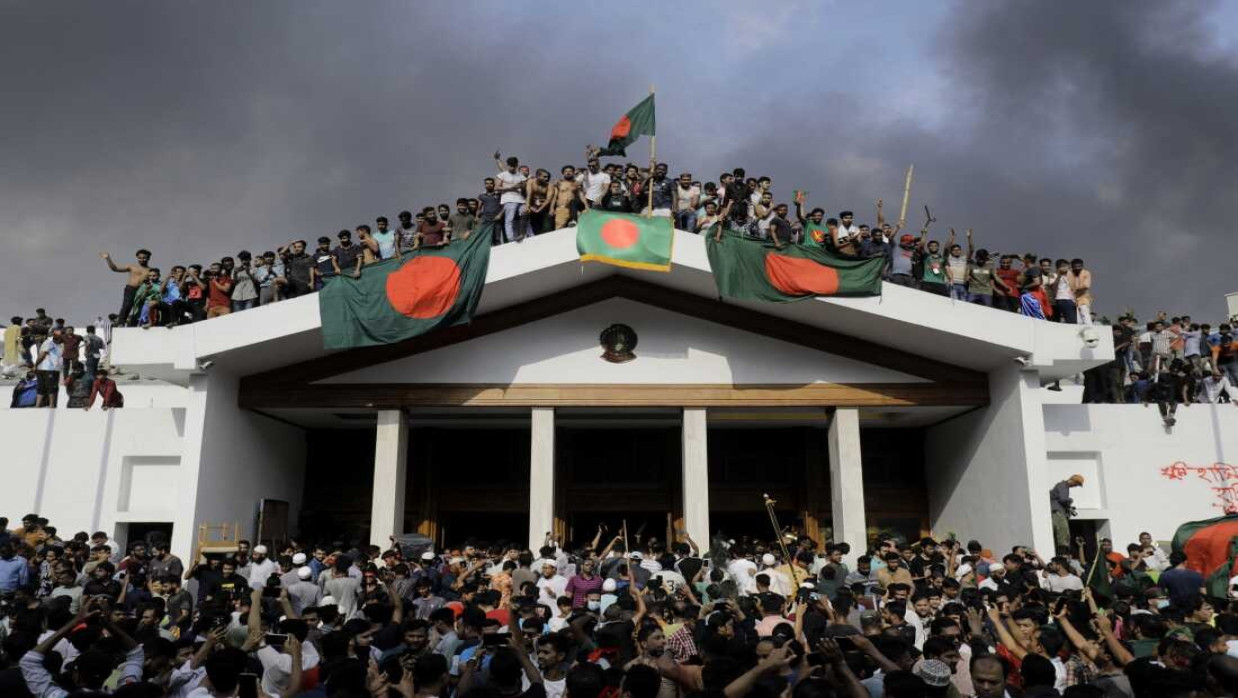
Bangladesh in Revolt
Bangladesh is not alone; it has seen mass uprisings in South Asia that have led to regime changes in Sri Lanka, Nepal, and the Maldives over the past few years. Although each of these countries is experiencing a unique domestic crisis, be it over corruption, unemployment, authoritarianism, or economic mismanagement, there is a pattern of common regional dynamics behind these uprisings.
People across South Asia have taken to the streets against corrupt and unaccountable political classes accused of being puppets in the hands of foreign powers. In totality, they represent a region-wide recalibration of citizens’ expectations from their governments about democracy, nationalism, and accountability.
Local Causes
Bangladeshis took to the streets over domestic issues. Rampant corruption among the political elite was the tipping point for protesters in Bangladesh, with billions of dollars lost to ‘fake’ loans and vote-bank businesses during the tenure of the incumbent Awami League government. An estimated 8 billion dollars have been siphoned off from Bangladesh to various destinations.
Nepalis and Sri Lankans vented their anger against corrupt politicians after losing billions of dollars of foreign aid and development funds, respectively. Additionally, democratic erosion became another major contributor in these countries, and in Bangladesh, which triggered street protests with similar accusations leveled against the ruling regimes of authoritarianism, media crackdowns, enforced disappearances, vote rigging, weakening civic spaces, and stifling opposition voices. Democratic institutions have lost their confidence among the populace, with many believing that change can no longer come about through voting. In Bangladesh, even the voting was rigged.
Poor economic management has been a catalytic factor for the downfall of regimes elsewhere in South Asia. Rampant inflation, electricity blackouts, and food scarcity created a disgruntled generation unable to find jobs. Youth unemployment became another reason behind mass protests in Bangladesh when young Bangladeshis realized that “most jobs” in the public sector were reserved for “family friends”. Sri Lanka saw similar disgruntlement amid its economic crisis, while Nepal has been unable to overcome the trend of unemployment.
India’s Regional Role and the Debate on “Illiberal Hegemony”
Domestic considerations aside, regional developments, namely India’s role in South Asia, have played an outsized role in shaping public narratives. India’s position as South Asia’s unipole has given it an outsized degree of political, economic, and strategic influence over its smaller neighbors. It is here that accusations arise that India is pursuing “illiberal hegemony.”
Definitely, hegemony means pursuing dominance in the service of national interests and often materializes through military, political, and economic power. Where liberal hegemony advocates, such as the United States, prioritize the liberal ideal, democracy promotion, human rights, and international institutions alongside national interests. Accusers say India asserts the former without frequently enough embracing the latter in its foreign policy.
India has often supported governments lacking democratic credentials for stability and counterterrorism purposes. Bangladesh presents a textbook example of India cozying up to Sheikh Hasina’s Awami League government. India had shared intelligence and partnered with Bangladesh on counterinsurgency operations early on. Both countries benefited from quelling insurgent sanctuaries in Bangladesh’s east aimed at India’s northeast. India, however, crossed a line by actively supporting AL’s political dominance. New Delhi’s response to Bangladesh’s 2014 election, which was boycotted by most of its opposition, reinforced this notion.
India was quick to congratulate the Sheikh Hasina-led government hours after it was declared the winner. It subsequently pressured the United States to tone down criticism over the election’s legitimacy. India’s actions did secure a stable-ish government in Bangladesh, but anti-India rhetoric surfaced in otherwise pro-India media outlets. Actors opposing the Awami League used the opportunity to galvanize anti-Indian sentiment by claiming bias and Indian meddling in Bangladesh’s domestic politics.
This same Bangladesh government continues to deepen ties with China despite India investment and support.
The United States: Strategic Alignment and Limited Intervention
The United States has allowed India a wide berth in dealing with regional affairs in South Asia. Occasionally raising human rights and democratic election issues, Washington has infrequently acted in ways that might upset friendly governments or complicate India’s regional designs. In Bangladesh, for instance, Washington imposed travel bans and sanctions on those found to interfere with democratic elections, but these measures fell well short of attempts to reorder the status quo that India desires in its neighborhood. Claims that Washington influenced regime change in Bangladesh have surfaced in India, but these arguments have little merit. Regime change in both Nepal and Bangladesh came about through domestic political means.
Structurally, U.S. interests align with India's. Both countries share a common interest in countering China’s influence in the Indo-Pacific region. Going forward, however, Washington has sought to hedge its bets by deepening ties with Bangladesh, Sri Lanka, and even Pakistan independently of New Delhi.
“India Out” Movements and Sovereignty Concerns
Many years after independence, Bangladesh, Sri Lanka, and Nepal witnessed mass protests calling for an “India Out”. More recently, in the Maldives as well, there have been growing calls for India to leave. Some of these protests have stemmed from legitimate domestic political grievances against their own governments for being too cozy with New Delhi. Sovereignty issues have also been at the forefront of many of these protests. Bilateral agreements on energy, infrastructure projects, transit access, and security cooperation are often criticized for undermining national sovereignty. For example, Nepal witnessed protests and what many called a blockade by India in 2015–2016 over a constitutional issue, which still rankles with Kathmandu. Bangladesh, too, saw public outcry over economic and infrastructure agreements unfavorable to Dhaka. Water sharing among common rivers is a major issue. India simply doesn’t give a hoot. They keep building barrages and dams to divert water away from the lower riparian nations, depriving Bangladesh of its share.
India’s sheltering of certain politicians accused of oppression has also not gone down well with these countries. Accusations of interference in internal politics are substantiated; such actions contribute to distrust and reinforce narratives of external influence in domestic politics.
China’s Expanding Strategic Footprint
China, most notably, has been swift to take advantage of openings created by domestic grievances with the status quo. Beijing has strengthened its economic, infrastructure, and defense cooperation with several countries across South Asia. In Bangladesh, defense deals have increased alongside growing Chinese infrastructure investments and trilateral dialogue initiatives with Pakistan.
Chinese-financed mega-infrastructure projects in Sri Lanka and the recent push for connectivity projects through economic corridors in Nepal are further indicators of Beijing’s growing influence. Although China is still attempting to solidify its presence in the region, many governments and citizens now view China as offering options that may enable “decoupling” from India.
Notably, anti-foreign sentiment has also affected public perceptions of China. In countries such as Sri Lanka, there are serious concerns that replacing economic reliance on India with Chinese debt will simply trade one foreign master for another.
Recipe for Stability: A Balance of Power
Recent eruptions of mass unrest across South Asia may serve as an important lesson to both India and extra-regional powers that geopolitical influence built on acute power mismatches is unlikely to yield long-term stability. Citizens throughout South Asia are increasingly vocal about their expectations for accountability, economic prosperity, and good governance from their governments.
India may discover that taking a less “muscular” approach to its role as regional leader, one that respects democratic plurality and sovereign rights even when they conflict with New Delhi’s own strategic interests, can help it regain some of the public goodwill it has lost. For its part, the United States may need to craft a more discerning policy that engages with countries across South Asia on their own merits while retaining India as a vital strategic partner.
South Asia will ultimately shape its own future, not on great power competition alone but on how well its people are governed. The message from South Asia’s doorstep is clear: its citizens are unwilling to accept poor governance, whether homegrown or supported by foreign powers.

0 Comments
LEAVE A COMMENT
Your email address will not be published