

Interviewer: Dr. Serajul I. Bhuiyan • For South Asia Journal
Preface: The Anatomy of Fear
This exclusive interview features Barrister Mir Ahmad Binquasem (Arman), who was abducted in 2016 by security forces operating under the authoritarian regime of former Prime Minister Sheikh Hasina, whose fascist rule turned enforced disappearance into a weapon against dissent. For eight long years, Arman existed in the shadow of a state that had outlawed compassion. His abduction was not an isolated act of cruelty but a reflection of Bangladesh’s moral collapse under a government that transformed its police and intelligence agencies into tools of vengeance. Under Hasina’s command, the machinery of law was replaced by the machinery of fear: political opponents vanished in the night, families searched morgues for their loved ones, and the very institutions meant to protect citizens became instruments of their persecution.
For eight long years, Barrister Mir Ahmad Binquasem Arman existed in the shadow of a state that had outlawed compassion. His abduction in August 2016 was not an isolated act of cruelty but a reflection of Bangladesh’s moral collapse under Sheikh Hasina a ruler who turned the institutions of democracy into instruments of fear. Under her watch, political opponents vanished in the dead of night, journalists were silenced, and dissenters became the disappeared. The state’s security forces acting without accountability built a hidden architecture of terror where citizens were reduced to confessions, files, and ghosts. In the underground labyrinths of Aynaghar, daylight was forbidden, names were erased, and prayers were whispered only to survive another hour.
This machinery of fear did not operate in isolation. It was fortified and excused by the regional calculus of power that saw Bangladesh not as a sovereign democracy but as an obedient frontier. Under the strategic prescriptions of New Delhi, Hasina’s government was allowed to crush her political opposition, muzzle her critics, and rewrite Bangladesh’s identity to fit the vocabulary of “stability.” The partnership that once promised shared progress became a silent pact of suppression, where human rights were traded for political leverage. Through it all, families searched for sons who never came home, mothers mourned in the dark, and a nation built on liberation learned to live in chains. The story of Barrister Arman dragged from his home before his young daughters and vanished into a subterranean cell is the story of that lost decade: of a country held hostage by fear, and of one man who returned from the abyss to bear witness.
It was a familiar script in Sheikh Hasina’s Bangladesh, a nation where dissent was criminalized and disappearance was the regime’s cruelest language of control. Arman’s only crime was being the son of Mir Quasem Ali, a prominent businessman and political figure who was executed that same year after a highly politicized trial. The son, a young lawyer, was abducted not for what he had done, but for what he represented a legacy the regime sought to erase.
- The Night of Abduction A House Falls Silent
SAJ: Barrister Arman, could you take us back to that night in August 2016 when you were taken from your home? What exactly happened, and what were your final moments like with your mother and young daughters before you disappeared?
Barrister Arman: “They gave me five minutes with my family. Those five minutes stretched into eight years.”
It was an ordinary Dhaka evening in August 2016, one of those warm, breathless nights when the air felt heavy yet familiar. I had just returned from my law chamber, looking forward to dinner with my family. The ceiling fan spun lazily overhead; my wife, sister, and two little daughters were gathered in the sitting room, their laughter soft and comforting. On my way home, I had noticed a group of men following me, but in the routine bustle of Dhaka’s traffic, I dismissed it as coincidence. Then came the knock gentle at first, almost polite, but with persistence that carried something colder underneath.
When I opened the door, a group of men in plain clothes stood there, their stance unmistakably trained, their eyes expressionless. They carried automatic weapons but offered no identification, no warrant, no reason for being there. I asked who they were. One replied in a flat voice, “Open the door. You have to come with us.” Their tone left no space for argument.
Inside the house, confusion turned quickly into panic. My wife stood frozen, my daughters clung to me. One of the men granted what he called “a courtesy” five minutes with my family. Those five minutes would become eight years stolen from my life. I used them to reassure my girls that I would be back soon, to mask my terror behind a father’s calm. Then they cuffed my hands, blindfolded me, and pushed me toward an unmarked van waiting outside.
The door slammed shut with a hollow sound final, absolute. The van lurched forward, and with each turn. The hum of the city outside continued as if nothing had happened. That is how disappearances work: a life is erased, and the world does not even pause.
Blind fold was on 27/7 till my release. I found myself in a small, windowless room. The air was thick and sour, the walls closing in. There was no fan, no ventilation, no sense of direction. I asked one of the guards whether it was day or night. He answered coldly, “It is forbidden to tell you that.” They gave me dirty lungi and a smelly gamcha. Time ceased to exist. The darkness was complete so absolute, so I began to doubt my own sense of existence.
I told them that what they were doing was illegal that to confine a person in darkness without charge or trial was a violation of every law in Bangladesh. They laughed. Law, in that place, was not a protection it was a memory.
The conditions were inhuman. In the stifling heat of summer, I felt the air burn in my lungs; in winter, the damp walls froze my bones. There was no fan, no blanket, no relief. I was sick, often wracked by asthma attacks for which they gave little or no medicine. The meals were scarcely enough to sustain life: a handful of rice, watery lentils, sometimes nothing at all (just enough to keep me alive). When I was taken, I weighed 110 kilograms. When they released me, I was 49.
I was handcuffed day and night, the metal cutting deep into my wrists until they bled. The wounds festered; my hands grew raw and numb. I asked for treatment, for a doctor none came (there were doctors but they only provided enough to keep me barely alive). Sleep was a luxury I could no longer afford. The exhaustion blurred thought and memory until I could not tell one day from the next.
They did not always torture me with blows. Their cruelty was more deliberate, more scientific. They tortured the mind. They made silence the weapon. They controlled air, light, and time itself. In that world without sound or color, the human spirit becomes its own enemy. Some men broke. Others prayed. I survived by repeating verses under my breath, by imagining my daughters growing taller somewhere in the world above me.
For eight years, I remained in that cell blindfolded, forgotten, existing in the gray space between life and death. My world was a rectangle of concrete and a single thought that refused to die that truth, however buried, will one day find its way to light.
When they finally released me in August 2024, the country had changed. Sheikh Hasina’s regime had fallen, and her silence had collapsed with her. I emerged skeletal, trembling, but alive. Later, I learned that I had been one of three men along with Humam Quader Chowdhury and Abdullahil Amaan Azmi abducted in August 2016 by plainclothes operatives linked to the Directorate General of Forces Intelligence (DGFI). Amnesty International had documented our disappearances that very year, demanding our release, but the regime denied everything. Our families had begged for answers; none were given. Eight years later, their faith was vindicated not by the regime’s mercy, but by its collapse.
- Into the Unknown the First Hours
SAJ: Can you describe your first hours and days after abduction where you were taken, how you were treated, and when you realized you had entered a secret world controlled by the DGFI?
Barrister Arman: “In the first night I learned the grammar of fear: answer what is asked, forget who you are.”
The van moved through sleeping streets, long turns, an echoing gate, the dense hush of a military compound. Inside, they took my phone, belt, shoelaces; they counted my breaths with indifference. Questions rained down: my father, my work as a lawyer on his case, my alleged loyalty. No charge, no counsel, no daylight. It took only a day to understand I had fallen into a system where law was a costume and disappearance the policy behind the mask.
International Warnings Ignored: The Silence of the Powerful
In the months following our abduction, Amnesty International and Human Rights Watch issued urgent appeals that should have shaken the conscience of any democratic nation. Both organizations repeatedly warned that the men taken in August 2016, including myself, Humam Quader Chowdhury, and Abdullahil Amaan Azmi were being “held incommunicado” by Bangladesh’s security apparatus, most notably the Directorate General of Forces Intelligence (DGFI) and the Rapid Action Battalion (RAB). These were not isolated disappearances, Amnesty noted, but part of a consistent and deliberate pattern of state-sanctioned abductions that had become the defining feature of Sheikh Hasina’s regime.
Their statements were unambiguous. Human Rights Watch described Bangladesh as “a country where the rule of law has been replaced by the rule of fear,” and Amnesty’s 2017 alert urged the government to “disclose the whereabouts of the disappeared, release them if they are in custody, and end the systematic use of secret detention.” Each warning carried the weight of evidence eyewitness accounts, family testimonies, and patterns of arrests conducted by men in plain clothes driving unmarked vehicles, often in full view of neighbors and passersby. Yet, in response, the authorities denied everything, claiming ignorance even as mothers stood outside police stations clutching photographs of sons who had vanished into the night.
The international community remained largely silent. While foreign governments praised Bangladesh for its economic growth and counterterrorism cooperation, few confronted the growing body of evidence that the same agencies hailed for “security operations” were running a clandestine network of extrajudicial detention centers. Inside these black sites Aynaghar chief among them citizens were not merely silenced; they were erased.
Amnesty and Human Rights Watch had recognized the pattern years before it became impossible to deny. Their early documentation was an act of moral clarity amid political blindness, a record that now stands as proof that the world was warned and chose not to listen. What they called enforced disappearances, Sheikh Hasina’s regime is called national security. Between those two definitions lay the lives of hundreds of men who disappeared into Bangladesh’s secret prisons, where law ended and fear began.
- Inside Aynaghar Life in the “House of Mirrors”
SAJ: For eight years, you were confined in what many call Aynaghar, the most secret prison in Bangladesh. How would you describe life inside that place --its physical conditions, the treatment of detainees, and the methods used to silence or break them?
Barrister Arman: “They didn’t need to beat us daily. The cell did the beating.”
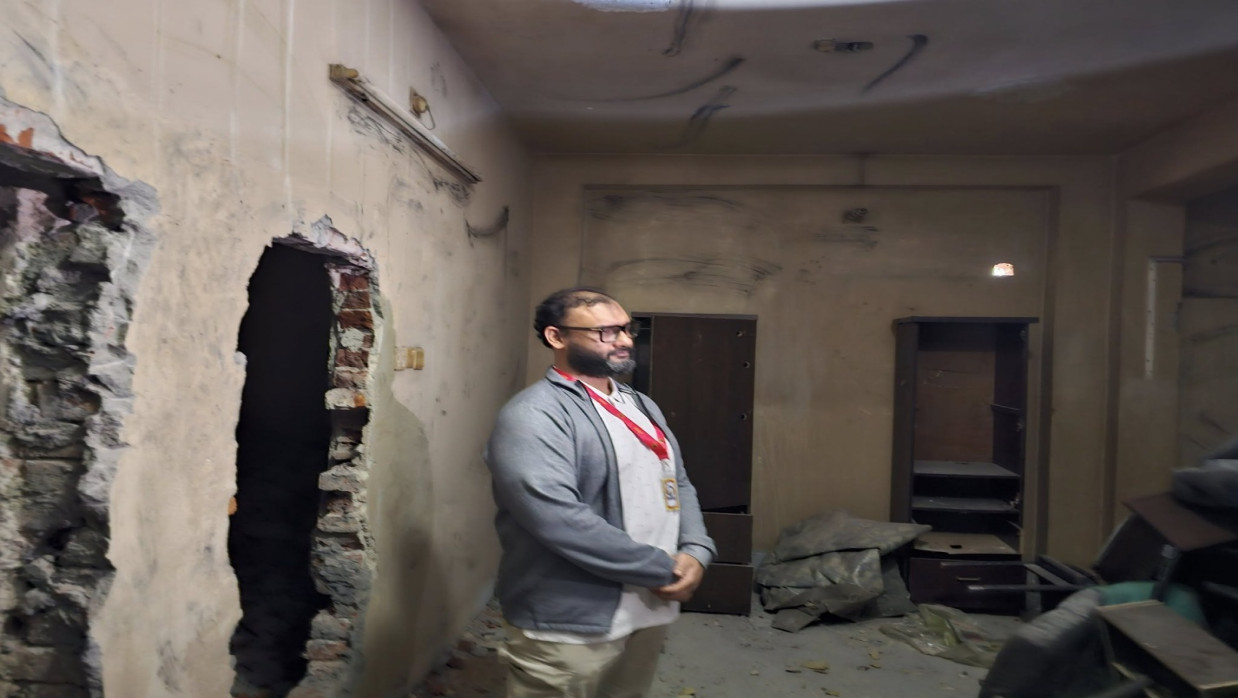
Aynaghar was not a prison in the traditional sense; it was an architecture of unmaking. Windowless cells. No natural light. A huge exhaust fan that hummed day and night to drown human sound and unravel human thought. We were numbers more than names, movements choreographed by blindfold and barked orders. Interrogations early, isolation always. You could chart time by the sound of boots, the rattle of keys, the ache in your bones. Former detainees later sketched near-identical floor plans for journalists long corridors, half a dozen cells facing away from each other, toilets at both ends, the fan that numbed the mind. The method was clinical: preserve the body, corrode the person.
Anatomy of a Torture Cell
The documented details of Aynaghar its suffocating architecture, the ever-humming fans, the regimented cruelty of its routines, emerge not from speculation, but from painstaking investigations and the testimonies of survivors who endured its darkness. The New York Times’ 2024 exposé, corroborated by first-hand interviews with former detainees like me, Abdullahil Amaan Azmi, and Maroof Zaman, reconstructs this subterranean world with chilling precision.
Beneath a military garrison in Dhaka, investigators mapped a series of narrow corridors leading to a handful of small, sealed chambers cells designed to annihilate the senses rather than the body. Each cell was equipped with an industrial exhaust fan that droned without pause, drowning out human sound and destroying any perception of silence or sleep. The air inside was stale, heavy with dust and despair. Detainees were forbidden to speak or pray aloud. They were blindfolded, shackled, and identified only by number. Their world was reduced to concrete, metal, and noise.
What made Aynaghar singularly terrifying was its methodical psychological engineering. It was not merely a prison; it was a laboratory of mental erosion. Prisoners were subjected to prolonged sensory deprivation, no sunlight, no clocks, no human voices save those of interrogators who appeared unpredictably, often after days of silence. The goal was not confession but disintegration. As one survivor recalled, “They didn’t beat us every day they let the walls do the beating.”
The Times investigation, built on matching testimonies and corroborating satellite imagery, revealed a routine of precision: medical checkups to keep the body alive, measured haircuts every few months, rations calibrated for survival but not strength. Direct physical torture was often limited to the early days, but the psychological torment was unrelenting, a slow violence that made madness seem merciful.
These details, now verified by multiple survivors and rights organizations, have transformed Aynaghar from whispered myth into documented atrocity. They expose not rogue operation but an institutional design a blueprint for erasing human beings while preserving their physical shell. It was, as one investigator described, “a prison where the body was kept breathing only so the soul could be dismantled piece by piece.”
In Bangladesh’s collective memory, Aynaghar stands as the ultimate metaphor for authoritarian darkness: a subterranean monument to fear where truth was gagged, justice buried, and humanity put on trial. Today, as the walls of silence crack open, the House of Mirrors has become something else a mirror held up to the nation itself, forcing it to confront what it became, and what it must never become again.
- The Ordeal of Isolation What Silence Does
SAJ: What were the most difficult aspects of prolonged isolation mentally, spiritually, and emotionally? How did you find the strength to endure so many years without knowing whether you would ever see your family again?
Barrister Arman: “In the dark, the mind invents a window. Survival is choosing to believe it’s real.”
Solitary confinement distorts reality until memories become your only furniture. I recited verses to hear my own voice; I counted heartbeats to anchor time. Sometimes I would imagine sun-warmth on my face and hallucination born of longing. Faith became discipline: prayer as rebellion, ritual as proof I existed. In that cell, despair would have been obedient. So, I made a pact with God: if I had to be unseen, let my testimony one day make the unseen visible. I survived because I strongly belief in God and belief in religion that made me strengthened me survived. Though many survivors noted that their captors avoided overt or prolonged physical torture, the cruelty of Aynaghar was no less devastating. Pain in that subterranean world was not measured by wounds or bruises; it was engineered into the very architecture of existence. Survivors spoke of a system designed to torture the mind, where the body was spared only so that consciousness could be methodically dismantled. The torment was continuous, deliberate, and insidious choreography of exhaustion and despair.
Instead of beatings, there were endless routines that stripped away one’s sense of time and self, and guards spoke in monotones meant to blur the boundaries between day and night. Prisoners were forced to live in a world without silence and without sound: an industrial fan roared twenty-four hours a day, erasing thought and drowning out prayer. It was an assault on the senses, a noise that became both the soundtrack and the weapon of captivity.
The deprivation was total. There were no mirrors, no clocks, no way to track the passing of hours or years. Interrogators exploited this disorientation with precision, manipulating prisoners through false promises, fabricated news of their families, and sudden, cruel glimpses of hope followed by renewed isolation. All detainees were blindfolded always, forbidden to speak even a single word. Guards would open the cell door in silence, then close it again without explanationa gesture that kept the mind perpetually suspended between expectation and dread.
Over time, this psychological torture achieved what physical pain could not: it erased the boundaries of the self. Survivors described hallucinations, conversations with imagined voices, and moments when they no longer knew whether they were awake or dreaming. One former prisoner said, “They didn’t need to hit us; they just made sure we could never rest.” Another recalled counting breaths to prove he still existed. The goal was not interrogation t was disintegration.
By replacing the spectacle of violence with the invisibility of mental collapse, the regime perfected a cruelty that left no scars yet destroyed lives. It was a form of repression that could be denied in public because it left little visible evidence, even as it annihilated identity in private. The absence of physical marks became the regime’s greatest disguisea mask of civility concealing a machinery of psychological ruin. In this way, Aynaghar was not merely a prison; it was a laboratory of dehumanization, a place where silence screamed louder than any blow.
- The World Beyond the Walls A Chorus I Couldn’t Hear
SAJ: During your confinement, did you ever learn that your family and international advocates were campaigning for your release? How does it feel now to know that they fought relentlessly even when your fate was uncertain?
Barrister Arman: “I was buried in silence; strangers kept saying my name aloud.”
For years, I knew nothing of the world beyond the concrete walls that entombed me. In that black stillness, I believed I had been erased a name deleted, a life forgotten. But while I was buried in silence, strangers were saying my name aloud. My mother, my wife and my sisters, refusing to surrender to despair, led a relentless campaign that reached across oceans. They held vigils, filed petitions, and pleaded with anyone who would listen human-rights defenders, diplomats, foreign lawyers, even governments that preferred not to see. What I could not know then was that my disappearance had become a rallying cry, that my absence had a heartbeat sustained by others.
Amnesty International kept our names alive in the global conscience, documenting our cases with the precision of those who understood that truth must be preserved even when justice is denied. Journalists and rights advocates, working often at personal risk, tracked whispers, mapped the patterns of abductions, and followed the faint trails left by our captors. In time, Robert F. Kennedy Human Rights (RFKHR) investigators even walked through one of the secret sites near Dhaka’s airport just steps away from the noise of arriving planeswhere they found blindfolds, shackles, and the traces of the torture survivors had described for years. Their visit confirmed what the regime had spent a decade denying: that Bangladesh had constructed its own network of invisible prisons, and that I had been one of the many ghosts within them.
My family, meanwhile, sought help through every channel they could find. My mother and wife worked with my sisters, relatives, and legal teams in Bangladesh and abroad to pressure the government to acknowledge my existence. They reached out to international attorney Mr Michael Polak and others and the British High Commission, hoping that diplomacy might succeed where justice had failed. My counsel Mr Polak also contacted British MP Tulip Siddiq who shared familial ties with Sheikh Hasina herself, appealing to her humanity and political influence. But instead of compassion, the response was cruelty. Not only did she refuse to engage with my case, but soon after that outreach, our home in Dhanmondi Mirpur was raided. Officers harassed my family, warning them to stop contacting foreign officials, to stop speaking my name.
They wanted silence but silence was the one thing my loved ones refused to give them. Each act of intimidation only deepened their resolve. Their voices joined those of strangers rights defenders, journalists, and ordinary citizens who believed that even one forgotten life was too many. And so, while I was trapped in darkness, my name travelled the world. I did not hear it then, but it was being spoken in courtrooms, in conference halls, in British Parliaments and in whispered prayers. That chorus of unseen voices kept me alive when the state had decided I no longer existed.
Bridging Annotation: From Evidence to Accountability
The convergence of Amnesty International’s early documentation and the Robert F. Kennedy Human Rights Organization’s forensic mission created a moral and legal tipping point that the world could no longer ignore. For years, reports of secret prisons and enforced disappearances had circulated in diplomatic briefings and human-rights files, dismissed by the Hasina regime as “fabrications of political enemies.” But once survivor testimonies, architectural evidence, and international field verification aligned, the denial collapsed under its own weight.
The United Nations responded swiftly. In early 2025 2024, the UN Working Group on Enforced or Involuntary Disappearances issued an unprecedented statement citing Bangladesh as a “country of concern,” demanding full disclosure of all individuals held incommunicado since 2009. The Office of the High Commissioner for Human Rights (OHCHR) urged Dhaka’s transitional administration to take “immediate and transparent measures to locate, release, and compensate victims,” while signaling the need for criminal accountability for those responsible. For the first time, the international community recognized enforced disappearance in Bangladesh not as isolated abuse but as a systematic crime against humanity under international law.
Facing both moral responsibility and the gaze of the world, Dr. Muhammad Yunus’s interim government moved quickly to anchor justice in law. Within weeks of taking office, the administration signed and ratified the International Convention for the Protection of All Persons from Enforced Disappearance, signaling Bangladesh’s historic alignment with global human-rights norms. The government established a National Commission on Enforced Disappearances and Secret Detentions, tasked with cataloging every case, protecting witnesses, and preparing referrals for prosecution. In parallel, a Truth and Reconciliation Commission was formed to record testimonies of victims and families transforming private grief into public records.
This institutional reckoning, catalyzed by Amnesty’s persistence and RFKHR’s courage, represents more than an act of policyit marks Bangladesh’s moral re-entry into the community of civilized nations. What began as a whisper of warning in 2017 has evolved into a chorus demanding justice in 2025. The nation that once built prisons to bury its truth is now, under Yunus’s leadership, building tribunals to exhume it.
- Faith, Morality, and Survival Lawyer and Believer
SAJ: What sustained your faith during those long years in darkness? Did prayer, reflection, or memory become your means of survival and how did your identity as both a lawyer and a believer shape your endurance?
Barrister Arman: “In a godless system, I held on to God.”
Faith, for me, was not a matter of ritual it was the architecture of survival. My legal training had taught me to measure the distance between power and principle, between what is lawful and what is right. But captivity taught me something more profound: that when every law collapses, when justice becomes a tool of tyranny, faith is the only remaining form of order. Inside that cell, I lived by an invisible constitution written not by man but by conscience. I prayed across that distance between myself and my family, between darkness and dawn, between despair and the divine.
Each day was built upon the scaffolding of faith. My captors-controlled time, but prayer restored it. Dawn, noon, afternoon, evening, these were no longer hours but lifelines, each marking a fragile continuity between the living and the unseen. I performed ablution with the little water I was given (only thing was abundant was water), reciting verses of the Qur’an I had memorized as a boy. In those verses, I found my bearings. The rhythm of recitation became the heartbeat of my sanity. Between the lines of scripture, I wove fragments of memory: my daughters’ laughter, my mother’s quiet strength, my father’s defiance. Every recollection became a form of resistance.
I would spend hours arguing invisible cases in my mind as though standing before a court no tyrant could dissolve. I presented evidence, invoked the constitution, cross-examined my own fears. These imagined proceedings gave me purpose, reminding me that justice, though absent in the world around me, still lived within reason and faith. Yet my soul argued a parallel case not against injustice, but against despair. I learned that justice and mercy are not opposites; they are twins born of the same truth. To believe in one without the other is to misunderstand both.
There were moments when I believed I would never see my family again, when I thought my daughters would grow up thinking their father had simply vanished. In those hours, I stopped asking God why and began asking how: how to endure, how to find grace in affliction, how to keep my heart alive when everything else was buried. I prayed not to escape suffering, but to transcend it to transform pain into purpose. And I found solace in one thought that never left me: If I cannot see my family again in this world, let me be reunited with them in heaven, where no one can make them cry.
Faith became the last unbroken possession they could not confiscate. It was my protest and my peace, my rebellion and my refuge. The state could blindfold my eyes, but it could not blindfold my belief. In a system stripped of humanity, I learned that prayer was not only worship it was witness. It was the testimony of a man who refused to surrender his soul, even when his body had been rendered invisible.
- The Moment of Freedom Daylight, After Eight Years
SAJ: Can you recount the moment you were told you would be released? How did it feel to step outside after eight years in total secrecy and what emotions filled you when you finally embraced your mother and daughters again?
Barrister Arman: “They changed metal cuffs for cloth. I thought it was to leave no evidence on a corpse.”
It was still dark, that hour before dawn when the world held its breath. They were harsh and aggressive even while taking me out& Harshly shouted): “Finish your prayer.”
For eight years, that prayer had been my one constant, my map through darkness. When I finished, they removed the iron cuffs that had carved into my wrists and replaced them with strips of coarse cloth. In that place, such gentleness carried a single meaning: it was the kindness that comes before death. My heart steadied, not with fear, but with a kind of weary acceptance. So this is how it ends, I thought with prayer, not protest, with cloth, not chains.
They blindfolded me and led me down the narrow passage I had come to know by sound alone. The door groaned open, and I was pushed at the floor of a van. Two guards pressed me down on the floor, their knees digging into my ribs. No one spoke. The van started to move, and the air began to change I could smell rain, soil, and the faint scent of life beyond the concrete walls that had defined my world for nearly a decade. It was the first reminder that the world still existed.
After what felt like an hour, the van came to a stop. One of the men muttered something to the driver, his voice low, almost reluctant. Then they dragged me out, and left me on the cold ground. The door slammed. The engine roared away. And then silence. No footsteps, no commands, no gunfire. Just the sound of wind in tall grass.
I waited for the bullet that never came. Minutes passed, maybe hours I had lost all measure of time. Finally, trembling, I reached up and pulled off the blindfold. The world exploded into light. It was unbearable at first; I had forgotten what light felt like. The sky spread open above me, vast and pale, like forgiveness itself. The air was sharp and alive, filling my lungs with something that felt both alien and sacred. My eyes burned; tears came unbidden.
I pressed my hands into the soil, its roughness cutting into my palms, grounding me in the truth of existence. This was not a dream. I was alive. I whispered the only words that mattered: Alhamdulillah. Praise be to God. I fell to my knees and kissed the dirt the same earth that had seemed lost to me forever. For the first time in eight years, I felt the world’s pulse beating beneath my fingertips.
I stayed there, between laughter and sobbing, overwhelmed by the vastness of the sky and the weightlessness of freedom. My body shook uncontrollably, my spirit still chained to disbelief. I had been buried in darkness for so long that daylight itself felt like a miracle too large to hold.
Only later did I learn the truth: Sheikh Hasina had fled Bangladesh that very morning, August 5, 2024. Her regime, the one that had built the prisons, buried the voices, and denied our existence had fallen to the fury of the people she had tried to silence. My release, I discovered, was not an act of mercy but of panic, a desperate attempt by my captors to erase evidence before the world came looking for us.
But as I stood there, blinking against the light, I did not think of politics. I thought of my daughters. I thought of my mother’s prayers, my wife’s waiting, the strangers who had spoken my name aloud when I could not. I realized that both I and my country had survived the same night two captives released into the same fragile dawn.
Every breath I took that morning carried the scent of truth raw, unfamiliar, uncontainable. I had been buried alive, but I had risen with the sunrise. After eight years of silence, I was breathing not just air, but freedom itself.
- A Glimpse in the Mirror Recognizing a Stranger
SAJ: When you first saw yourself after release frail, changed, yet alive what did that reflection mean to you? Did you see a survivor, a witness, or a reminder of a nation’s pain?
Barrister Arman: “I looked like someone who had lived by candlelight inside his own skull.”
In the hospital mirror, a gaunt face, a ragged beard, eyes trained by darkness to search for edges. I mourned the years stolen my daughters’ entire childhoods smudged into absence. But the reflection was more than mine; it was the face of a country coming to terms with its secret dungeons. Survival gave me a task: to be a witness whose body holds the footnotes of an era the nation must read.
Reflection: The Body as Evidence, the Mind as Witness
When I first saw myself after release, it felt as though I were staring at a stranger who had borrowed my name but not my life. The face in the mirror belonged to someone else, someone hollowed out by years of silence. My reflection startled me: a frail, almost spectral figure stared back. The once round face of a young lawyer was gone; in its place was a gaunt shadow with hollow cheeks, sunken eyes, and thinning hair. My beard had grown not from time, but from grief. My skin carried the pallor of concrete, my voice cracked when I tried to speak, unaccustomed to sound. Even my hands trembled when sunlight touched them, as though my body had forgotten how to belong to the world.
The world itself felt unfamiliar. I had forgotten the scent of rain after a storm, the feel of wind against my face, the rhythm of the city beyond those walls. In the hospital where I was taken, a nurse opened a window, and the rush of air started to me so deeply that I wept. It wasn’t pain that broke me in that moment, it was recognition. I was alive, but not entirely human. Captivity had not only stripped me of years; it had unstitched the fabric that once connected me to the ordinary beauty of living.
And yet, within that fragility, I found something resembling strength. For eight years underground, when the silence pressed against my skull like a weight, one image had kept me sane the imagined faces of my daughters. I saw them in dreams that felt more real than waking: two little girls walking to school, holding their mother’s hands, their laughter echoing somewhere far above the earth that imprisoned me. I measured time not by days or seasons, but by their imagined birthdays conjured from memory, from hope, from faith. In a world without clocks, their growing up became my only calendar.
When I emerged into daylight, I saw those imagined children standing before me no longer the little girls I had carried in memory, but young women, poised and radiant, their eyes carrying both joy and sorrow. In that moment, the weight of my lost years struck me with greater force than any blow I had endured. I realized that the most profound cruelty of captivity is not the deprivation of freedom, but the theft of time, the irretrievable moments that can never be reclaimed.
My first words after my release were simple, but they carried the ache of those years: “I will never get that time back to watch my daughters grow up.” No apology can restore it; no tribunal can measure its loss. That wound is permanent, yet it also carries purpose. It reminds me why truth matters because every act of silence by the state does not only imprison the living; it robs generations of memory, of love, of continuity.
My daughters were my compass through the darkness. In their imagined laughter, I heard the promise of light. Now, when I hear that laughter again real and near it reminds me that even the longest night ends, and that life, though battered, has a way of finding its way back to sound, to color, to hope. Their laughter is my proof that I survived not just as a man freed from a cell, but as a father reawakened to the meaning of being alive.
Parallel Awakening: A Father’s Reunion and a Nation’s Rebirth
My reunion with my daughters was more than a personal homecoming; it mirrored the awakening of an entire nation emerging from captivity. As they reached for mehesitant, disbelieving, as if touching a ghost I saw in their eyes the same mixture of grief and wonder that I saw in the faces of people crowding Dhaka’s streets after Sheikh Hasina’s fall. We were all survivors of a silence that had lasted too long. The distance that years of fear had carved between a father and his children was the same distance that tyranny had forced between Bangladesh and its own conscience. My embrace with them was not just a family’s moment of reunion; it was a symbolic act of restoration living reclaiming what oppression had stolen.
In that instant, the private and the political became one. The hug that closed the gap between my daughters and me felt like the nation’s first breath after years underground. Just as they reached to recognize the father they thought lost, Bangladesh, too, began to rediscover itself to recognize the democracy it had been taught to forget. Our tears were the same tears shed by the mothers who waited outside barracks for missing sons, by the wives who kept doors unlocked for a decade, by people who had learned to whisper prayers in fear. The return of light to my life, and to theirs, became inseparable from the return of truth to the country that birthed us. In their eyes I saw not pity but a promise reminder that love, like freedom, may be delayed but never truly defeated.
- The Machinery of Disappearance Who Ordered the Silence?
SAJ: In your view, who was ultimately responsible for your abduction and disappearance? Do you believe Sheikh Hasina’s government and the DGFI operated a systematic program of secret detentions against political opponents?
Barrister Arman: “This wasn’t rogue behavior. It was a system; it had a chain of command.”
There are news reports from home and abroad that Sheikh Hasina herself ordered my detention. The enforced disappearances were not accidents or overreach they were policy. Lists of “threats” were reportedly presented to the Prime Minister; once the nod came, the system acted. RAB became an “in-house death squad,” DGFI ran long-term secret detention; police fed the crossfire fictions.
The Mechanics of Disappearance How the System Worked
When I look back now, I realize that behind every disappearance in Sheikh Hasina’s Bangladesh was not chaos, but choreography a system so organized, so ruthlessly efficient, that it could make a person vanish from existence without leaving a trace of sound or paper. What the public saw were only fragments men in plain clothes, unmarked vans, the midnight knock that turned homes into graves of silence. But behind those fragments was a machine of fear, a network of intelligence officers, paramilitary forces, and political operatives working in perfect synchrony under a single directive: erase dissent and erase the evidence of erasure itself.
I know this not from study, but from survival. The process that claimed me was mechanical, almost bureaucratic in its precision. It began, I have since learned, in the Prime Minister’s Office where intelligence briefings were delivered like daily weather reports, accompanied by lists of names: “persons of interest.” On those lists were opposition leaders, student activists, journalists, and sometimes lawyers like me perceived as a potential challenge to the myth of absolute control. These lists were reportedly reviewed by Sheikh Hasina herself, or by her closest circle of advisers. A single nod from that room could determine the fate of a man and erase him from public memory before sunset.
Once the order was given, the state’s invisible machinery moved without hesitation. The Directorate General of Forces Intelligence (DGFI) acted as the regime’s secret hand, its officers surveilling their targets for weeks tapping phones, monitoring movements, noting habits and associates. When the moment came, they struck with the cold precision of a military operation. Teams from the Rapid Action Battalion (RAB) or the Detective Branch (DB) often joined them, providing muscle and plausible deniability. The methods were identical every time: unmarked microbuses or SUVs, plainclothes agents, and the flash of a badge or weapon to freeze protest. Within seconds, the target was gone swallowed by the night, by the state, by fear itself.
From there, the machinery followed a grim sequence. The abducted were first taken to transit houses small, hidden facilities inside military compounds or abandoned government buildings. There, initial interrogations took place the beatings, the blindfolds, the forced confessions. Within days, some were transferred to long-term sites like Aynaghar, the secret underground prison beneath inside Dhaka Cantonment a place where the state’s war on memory was perfected. In those cells, prisoners were stripped not only of their names but of their humanity. The goal was not to extract information. It was to obliterate identity.
The process was chillingly bureaucratic. Upon arrival, each captive was blindfolded, assigned a number, and catalogued in silence. Psychological profiles were made to determine who would break quickly and who would require months of isolation. Some were tortured and released, their release a warning rather than a mercy. Others were held indefinitely stored like files in a secret archive of suffering. A few, too defiant or too visible, were executed extrajudicially and later declared dead in “crossfire.”
Each institution had its incentive to participate. The DGFI gained political clout and untouchable status. RAB earned funding and fear-based legitimacy. The police secured promotions for “controlling threats.” And at the top, the Prime Minister’s office enjoyed the illusion of order as though fear itself were a form of governance. In truth, it was a governance built on ghosts.
The deception was complete. Families who dared to report missing loved ones were met with ridicule or threats. Officials claimed their sons had “joined extremists,” “gone abroad,” or were “under investigation.” International appeals were dismissed as “foreign interference.” On state television, the same mouths that issued denials called the abducted “traitors” or “terrorists.” Euphemism became the regime’s language of cruelty: lawful detention, security concerns, crossfire deaths.
Between 2009 and 2024, more than 700 disappearances were documented by human-rights groups. Around 450 resurfaced after months or years in hidden detention warned into silence. Eighty were returned as bodies. And about 150 missing names remain without graves, stories without endings.
This was not random violence; it was statecraft. Sheikh Hasina’s government did not simply suppress opposition that it perfected the art of erasing it. By merging intelligence, propaganda, and fear, her regime created a total surveillance state where citizens learned to censor themselves, to whisper even their grief. The most terrifying part of the system was not its brutality, but its banality, how ordinary it became to vanish, how silence became the new normal.
What she built was not a government, but a factory of terror and an industrial complex of disappearance sustained by paperwork, propaganda, and power. Bureaucracy became the executioner; denial became its accomplice. In that Bangladesh, every midnight knock was both a warning and a prophecy.
Today, as I speak these words, I am one of the few who returned from that machinery. My survival obliges me to tell the truth not just for myself, but for those whose names were never spoken again. To describe the system is to dismantle it, piece by piece. The same precision that once made it function must now be turned against it as testimony, as evidence, as memory. Because what we cannot name, we cannot reform. I was once a case number in that hidden system. Now I am its witness. And I will continue to speak until every silence it created has been broken.
- The Politics of Fear an Era Defined
SAJ: Having lived through what many call the politics of disappearance, how do you interpret that period in Bangladesh’s history and what does it reveal about the erosion of justice and rule of law under the previous regime?
Barrister Arman: “Bangladesh learned to whisper because the walls learned to listen.”
There was a time when my country forgot how to speak. The fear was so thick that even the air seemed to carry ears. We whispered not because we had nothing to say, but because the walls had learned to listen. That was the genius of the regime it made silence feel safer than truth. Under Sheikh Hasina, Bangladesh underwent a quiet metamorphosis: a democracy drained of its soul, converted into an autocracy sustained by terror.
During those years, the instruments of state were inverted. Disappearances replaced due process; confessions replaced convictions; and rumors replaced journalism. Families searched for justice and received either bodies or silence, sometimes a call in the night, sometimes a knock that never came. People learned to grieve quietly, to bury questions alongside the disappearance. Even mourning became subversive.
The brilliance and the horror of the system was in its deniability. It was tyranny with paperwork, cruelty without fingerprints. Each branch of authority, the Rapid Action Battalion (RAB), the police, the Directorate General of Forces Intelligence (DGFI) performed its assigned task while claiming innocence. When the world asked who was responsible, every hand pointed elsewhere. It was a perfect circle of guilt without accountability. The Prime Minister sat above it all like a conductor before an orchestra of silence, turning institutions into instruments of fear. Bangladesh was no longer governed it was managed, as though run by a monarch cloaked in the language of democracy.
That period will be remembered not only for its brutality but for its psychological conquest. It wasn’t just the bodies that vanished it was the courage to speak, the belief that words could matter. The nation learned to live in whispers, to measure sentences before they left the mouth, to mistrust even laughter. Fear seeped into the bloodstream of public life until it felt normal. That normalization was the regime’s greatest crime.
But revolutions, like dawn, arrive even after the longest nights. The uprising of 2024 the outcry of a generation that refused to inherit fear broke the spell. When Sheikh Hasina fled, the silence cracked, and the country began to rediscover its voice. Yet freedom, I have learned, is not simply the fall of a tyrant; it is the rebuilding of trust. Bangladesh now stands at a crossroads, tasked with the hardest form of reconstruction the rebuilding of conscience.
To heal, we must refuse to return to the politics of vengeance. The work ahead cannot belong to one party, one ideology, or one generation. It must be a collective act a covenant among all political forces to rebuild the republic on a foundation of truth, justice, and compassion. We must learn again how to disagree without dehumanizing, how to lead without lying, and how to remember without hating.
If fear once made us whisper, let courage now make us speak not with anger, but with resolve. The walls that once listened to must now echo with the sound of a nation unafraid to tell its own story.
Contextual Arc: The Architecture and Choreography of Repression
When I reflect on those years, I understand now that Sheikh Hasina’s rule was not a government in the traditional sense it was an architecture of control, a system so meticulously constructed that even its cruelty felt administrative. What the world saw as chaos the arrests, abductions, the public trials was, in truth, a choreography of fear, performed with bureaucratic precision and political intent. Every act of repression had a file number, every disappearance a protocol, every silence a purpose.
It began under the banner of “law and order.” In 2009, the rhetoric was safety, stability, progress. But what unfolded was a slow transformation of the state into an apparatus that served one person’s insecurities and ambitions. The very institutions meant to uphold justice the police, the courts, the intelligence agencies were reprogrammed to enforce loyalty rather than law. The Directorate General of Forces Intelligence (DGFI) became the invisible spine of her power, while the Rapid Action Battalion (RAB) executed the state’s darkest work, operating as both sword and shield. Their mission was not to protect citizens but to discipline them to remind the nation that obedience was safer than truth.
I witnessed the effects of that system not as an observer but as one of its captives. Behind my abduction, there was no rage, no improvisation only procedure. My disappearance was not an accident of excess; it was the execution of a plan. The men who came for me were not acting out of passion; they were following orders from a hierarchy that reached the highest seat of power. In that sense, Sheikh Hasina’s true genius was not in the creation of violence, but in institutionalizing it in turning oppression into paperwork, in transforming tyranny into routine.
The cruelty was systemic, but it was also disguised. The courts delivered verdicts that had already been written. The press, once proud and unruly, was suffocated beneath the Digital Security Act, where a single word could be tried as sedition. Even the economy became part of the illusion gleaming infrastructure and statistics of growth paraded to the world as proof of progress, masking the rot beneath. Behind every ribbon-cutting ceremony lay a family searching for a missing son. Behind every headline of “development” stood another home left in mourning.
What struck me most was the psychological choreography of her regime. It wasn’t enough to silence people; they had to be made complicit in their own silence. The state turned fear into patriotism. The abductions were renamed lawful detentions, the killings became crossfire deaths, and censorship was rebranded as national responsibility. In this theater of power, the lie was rehearsed until it sounded like truth. The audience the people learned to applaud out of habit, or out of fear.
From my cell, I could sense that Bangladesh was becoming a country where obedience replaced morality. Citizens internalized surveillance, speaking in whispers even at home, lowering their eyes even when alone. The regime did not need to control every action; it had colonized the mind. Every institution court, police, media, and diplomacy played its assigned part in maintaining the illusion that this was governance, not occupation.
Looking back, I see it clearly now: Bangladesh’s descent into autocracy was not born of chaos, but of cold design. It was systematic, scalable, and sustained a machinery that served one purpose only: to extinguish every alternative source of power, whether political, moral, or spiritual. Every disappearance, every censored journalist, every courtroom farce was a note in a dark symphony, conducted from the Prime Minister’s Office with ruthless precision.
Sheikh Hasina did not simply violate human rights, she redefined governance itself as cruelty, transforming obedience into the unwritten constitution of the nation. It was a system that made silence safer than speech, and submission indistinguishable from survival. And it is against that legacy of engineered fear that Bangladesh must now reclaim its soul.
- Accountability and Justice Where to Begin
SAJ: Now that you are free, what steps do you believe Bangladesh must take to hold those responsible accountable and to ensure that enforced disappearances never occur again?
Barrister Arman: “To forgive without truth is to bury the victims twice.”
Open the archives. Unseal the orders. Name the chain of command. Prosecute those who designed, authorized, and ran the sites. Protect whistleblowers and classify enforced disappearance as a crime consistent with international law. Bangladesh has already moved: the interim government signed the international treaty on enforced disappearances and created an investigative body; warrants have followed. But laws must be matched with trials, reparations, and institutional reform. Three steps put them in trial for exemplary punishment; compensation for the victim families and third, keep reminding the stories of horrific stories to the next generation for no repetition of such occurrences.
From Signatures to Substance: Building the Architecture of Justice
When I walked into freedom, Bangladesh was already changing. The air felt different, not merely lighter, but cleaner, as if the country itself had begun to breathe again after years of suffocation. For the first time in my lifetime, the machinery of the state once built to hide and harm was being turned toward truth. Dr. Muhammad Yunus’s interim government did not begin its work with slogans or ceremonies; it began with conscience. Within weeks of the regime’s collapse, the new leadership took a step that will be remembered as one of the most sacred in our nation’s history: Bangladesh signed and ratified the International Convention for the Protection of All Persons from Enforced Disappearance.
For a country that had lived so long in darkness, this was more than an act of policy it was an act of repentance. That signature was our collective declaration that the age of fear had ended. It was a promise that no citizen, regardless of faith or politics, would again be erased from the earth without a name, a record, or a reckoning. To me, as both a lawyer and a survivor, that moment carried a sacred weight. It was as if the republic had finally spoken aloud what we had whispered for years in our cells: never again.
But it was not words alone. The new government matched morality with method. It established a National Commission on Enforced Disappearances and Secret Detentions, empowered not only to investigate but to remember to trace the lost, to name the nameless, to gather fragments of stories scattered by terror and return them to their families. The commission’s work was not limited to uncovering crimes; it was also about restoring dignity, allowing families to bury their dead with truth instead of lies, and to grieve with honor rather than fear.
Alongside, came the creation of a Special Judicial Tribunal on Crimes Against Humanity, a court authorized to prosecute those responsible for extrajudicial killings, torture, and prolonged illegal confinement. For the first time, the same walls that had once echoed with screams were now echoing with testimony. Survivors stood where interrogators once stood, speaking their truths to judges instead of captors. It was not vengeance that guided this tribunal, it was accountability, tempered with compassion and guided by law.
These actions marked a profound reversal in Bangladesh’s moral trajectory. The same state that had once institutionalized denial was now institutionalizing truth. The same bureaucracy that once manufactured fear was now tasked with documenting facts. As I watched this transformation unfold, I understood that justice, when rooted in humility, can heal even the deepest wounds. The treaty, the commission, and the tribunal each was a brick in the rebuilding of a country that had learned the cost of silence.
For families who had waited in anguish for years, these reforms were not political gestures; they were the first breaths of justice. For survivors like me, they were proof that law the very instrument that had once been perverted into tyranny, could still be redeemed. And for the world, they offered something even larger: evidence that a nation once haunted by its crimes could still choose the path of moral regeneration.
Bangladesh today is learning to rebuild itself not through rage or revenge, but through remembrance. Our task is immense to transform a nation that once buried truth into one that protects it. But I believe we can. Because the arc of this new Bangladesh is not drawn by power, but by conscience. And conscience, once awakened, does not sleep again.
- Healing the Nation A Truth Commission With Teeth
SAJ: What kind of transitional justice process or truth commission do you think Bangladesh needs to confront this dark chapter and begin national healing?
Barrister Arman: “We cannot stitch a new flag over unmarked grave.”
I support a Bangladeshi Truth and Reconciliation Commission our design, our values empowered to compel testimony, protect victims, and recommend prosecutions. Its work should be public, archived, and memorialized, with a victims’ registry and a permanent museum. RFK Human Rights urges security-sector reform; survivors like me have already guided investigators to sites. The Commission of Inquiry should integrate that evidence, secure the locations, and build cases that meet international standards.
Truth Unearthed from Beneath the Soil
When I finally stepped into the sunlight, I understood that freedom was not the end of my journey it was the beginning of a harder one. To survive Aynaghar was to inherit a duty: to uncover what had been buried, to give voice to what had been deliberately erased. For years, the existence of Bangladesh’s secret prisons had been dismissed as rumor, the stories of the disappeared reduced to political noise. But I had lived inside that darkness. I knew its smell, its sound, its shape. And so, when the time came to expose it, I knew where to lead the way.
I returned to those hidden places not as a prisoner, but as a witness. The first time I walked down the same narrow corridor where I had once been dragged in chains, my legs trembled. The air still carried the odor of rust and despair; the walls, even after cleaning, seemed to hum with old cries. Every mark, every stain, every dent told a story. I traced my fingers over the cold concrete and remembered the countless men who had never walked out. It was unbearable and yet necessary. To stand there as a free man was to reclaim what fear had stolen. Those walls had once been instruments of silence; now they were evidence.
Each site we uncovered was a wound in the nation’s conscience. Some were buried beneath military installations, others hidden behind police compounds or disguised as government storage. Inside, we found the same architecture of cruelty repeated like a template windowless rooms sealed against light, metal rings set into the floors, exhaust fans that roared endlessly to drown out sound. Even the dimensions of the cells were identical, as though designed by a single mind obsessed with control. It became clear that this was no random network of abuse; it was a system, engineered and maintained with precision.
As I walked through those ruins, I was struck by terrible symmetry: the same walls that had once confined me were now the backdrop of my testimony. I spoke aloud the things I had once been forbidden to say the sounds, the routines, the methods of psychological breaking. I pointed to the corners where guards had stood, to the stains where men had fainted, to the ceiling where the light never turned off. Each word felt like a liberation, not only of myself but of the memories of those who never returned.
The process of revealing these sites changed more than just the record of our history; it changed the moral atmosphere of Bangladesh. For the first time, the invisible had form. What had been denied for a decade could no longer be hidden behind official phrases or patriotic lies. The truth was literally carved into the walls concrete testimony against the machinery of disappearance.
When I stepped outside those compounds for the last time, I looked at the ground beneath my feet and realized what we were really unearthing was not just evidence it was the buried soul of a nation. For years, that soil had absorbed the echoes of suffering. Now, it was releasing them. The truth was rising, grain by grain, from beneath the weight of fear. And with it rose the possibility of redemption not only for those of us who survived, but for Bangladesh itself.
- The Human Cost Learning to Breathe Again
SAJ: How are you adjusting to life after years of isolation? What emotional and physical scars remain, and how are you rebuilding your relationship with your daughters and family after such a long separation?
Barrister Arman: “Freedom felt like a bright room beautiful and too loud.”
I am still startled at footsteps in corridors. Darkness can squeeze the lungs. Crowds are a storm of sound. My daughters are young women now; I missed scraped knees, first exams, birthdays, the music of an ordinary life. We are rebuilding with careful rituals: tea together, quiet walks, and laughter required like a language. Healing is not linear; some nights the exhaust fan returns to my dreams. But each morning I choose light.
The Aftermath of Release: Living with the Echoes of Darkness
Freedom did not come to me as celebration; it came as confusion. The morning, I stepped into sunlight, I expected joy to flood my heart, but instead there was only silence vast and unfamiliar. After eight years in darkness, the light hurt my eyes, and the open air felt too large to bear. I had lived so long within walls that I no longer trusted the sky. Every sound startled me. Every voice, even kind ones, carried the echo of interrogation. I was alive, yes but my soul moved slowly, as if afraid to breathe.
The world I returned to had kept turning while I was gone. My daughters, who once clung to my knees, now stood taller than I remembered. My mother’s hair had gone white. Streets that had once been filled with my footsteps felt foreign, as if they belonged to another man. The hardest part was not adjusting to what had changed outside it was facing what had changed inside me. Years of forced isolation had hollowed out the rhythms of trust and conversation. I spoke too softly at first, as though someone might be listening. Even laughter frightened me. Sleep was a battlefield each dawn I woke expecting to hear the jangle of keys, the thud of boots in the corridor, the command that meant another day in captivity had begun.
I carried my prison within me. Even in open spaces, I felt the invisible walls pressing close. The mind learns confinement too well; it takes time to teach it freedom again. I remember walking into a field one afternoon, barefoot on grass, and feeling overwhelmed by its softness as if the earth itself were too gentle to be real. I had to relearn the simplest human gestures: how to sit at a dinner table, how to look at people in the eye without fear, how to speak without lowering my voice. These are not skills you lose; they are stolen from you, piece by piece, until silence becomes instinct.
But the cruelest loss was not psychological, it was time. Time was the one thing no one could return to me. Entire lifetimes had unfolded in my absence. My children had grown into young women without my guidance. My mother had waited through nights that stretched like years. Friends had moved on, families had rebuilt their lives around an empty chair that was once mine. The world had aged, and I had been left outside its clock. When I saw my daughters for the first time, I realized that the deepest wound of captivity was not what I had suffered, but what I had missed. You can survive torture, but you cannot recover the years that vanish while you endure it.
I often say that I did not return from Aynaghar as the man who was taken. Something fundamental had changed not broken but altered. The silence I lived in for eight years left an imprint that no noise can erase. Freedom brought gratitude, yes, but it also brought loneliness the loneliness of knowing that no one outside those walls can truly understand what it means to live without time, without sound, without self.
Even now, I sometimes catch myself pausing mid-sentence, listening for footsteps that are not there. The cell is gone, but it lives inside me a quiet echo, a reminder of what fear can make of a human being. Yet, I have come to see that echo not only as pain but as purpose. I carry it so that others may never have to. I speak so that silence can no longer be mistaken for peace. My freedom is incomplete until every voice once buried in the dark can rise again to meet the light.
- The Global Silence Diplomacy’s Price
SAJ: What message do you have for the international community governments, human rights organizations, and global institutions that remained largely silent during your years in captivity?
Barrister Arman: “Strategic partnerships without human rights are just transactions with blood on them.”
Governments knew. Human-rights groups briefed them; journalists risked arrest to publish. Yet trade, security cooperation, and geopolitical convenience often outweighed a principled stand. Targeted sanctions could have come earlier; peacekeeping privileges could have been conditioned on rights. Silence signaled permission. Still, individuals inside institutions the reporters, advocates, and a handful of diplomats kept breathing oxygen into our stories. To them, we owe much.
National Healing: When a Country Learns to Breathe Again
When I look at my country today, I see in its eyes the same tremor that once lived in mine the cautious wonder of someone stepping into light after too many years in darkness. The trauma of those who returned from secret cells is, in many ways, the trauma of Bangladesh itself. For more than a decade, the nation held its breath under the weight of fear a quiet, suffocating fear that made people measure every word, every silence, every glance. Surveillance replaced trust. Censorship replaced conversation. And the sound of vanishing footsteps at night taught citizens that safety lay not in truth, but in silence.
Emerging from that era feels like a kind of collective re-entry a country learning once again to breathe, to speak, to believe. Just as I had to relearn the simplest acts of living how to stand in open air, how to trust the sound of my own voice Bangladesh must now relearn how to exist without fear. The discipline of silence became part of our national reflex. Even in freedom, the whisper remains. It will take time and courage for us to learn to speak again not in whispers, but in the clear, steady voice of truth.
The silence that once enveloped the disappearance did not stop at prison walls; it seeped into every household. Families whispered prayers instead of names. Neighbors pretended not to notice who was missing. Journalists wrote between the lines, and judges read verdicts already written. That silence was not only the absence of speech, it was the corruption of conscience. To break it now is more than a political act; it is an act of national therapy, an exhalation after years of holding pain inside.
Every public hearing, every truth-telling session, every reopened case is part of this great unburdening. I have stood in courtrooms and community halls where families, once terrified to speak, now say their loved ones’ names aloud not as accusations, but as prayers. Those names, once erased from the record, now echo against walls of justice instead of walls of confinement. Each testimony, each tear, each trembling voice brings us closer to redemption. Healing is never linear; it falters, hesitates, and sometimes retreats. But even a hesitant truth is stronger than a confident lie.
For Bangladesh to heal, it must do what we survivors have had to do: confront memory without letting it rule us. We must look into the face of our past not to be imprisoned by it, but to understand it, to ensure it never repeats itself. Our strength will not come from forgetting the darkness, but from learning how to live fully despite it.
I believe the nation’s recovery, like my own, will be quiet at first fragile, imperfect, but alive. It begins with courage, with small acts of honesty, with the willingness to trust that speaking the truth will no longer invite punishment. Only then can Bangladesh reclaim its moral rhythm, the pulse that once made it a nation of hope and dignity.
In every story of return in every man or woman who steps back into the world after years of silence I see a reflection of our country itself: hesitant yet unbroken, wounded yet alive, looking once again toward the light.
- Freedom and Future Work Ahead
SAJ: Finally, if you could summarize your eight-year ordeal in a single thought or sentence, what would it be? And how do you now envision your role in rebuilding a rights-based, democratic, and compassionate Bangladesh?
Barrister Arman: “They tried to erase me; I returned as a witness.”
If I had to compress eight years of captivity into a single line, it would be this: They buried me alive in a room without windows, but faith carved a window inside my chest. I was meant to vanish to become one more forgotten name, one more statistic in the ledger of silence. Instead, I have returned, not as a victim, but as a witness. My survival is not a miracle to be marveled at; it is a responsibility to be lived. Freedom, for me, is not a gift, it is an assignment.
God has given me a second life, and I intend to spend it ensuring that no one in Bangladesh is ever made to live what I lived that no mother waits by a locked door for a son who never comes home, that no child grows up mistaking silence for safety. My faith, which sustained me in the cell, now guides me in this open world. It teaches me that justice is not born from revenge but from remembrance from the courage to face what we once chose to ignore.
I will dedicate this second life to reconstructing truth, piece by piece, with those who have survived and those who still seek their disappearance. Together, we must build a Bangladesh where no citizen disappears into the shadows, where dissent is answered with dialogue, not with vans and blindfolds. The law once twisted into a weapon must again become a shield, protecting the weak rather than serving the powerful. This is how we redeem our future: not by erasing our wounds, but by illuminating them.
Yet I know that justice cannot thrive in a country whose politics remain poisoned by fear and arrogance. Systems can change, but if the mindset does not, nothing will endure. Bangladesh must heal not only its institutions but its imagination the way it conceives of power, opposition, and truth. We must move beyond the politics of vengeance and embrace the politics of vision, where leaders are not worshipped and critics are not condemned.
I was buried once in silence; now my duty is to speak. They tried to erase me, but I have returned to write the names of those who still cannot. I carry within me the memory of darkness not as bitterness, but as a compass. It points always toward one truth: that a nation’s dignity lies not in the power to silence its citizens, but in the humility to listen to them.
If God spared me, it was not to rest, but to remind. My freedom is a testimony and I will spend whatever remains of my life ensuring that the story of Aynaghar becomes not a prophecy repeated, but a lesson remembered.
The Rise of Survivor-Led Justice: From Silence to Testimony
The months after August 2024 were unlike anything I had ever known. The streets of Bangladesh felt lighter, the air almost trembling with disbelief as though the nation itself was learning how to exhale after holding its breath for fifteen years. For those of us who had lived beneath the earth, the days that followed our release were not just about freedom; they were about responsibility. We understood that surviving Aynaghar came with an unspoken duty: to speak not only for ourselves, but for those who never returned.
In the beginning, our voices were fragile, uncertain, halting, still shaped by years of enforced silence. Yet as we began to tell our stories, something extraordinary happened: truth started to breathe again. One by one, survivors came forward men who had vanished without record, women who had searched for them for years, children who had grown up with their fathers’ names whispered like prayers. Together we began retracing the map of Bangladesh’s hidden terror. I walked investigators through the same corridors where I had once been dragged blindfolded. I showed them the walls where names were scratched in desperation, the rooms where the air had been engineered to erase sound, the stains that no scrubbing could remove. Every testimony, every gesture was an act of reclamation. Speaking was no longer a risk it was justice itself.
What began as a handful of voices soon became a movement not of politics, but of conscience. Survivors and families of the disappeared began organizing across cities and villages, united by one simple demand: Never again. We held vigils where the regime had ordered silence. We opened archives where history had left blanks. We taught each other how to transform grief into evidence. In schoolyards and mosques, in courtyards and town halls, the families of the lost began to speak their loved ones’ names aloud. For years, those names had been banned by fear; now they were spoken as blessings.
In this new Bangladesh, survivors are no longer the forgotten remnants of a brutal past we are its builders, its living conscience. The architecture of fear that once buried us is being replaced by an architecture of truth. The same men who were told they did not exist are now helping to design a future where disappearance itself becomes impossible. Each account, each testimony, is both evidence and indictment proof that conscience can outlast cruelty.
I have learned that silence, once used as a weapon by the powerful, can be reclaimed as the language of freedom. What began as whispers in the darkness has become a collective voice, a chorus that refuses to be quiet again. We speak not to reopen wounds, but to ensure that the next generation grows up in a country where justice is not an exception, and fear is not a form of governance.
My journey did not end with survival; it began with it. I was once a prisoner of a system that thrived on silence. Today, I am part of a movement that thrives on truth. This, I believe, is how nations are reborn not through the slogans of politicians, but through the courage of those who once vanished and dared to return as witnesses.
- Contesting Parliamentary Election in 2026
SAJ: Barrister Arman, you have announced your intention to contest the Dhaka-14 seat on behalf of Bangladesh Jamaat‑e‑Islami, emerging after eight years of secret detention and unimaginable hardship. How do you envision turning your personal experience of enforced disappearance and survival into a transformative political agenda, and what concrete policy priorities will you bring to Parliament to ensure that no citizen again becomes invisible in the corridors of power?”
Barrister Arman: Reclaiming Politics as a Moral Covenant
If the people of Dhaka-14 entrust me with their vote, I will enter Parliament not as a career politician, but as a man who has lived through the worst that a state can inflict on its own citizens and who still believes that this same state can heal, rebuild, and protect. My candidacy is not about power; it is about redemption for myself, for my generation, and for Bangladesh. I was buried alive for eight years by a government that mistook silence for order and fear for stability. From that darkness, I have learned that democracy is not preserved by institutions alone, but by empathy, vigilance, and moral courage.
My first commitment is clear and uncompromising: no citizen of Bangladesh should ever again disappear into the shadows of power. If elected, I will introduce and advocate for a comprehensive Law on the Prevention of Enforced Disappearance and Secret Detention one that criminalizes such acts unequivocally, ensures independent oversight of law enforcement agencies, and guarantees immediate judicial review for anyone detained by the state. This law must include the right to habeas corpus within 48 hours, the protection of whistleblowers and witnesses, and strict penalties for any official who participates in or conceals a disappearance.
But legislation alone will not heal us. We must also rebuild the culture of governance a culture where dissent is not treated as treason and opposition is not an invitation to persecution. I want to create a Bangladesh where disagreement strengthens democracy, not endangers lives. That means pressing for judicial independence, police reform, and the demilitarization of civil authority, ensuring that no intelligence agency or paramilitary force can ever again operate beyond the reach of law or conscience.
My second priority is to humanize the state to make it once again a servant of the people rather than their master. This begins with transparency and access to justice. I will push for open parliamentary inquiries into past human-rights abuses and the creation of a National Registry of the Disappeared, documenting every case with names, dates, and outcomes so that truth cannot be erased by time or convenience. I also want to see reparations for families who suffered under state repression not as charity, but as acknowledgment.
Beyond justice, I believe our politics must learn to speak the language of compassion. I want to serve as a bridge between communities and generations between those who lost faith in the system and those who still dream of its renewal. I will champion policies that prioritize education, youth empowerment, and social entrepreneurship, so that young Bangladeshis are defined not by fear or unemployment, but by creativity and purpose.
To me, Parliament must not be a theater for party rivalries; it must be a moral platform where law and conscience meet. My survival taught me that the greatest danger to any nation is not tyranny alone, but apathy the belief that injustice, once normalized, is inevitable. If I am elected, I will dedicate my voice, my experience, and my remaining years to proving that it is not inevitable that Bangladesh can be just, compassionate, and free.
I was once made invisible by power. Now I seek a mandate to ensure that power itself becomes transparent accountable to the people, guided by truth, and restrained by law. My campaign is not about revenge; it is about restoration. We owe it to our children to build a Bangladesh where no one is ever silenced for what they believe, and where the state’s most sacred duty is not to rule its people, but to protect their humanity.
Epilogue: From Darkness to Dawn
When Sheikh Hasina finally fled Dhaka in August 2024, Bangladesh awoke as though released from a suffocating nightmare. The dictator’s departure marked not only a political transition but the end of a psychological siege that had darkened the country’s conscience for fifteen years. Across the nation, people poured into the streets to reclaim their right to breathe, speak, and remember. They celebrated but they also mourned. For the fathers who vanished, for the daughters who grew up in absence, for the hundreds who never returned from the black chambers of Aynaghar. Hasina’s rule had weaponized loyalty, criminalized disagreement, and justified barbarity as patriotism. Her fall revealed the depth of the wounds she left behind a nation whose progress had been made upon the quiet suffering of its own people.
In her place emerged a different moral vision. Dr. Muhammad Yunus, the Nobel laureate who believed in the possibility of compassionate capitalism and social justice, assumed leadership of an interim government tasked with rebuilding not just a state but a soul. Under his stewardship, Bangladesh began to peel away the layers of silence to name its crimes, confront its ghosts, and begin the slow, painful work of healing. Survivors like Barrister Arman became the moral compass of this rebirth, turning trauma into testimony. They remind us that justice is not vengeance, that freedom is not simply the absence of chains, and that democracy without humanity is merely another form of bondage.
From the ruins of fear, a new Bangladesh is taking shape one defined not by obedience but by courage, not by imposed stability but by moral clarity. The House of Mirrors has shattered. And in its shards, the nation now sees itself clearly for the first time.

0 Comments
LEAVE A COMMENT
Your email address will not be published