

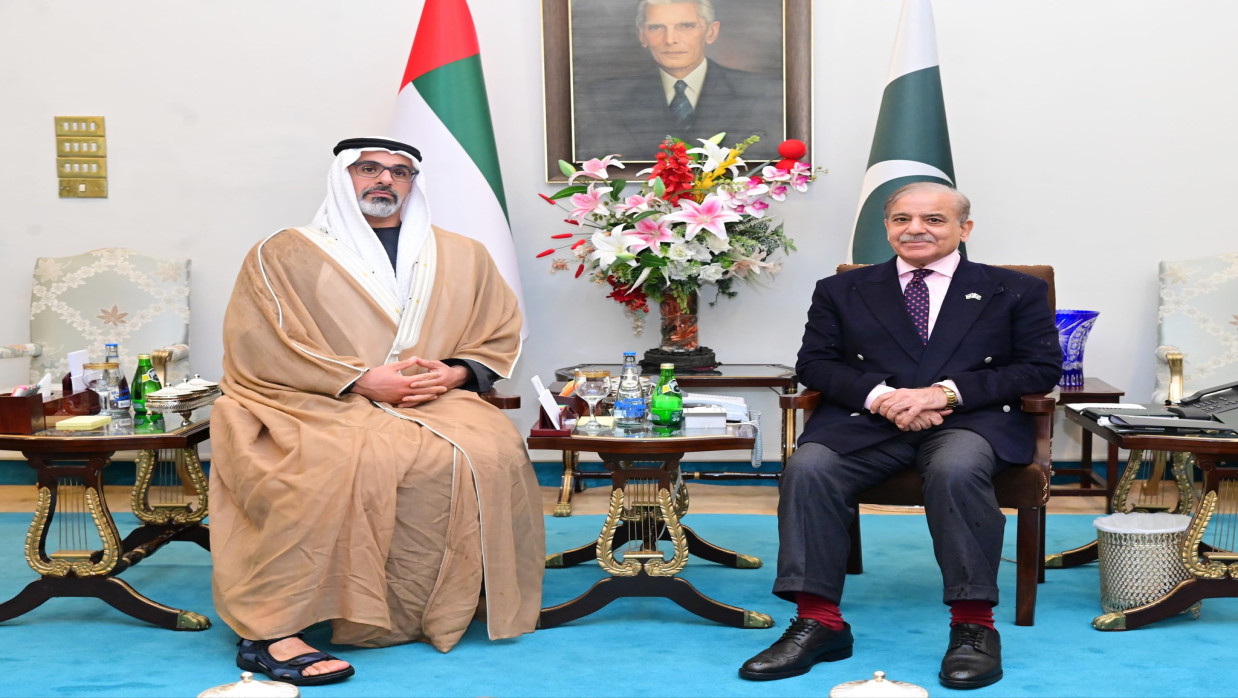
Pakistan–UAE relations are often described through the familiar vocabulary of brotherhood, friendship and shared interests. Yet such diplomatic language does not fully capture the origins or the contemporary potential of the relationship. The foundation of this partnership is deeper: it was built through people, professional networks, defence cooperation and decades of human interaction. The more important question today is whether that accumulated trust can be converted into durable economic and strategic interdependence.
The relationship acquired substance well before the UAE became the global commercial and financial hub it is today. During the formative years of the Emirates, Pakistani teachers, engineers, administrators, military personnel and skilled workers became part of the process of institution-building. The defence relationship was particularly significant. Historical research records that by April 1974, 115 Pakistani officers were serving in the Abu Dhabi Defence Force, alongside personnel from other countries. This was not merely symbolic cooperation; it created professional networks and institutional familiarity that subsequently became an enduring component of bilateral relations.
That history gives the defence relationship an unusual degree of depth. Pakistan and the UAE have accumulated experience in training, military exchanges and professional cooperation over decades. The next stage, however, need not be confined to conventional military cooperation. Cybersecurity, artificial intelligence, space capabilities, electronic warfare, advanced aviation and defence-industrial collaboration offer avenues for transforming established trust into technological partnerships. Such cooperation would require careful attention to intellectual property, export controls, financing, technology transfer and indigenous capability, but the institutional foundation already exists.
The more difficult challenge lies in economics. The problem is not an absence of commercial activity but a gap between the political significance of the relationship and its economic depth. Pakistan’s Foreign Office reported in May 2026 that around 2.2 million Pakistanis reside in the UAE, while bilateral trade and remittances were each close to US$8 billion. UAE figures cited in the discussion place non-oil trade with Pakistan above US$8.6 billion in 2024. These numbers demonstrate substantial economic connectivity, but they also reveal an important distinction: a large relationship is not necessarily an integrated relationship.
The reported progress toward a Comprehensive Economic Partnership Agreement in January 2026 therefore matters beyond tariff reduction. Pakistan’s Commerce Ministry described the negotiations as nearing conclusion and explicitly linked the agreement to the objective of creating a more robust and balanced trade and investment partnership. The real test will be whether such arrangements encourage productive investment rather than simply facilitating greater movement of goods.
Technology presents perhaps the clearest opportunity. Pakistan’s expanding software sector and large freelance workforce provide human capital that can be connected with the UAE’s financial resources, global commercial networks and appetite for emerging technologies. Cooperation in artificial intelligence, fintech, cloud infrastructure, cybersecurity and digital services could create an ecosystem in which Pakistani talent is not merely supplying labour but participating in higher-value global production chains. The January 2026 discussions between Pakistani and Emirati leadership also identified information technology and digital financial services among areas for greater cooperation.
Agriculture offers another practical avenue. Pakistan’s wheat and rice production, combined with its livestock and horticultural potential, intersects with the UAE’s long-term interest in food security. The opportunity, however, is not simply to export more agricultural commodities. Emirati investment in cold chains, irrigation, storage, processing, packaging, farm technology and logistics could help Pakistan capture greater value before its products reach international markets. Cooperation in the dates sector already provides an example of how bilateral engagement can move toward value addition rather than remaining confined to conventional commodity exchange.
Security is therefore inseparable from the economic agenda. The regional security environment directly affects infrastructure, logistics, mining and investment. The UN Monitoring Team’s 2026 report assessed that the TTP had been accorded greater liberty and support by Afghanistan’s de facto authorities and that attacks against Pakistan had increased. It also highlighted the wider ecosystem surrounding militant activity, including sophisticated communications and weapons networks. For Pakistan and the UAE, this means that counterterrorism cooperation can increasingly move beyond conventional security assistance toward financial intelligence, cyber monitoring, aviation security, border management and disruption of illicit financial networks. FATF standards provide an established international framework through which such cooperation can be strengthened.
The changing regional defence environment also requires strategic observation without automatically translating every development into confrontation. India’s expanding defence-technology relationship with Israel, particularly in research, innovation and advanced capabilities, is relevant to the broader regional security environment. Pakistan and the UAE can study such models for lessons in technology partnerships, research ecosystems and defence-industrial cooperation while retaining diplomatic flexibility.
The next phase of bilateral relations, therefore, may be less about proving that Pakistan and the UAE are close and more about determining how much strategic and economic value that closeness can actually produce.


0 Comments
LEAVE A COMMENT
Your email address will not be published