

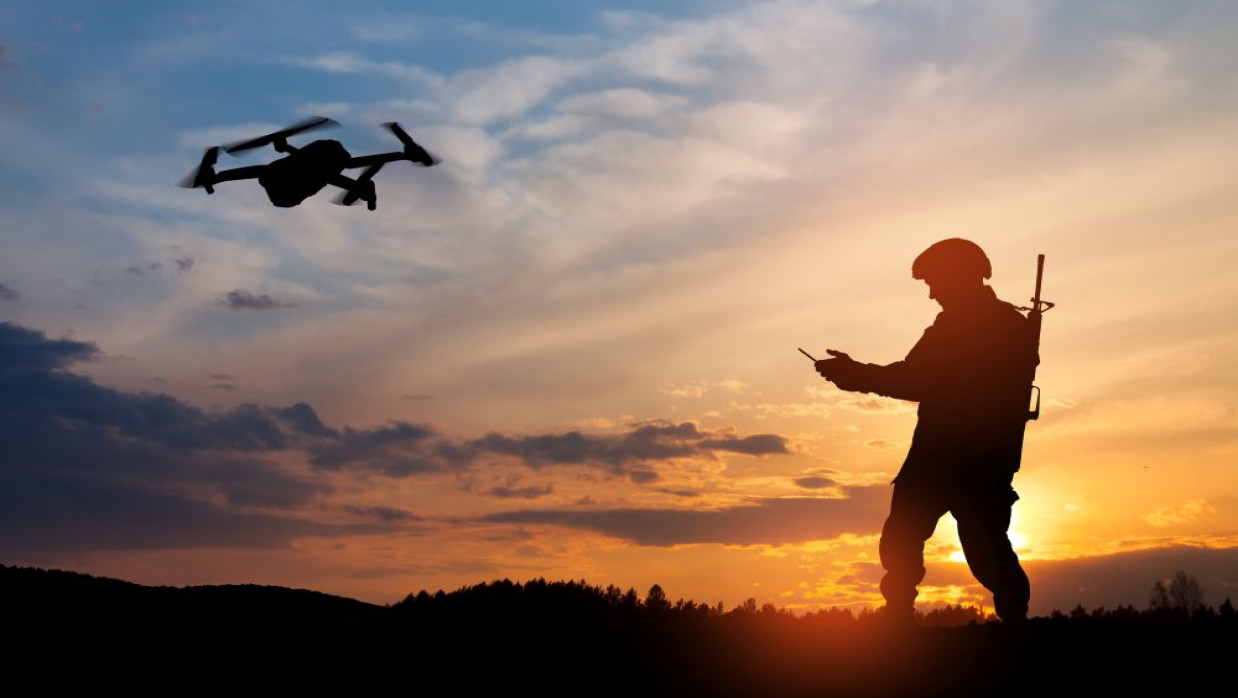
The character of warfare is undergoing a profound transformation as unmanned aerial vehicles (UAVs) move from a supporting role to a central role in military operations. Once associated primarily with surveillance and precision strikes by technologically advanced states, drones are now used by small and middle power states and non-state actors for reconnaissance, precision targeting, electronic warfare, deception, logistics and direct attack. The rapid proliferation of armed drones has reduced the cost of acquiring air power and enabled relatively inexpensive systems to threaten aircraft, armoured formations, air defence batteries, command and control systems and critical infrastructure.
Military drones can broadly be divided into several categories. Intelligence, surveillance and reconnaissance (ISR) drones provide real-time battlefield assessments and transmit targeting information to artillery, missiles and combat aircraft. Armed unmanned combat aerial vehicles (UCAVs) carry and launch precision-guided munitions, such as air-to-surface missiles, anti-tank guided missiles and guided bombs. Loitering munitions combine surveillance and attack functions by remaining airborne until a target is identified and then destroying it through a one-way strike. First-person-view (FPV) drones are small, highly manoeuvrable platforms controlled through live video feeds and adapted to carry explosives. Long-range one-way attack drones operate like low-cost cruise missiles, while swarms and decoy drones are employed to overwhelm air defences. Unmanned systems are also increasingly used as communication relays and platforms for electronic sensing, jamming and deception.
The evolution of drones in warfare reflects a shift from expensive, platform-centric air power to distributed, software-driven and expendable systems. Earlier generations, including the Predator and Reaper, required runways, satellite links and extensive support infrastructure. Contemporary conflicts have demonstrated the value of commercial quadcopters, modular components, artificial intelligence (AI) and mass-produced one-way systems. The convergence of surveillance and strike functions has compressed the “sensor-to-shooter” cycle. A unit can detect, identify and attack a target within minutes. Consequently, concealment, mobility and electromagnetic discipline have become as important as armour protection.
Drones have also altered the economics of warfare. A low-cost attack drone can compel an adversary to fire an interceptor worth hundreds of thousands or even millions of dollars. Repeated drone attacks can exhaust expensive missile arsenal, expose air defence batteries and radar positions, and impose a heavy financial and industrial burden. A 21 May 2026 report by The Washington Post stated that the US had fired more than 200 THAAD interceptors, accounting for approximately half of its total THAAD inventory in the ongoing war against Iran. Each THAAD interceptor reportedly costs around USD 12.7 million. The report further noted that the United States Central Command (CENTCOM) had also fired more than 100 SM-3 and SM-6 missiles, with each missile costing approximately USD 9.6 million. On 29 April 2026, Pentagon officials gave the US Congress the first public estimate of the war’s total cost, stating that Operation Epic Fury had cost approximately USD 25 billion by then.
Israel, meanwhile, reportedly fired fewer than 100 Arrow interceptors (each worth USD 3 million) and around 90 David’s Sling interceptors (each worth USD 1 million) during the conflict. An analysis published by Bruegel in July 2026 reported that regional forces had used hundreds of Patriot interceptors, each costing approximately USD 4 million, against Iranian Shahed drones with each drone costing between USD 20,000 to 50,000. These figures highlight the severe cost imbalance between Iran’s inexpensive drone attacks and the sophisticated air defence systems employed against them. These figures also show how relatively low-cost unmanned systems can impose disproportionate financial, logistical and industrial burden on militaries employing technologically advanced weapon systems.
However, drones are not invincible as their effectiveness depends on secure communications, navigation, trained operators, industrial production and integration with artillery, missiles, air power and intelligence. Electronic warfare can jam control links and satellite navigation, while guns equipped with smart ammunition, directed-energy weapons (DEWs) and interceptor drones are increasingly being employed against them. Modern warfare is therefore becoming a continuous contest between drone adaptation and counter-drone innovation.
The Ukraine war has provided the clearest demonstration of this transformation. Russian and Ukrainian forces have used commercial quadcopters for intelligence gathering, FPV drones for precision strikes, loitering munitions against high-value targets and long-range drones against critical infrastructure deep behind the front lines. A January-February 2026 US Army analysis cited estimates that unmanned systems were responsible for 70-80 percent of battlefield casualties on both sides by mid-2025, while FPV and munition-dropping drones accounted for an increasing proportion of damaged vehicles. These trends show that battlefield success increasingly depends not only on possessing sophisticated drone platforms, but also on the ability to manufacture, modify and replace them on an industrial scale. Russia has also introduced fibre-optic drones controlled through cables extending up to 20 km, along with relay drones capable of extending communication ranges and coordinating multiple unmanned systems. Such innovations underscore the rapid evolution of drone warfare and demonstrate how technological adaptation has become a critical determinant of battlefield success.
The ongoing conflict in the Middle East has further demonstrated that drones are now instruments of both long-range precision strike and asymmetric retaliation. For the first time in air combat, the US used the Low-Cost Uncrewed Combat Attack System (LUCAS). LUCAS is characterised as a one-way attack drone modelled on the concept of Iranian Shahed drone. Iran, meanwhile, successfully employed missiles and drones against Israel and US bases across the Gulf. The exchange exposed the vulnerability of fixed installations, commercial shipping and expensive air-defence networks to persistent low-cost attacks. It also illustrated an important reversal that even the world’s most technologically advanced military adopted a design philosophy pioneered by Iran, a heavily sanctioned country.
South Asia experienced its own drone watershed during the 4-Day War in May 2025. Nuclear-armed India initiated hostilities by launching coordinated missile, air and drone strikes against nuclear-armed Pakistan, despite Pakistan’s earlier offer of a neutral investigation into the Pahalgam incident of 22 April 2025. India sent waves of loitering munitions and killer drones across Pakistan’s territory, including Israeli-origin Harop systems. For the first time in South Asian history, the two nuclear-armed neighbours engaged in large-scale drone warfare.
India’s conduct over the past seven years demonstrates a repeated pattern of irresponsible military behaviour towards Pakistan. In February 2019, New Delhi violated Pakistan’s airspace and carried out air strikes inside Pakistan’s territory. Pakistan responded in accordance with its Quid Pro Quo Plus policy, shooting down two Indian fighter aircraft and capturing one pilot. In March 2022, India fired a BrahMos cruise missile into Pakistan’s territory, but Pakistan exercised restraint and prevented the incident from developing into a serious military crisis. India again launched coordinated missile and drone attacks against Pakistan in May 2025, but failed to achieve its strategic objectives and suffered significant military losses. Across all three episodes, Pakistan’s calibrated and responsible conduct prevented a wider conflict with serious consequences for the region and beyond.
India must therefore recognise that, in a conflict with peer nuclear power, drones are not instruments of guaranteed military success. Their effectiveness depends on reliable intelligence, joint force integration, secure communications, realistic operational planning and responsible statecraft. Most importantly, India must abandon the dangerous assumption that unmanned systems offer a low-risk means of aggression against Pakistan. Any future employment of drones could invite a proportionate response, accelerate escalation and once again expose the limitations of India’s highly publicised military prowess. Indian leaders must understand that there is no space for war under the nuclear overhang, and Pakistan’s strategic patience is not limitless.


0 Comments
LEAVE A COMMENT
Your email address will not be published