

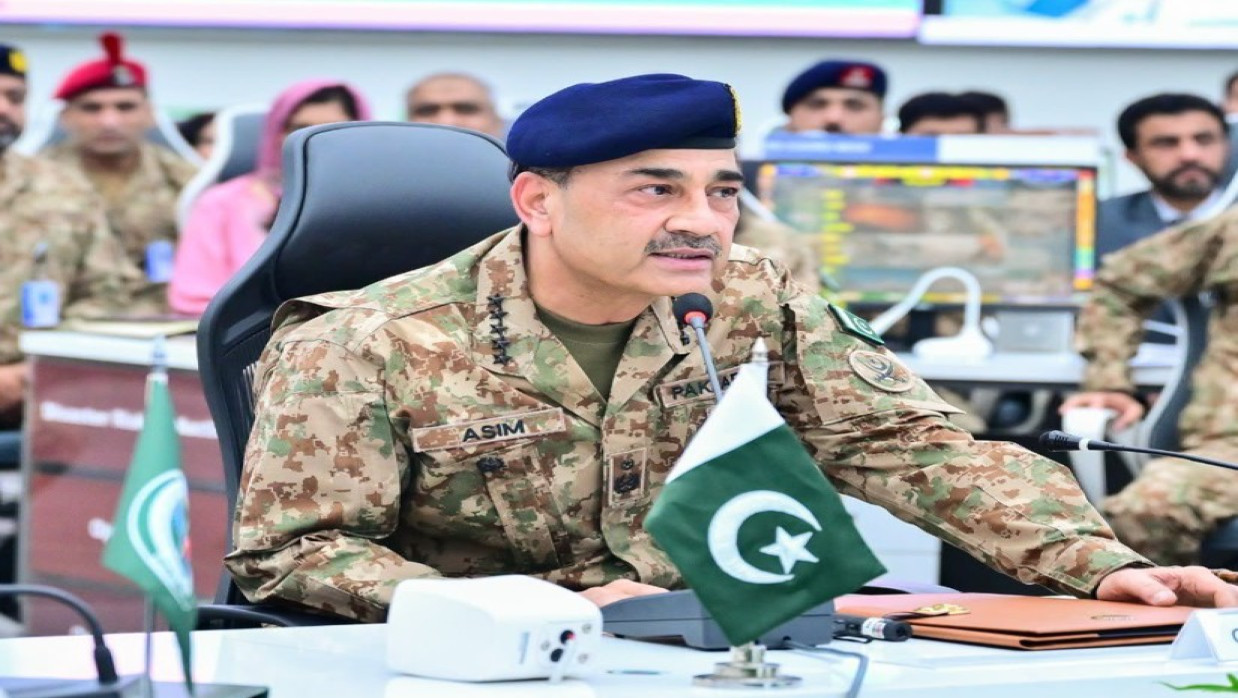
Pakistan’s political crisis is often personalized. These days one often encounters people who blame only Pakistan’s Army chief, “Field Marshal” Asim Munir, for the insurgency and its associated violence in parts of Pakistan, the political crackdown across Pakistan, and Pakistan’s deteriorating relationship with Afghanistan.
Similarly, former Prime Minister Imran Khan and members of his Pakistan Tehreek-e-Insaf (PTI) party have also blamed Asim Munir for the crackdown against PTI. Imran Khan is even reported to have called Asim Munir a psychopath. Before turning his criticism toward Munir, Imran Khan had directed much of his ire on former Pakistan army chief General Qamar Javed Bajwa, blaming him for his ouster from power in April 2022. While (former) army chiefs are frequently criticized in Pakistan, many—including Imran Khan—refrain from publicly criticizing the army itself.
If one takes even a cursory look at the history of the Pakistan Army, it becomes clear that individuals like General Bajwa or Munir are not the root cause of Pakistan’s problems. Rather, the army as an institution is the problem. Bajwa and Munir did not create the army. Instead, the army produced them—and many others like them. Therefore, unless the people of Pakistan, including their political leadership, confront the institutional role of the army and find a solution, blaming individuals who cycle in and out of power every few years will lead nowhere.
At first glance, it is understandable why Pakistan would want a strong army, particularly given its relationship with India. Any overt criticism of the army could erode its credibility in the public eye, potentially diminishing its status and perceived importance. Furthermore, because the army holds a respected position in Pakistani society, openly criticizing it may also damage the reputation of those who do so. As a result, it is often considered safer to target individual army chiefs rather than the institution itself. However, this approach—focusing on individuals while sparing the institution—is both flawed and misleading for several reasons.
First, the army as an institution has a long history of meddling in Pakistan’s domestic affairs. From the 1950s to the present, it is hard to find an era when the army was not directly or indirectly involved in Pakistan’s domestic affairs. Despite its long history of involvement in domestic politics, the Pakistan army would be hard-pressed to point to any significant achievements.
Second, it is noteworthy that army chiefs do not personally carry out most of the actions attributed to the army. Instead, they are carried out by a broader network—from corps commanders to junior officers—who implement policies such as toppling governments, rigging and influencing elections, and shaping and controlling media narratives. Thus, focusing only on recent chiefs like Bajwa or Munir ignores decades of historical precedent.
Third, the Pakistan army carries a colonial legacy rooted in the British Indian army. The British ruling elite in the Indian subcontinent, including military officers, held ordinary Indians in disdain. The British were primarily interested in taxing Indians heavily, keeping them under military and bureaucratic control, and selling them British manufactured goods produced largely from Indian raw materials. There is considerable evidence to suggest that many Pakistan army officers have inherited a mindset similar to that of their British predecessors. The belief that the army alone is Pakistan’s “protector” and therefore deserves unquestioning public trust is reflective of that colonial mentality. Similarly, the army’s constant meddling in politics and micromanaging domestic, foreign, and security policies shows a lack of trust in elected civilian officials and, by extension, in the Pakistani people who “elect” these civilian officials.
Fourth, the army is deeply entrenched in Pakistan’s economic life, often to its own advantage. The army is believed to be part of a vast shadow economy worth billions, if not tens of billions, of dollars. Military-linked business entities like the Fauji Foundation and Askari Group are household names in Pakistan. The army also provides extensive benefits to its (former) members, including pensions, medical care, and land allocations. Such incentives naturally encourage loyalty to the institution and help explain why many current and former officers and generals remain silent when the army leadership intervenes in politics, even when such interventions are not in the interest of the people of Pakistan.
All of these points suggest that army chiefs alone, especially Asim Munir, are not the problem—the institution itself is. This does not imply that every individual within the army is at fault; many undoubtedly serve with sincerity and dedication. However, the above-mentioned structural factors make it obvious that the problem runs far deeper than army chiefs.
Therefore, it is important to hold the institution accountable, rather than army chiefs alone. For instance, if the situation in Pakistan were to deteriorate further, the army high command—especially with “input” from Pakistan’s “friends”—might decide to remove Asim Munir. In that scenario, pro-establishment media and politicians would likely blame Asim Munir for the country’s problems while carefully leaving the army unscathed. This would give the army an opportunity to evade accountability and meddle in politics again under a new chief. Unless Pakistan undertakes fundamental reforms—such as holding the army accountable and meaningfully curbing its ability to interfere in politics—the cycle is likely to continue.


0 Comments
LEAVE A COMMENT
Your email address will not be published