

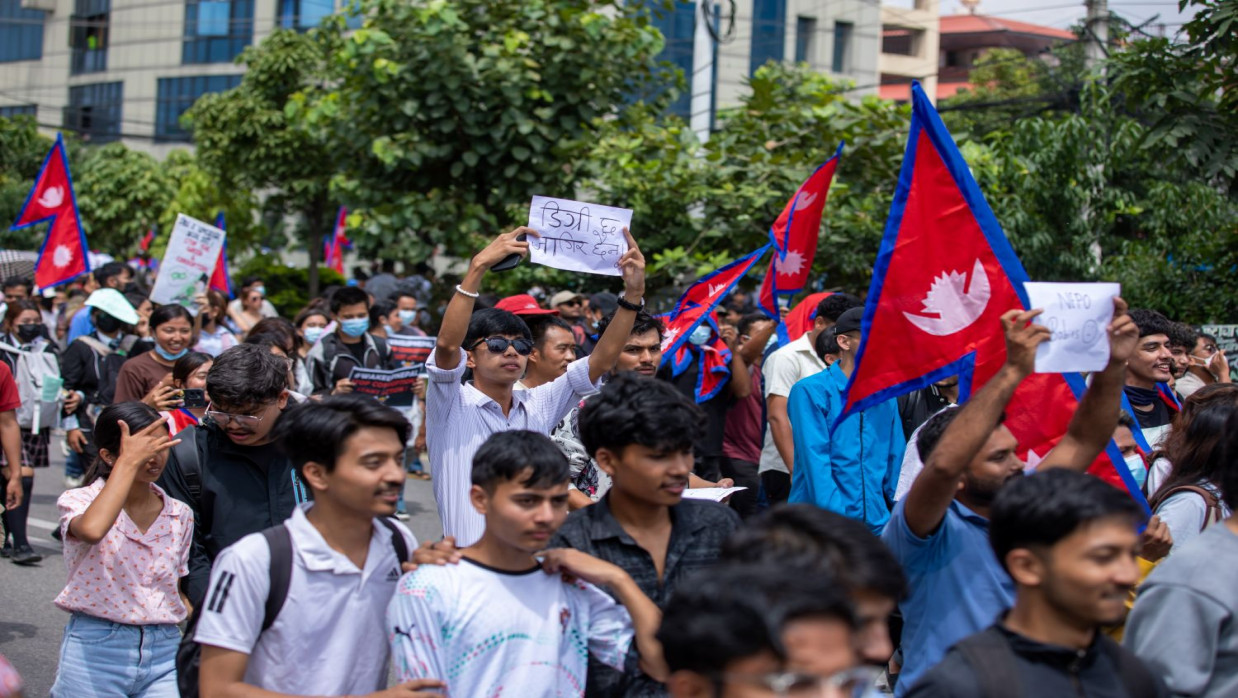
A quiet but consequential shift is under way in South Asian politics. In just a few years, young people have moved from being talked about in political speeches to becoming the ones forcing the conversation — pressuring governments, unsettling entrenched arrangements, and pushing questions about jobs, merit and accountability out into the open where they can't easily be managed away.
The triggers differ by country. Economic collapse brought Sri Lankans onto the streets in 2022. Public-sector job quotas ignited Bangladesh's student uprising in 2024. A social-media ban detonated deeper anger over corruption in Nepal in 2025. Examination failures and job insecurity have driven mobilisation in India through 2026. In Pakistan the pressures are more diffuse but no less real: inflation, shrinking opportunity, unequal education, unreliable services, and a widening gap between what young people were promised and what institutions actually deliver.
These are not one movement wearing five flags. South Asia's young people are divided by class, caste, religion, language, gender and ideology — divided, often, in exactly the ways their parents' generation was. What they share instead is a political instinct: governments are increasingly judged by outcomes, not announcements. And that instinct is rooted in something measurable. The World Bank found that only 59 percent of South Asia's working-age population was employed in 2023, against 70 percent across other emerging-market economies — a gap that means millions of young people competing for jobs that simply don't exist in sufficient number, while comparing their situation, in real time, to peers a border or an ocean away.
That comparison happens on a device most of them carry in their pocket. A student in Lahore checks recruitment systems against Bengaluru's. A graduate in Dhaka watches Kathmandu's protests unfold live. A freelancer in Peshawar competes for a client in London without ever leaving her room. Digital access remains sharply unequal — by gender, by geography, by class — but information now crosses borders faster than any government can control the comparison it invites. When official narratives celebrate progress and young citizens experience unemployment and opaque recruitment instead, that contradiction becomes politically explosive.
Sri Lanka: when economic failure became political failure
The Aragalaya of 2022 remains the region's clearest case of collapse curdling into a legitimacy crisis. Fuel queues, blackouts and shortages of basic goods pulled Sri Lankans from every class onto the streets. Young people weren't the only participants, but they supplied the movement's digital organisation and its language, framing the crisis as a failure of governance rather than an act of fate. The protests forced President Gotabaya Rajapaksa to flee and resign, and their influence carried through to the 2024 election of Anura Kumara Dissanayake on a platform built around rejecting the old political establishment.
But Sri Lanka also demonstrated protest's limits. Removing a president doesn't restructure sovereign debt, reform taxation or rebuild administrative capacity. Mobilisation can strip an order of its legitimacy; only institutional reform can turn that energy into anything that outlasts the moment that produced it. Without that second step, old patterns tend to reappear wearing new faces.
Bangladesh: from a quota dispute to a national rupture
Bangladesh's 2024 uprising began narrowly, over quotas in public-sector recruitment — a dispute that mattered enormously in a labour market where government jobs mean security most young people can't find anywhere else. The state's response transformed it: the UN human rights office later found evidence of systematic repression involving the former government and security services. Sheikh Hasina resigned and fled the country on August 5, 2024.
What happened next is the more instructive part. Student leaders founded the National Citizen Party in February 2025, hoping to convert protest legitimacy into an electoral alternative. In the February 2026 general election, the NCP won just six of roughly 300 seats, hampered by organisational weakness and a fraught alliance with Jamaat-e-Islami — while the Bangladesh Nationalist Party swept to power with more than two-thirds of the vote. This doesn't make the uprising insignificant. It demonstrates, plainly, that the skills required to bring a government down are not the skills required to build one — to recruit credible candidates, negotiate coalitions, and sustain organisation down to the local level. Bangladesh's warning for the wider region is blunt: a narrow administrative grievance, handled badly, can detonate into something far beyond its original scale.
Nepal: from a digital ban to a political realignment
Nepal offers the sharpest version of this pattern yet. A September 2025 ban on major social-media platforms — officially a registration dispute — was read by young Nepalis through a much wider lens of corruption and blocked opportunity. Within days, the unrest had killed 76 people, burned down the parliament building, and forced Prime Minister K.P. Sharma Oli's resignation.
Unlike Bangladesh's students, Nepal's Gen Z had a ready vehicle waiting: Kathmandu's rapper-turned-mayor, Balendra "Balen" Shah, led the four-year-old Rastriya Swatantra Party to a landslide 182 of 275 seats in the March 2026 election, becoming, at 35, the country's youngest-ever prime minister. Nepal's lesson runs in two directions at once — restricting communication rarely resolves the anger behind it, and protest energy converts into real governance far faster when a credible party exists to receive it. But governing has proven harder than winning: within months, fresh Gen Z demonstrations were already testing Shah's own government, a reminder that this generation's patience with power, including power it helped install, is not unconditional.
India: dispersed frustration finds a common target
India's youth politics has never reduced to a single movement — entrepreneurship, digital careers, caste and regional identity all pull young Indians in different directions at once. But examination failures have become a recurring point where that frustration converges, because competitive exams represent years of sacrifice for entire families, not just individual students. When a paper leaks or a marking system breaks down, the injury registers as political, not merely administrative.
By mid-2026, anger over a leaked NEET medical-entrance exam had grown into the "Cockroach" movement — a satirical youth campaign named, pointedly, after a Supreme Court justice's dismissive remark about unemployed young people — filling Delhi's Jantar Mantar with tens of thousands demanding Education Minister Dharmendra Pradhan's resignation. Hundreds have been injured in clashes with police; activist Sonam Wangchuk's weeks-long hunger strike pulled the movement into national headlines. As of this week, talks between protest leaders and the government continue without resolution. Whatever its outcome, it is further evidence of a regional pattern rather than an isolated dispute: educational failure, unemployment and eroding institutional trust compounding into something larger than any single exam ever was.
Pakistan: the test of a demographic dividend
Pakistan now faces, arguably, the most consequential version of this question: can a large young population become a national asset when institutions cannot keep pace with what it expects? A demographic dividend isn't automatic. It requires education, employment and functioning institutions to actually connect — without that connection, a youth bulge deepens pressure rather than relieving it.
Pakistan's younger generation has grown up inside recurring economic crises, inflation, political polarisation and climate disasters, but it is also the country's most digitally fluent — turning increasingly to freelancing, e-commerce, software services and content work rather than waiting on conventional employment systems that have repeatedly let them down. For many educated young Pakistanis, working online or considering migration abroad isn't a lifestyle preference; it's a strategy for managing uncertainty they didn't create.
There is real evidence that focused investment works. A World Bank-backed digital skills project in Khyber Pakhtunkhwa trained more than 13,000 young people — including over 4,000 women and 1,300 persons with disabilities — with nearly 5,900 participants subsequently reporting income from online work or jobs in the digital sector. The project also incubated women-led start-ups and connected young developers with provincial government departments. What this shows is that Pakistan's youth do not lack ability. What's missing is scale — the same programme, at a fraction of the size the need actually demands.
The core deficit is a credible connection: between education and employment, qualification and recruitment, taxation and public service, citizenship and any real say in how the country is run. Pakistan shouldn't assume it will replay Sri Lanka's, Bangladesh's or Nepal's script — its institutions, federal structure and civil-military history are its own, and its youth are as fragmented as the rest of its population. But the regional pattern still applies here: perceived unfairness mobilises as powerfully as ideology, and a digital network can turn a local grievance into a national argument overnight.
What Pakistan should do
The right response is policy, not political anxiety.
Public-sector recruitment needs to run through transparent, auditable systems — vacancies, eligibility, exam schedules, marking criteria, results and appeals, all published and reviewable. Exam security should be treated as a governance priority, not a clerical afterthought, with independent review mechanisms that respond quickly when allegations of leaks or favouritism surface. Nothing damages a young citizen's trust in the state faster than the belief that effort is irrelevant because access was already decided.
Education and employment need an actual working link, built by universities, vocational institutes, provincial governments and employers together — and that link shouldn't begin and end with coding bootcamps. Pakistan needs skilled people in healthcare, advanced manufacturing, renewable energy, construction, logistics and climate adaptation just as much, with training judged by employment and income outcomes rather than the number of certificates handed out.
Reliable internet needs to be treated as economic infrastructure, not a convenience, since a freelancer can't hold an international client through unpredictable connectivity — and that expansion needs to come with cybersecurity, privacy protection and workable channels for reporting online fraud. Entrepreneurship support needs to go beyond loans, toward mentorship, accounting help, export guidance and access to markets, including transparent procurement opportunities for youth-led and women-led businesses trying to get a foothold.
And young people need a genuine, representative role in the decisions that affect them — not as beneficiaries of programmes designed without their input, but through municipal and provincial youth councils with real consultative weight on education, transport, climate resilience and urban planning. Participation without influence becomes theatre; influence without accountability becomes just another form of patronage. Bangladesh and Nepal, above all, are a warning about what it costs a government to meet a manageable grievance with force instead of dialogue.
A regional generation, not a regional ideology
Sri Lanka, Bangladesh, Nepal, India and Pakistan aren't producing identical movements, and not every demonstration involving young people deserves to be romanticised as a democratic awakening. These movements can be fragmented, misinformed or hijacked by people with darker aims — and the same digital platforms that expand participation can just as easily reward outrage over substance.
What unites them isn't ideology. It's a demand for practical legitimacy — credible exams, dignified work, functioning public services, institutions where success doesn't depend on who you happen to know. None of that is a revolutionary ask. It's what a functioning state owes the people living inside it.
I'll admit I don't experience this as an abstract regional trend so much as something close to home. It's the friend's younger sibling who finished a strong degree and still can't find a real next step. It's the talented people I've worked alongside choosing to freelance for clients abroad because the path here felt closed to them. It's the quiet arithmetic almost every family in Islamabad runs at some point, weighing whether to stay and build or to leave and start over somewhere that seems to reward effort more reliably. That's the real texture underneath these headlines, and it's easy to miss if you only read the protest numbers.
Pakistan's young people already shape its workforce, its politics, its economy — whether or not the state has caught up to that fact yet. The real question isn't whether this generation will matter to the country's future. It already does. The question is whether Pakistan gives it a reason to build that future here, or watches it happen somewhere else, or — worse — watches it not happen at all.


0 Comments
LEAVE A COMMENT
Your email address will not be published