

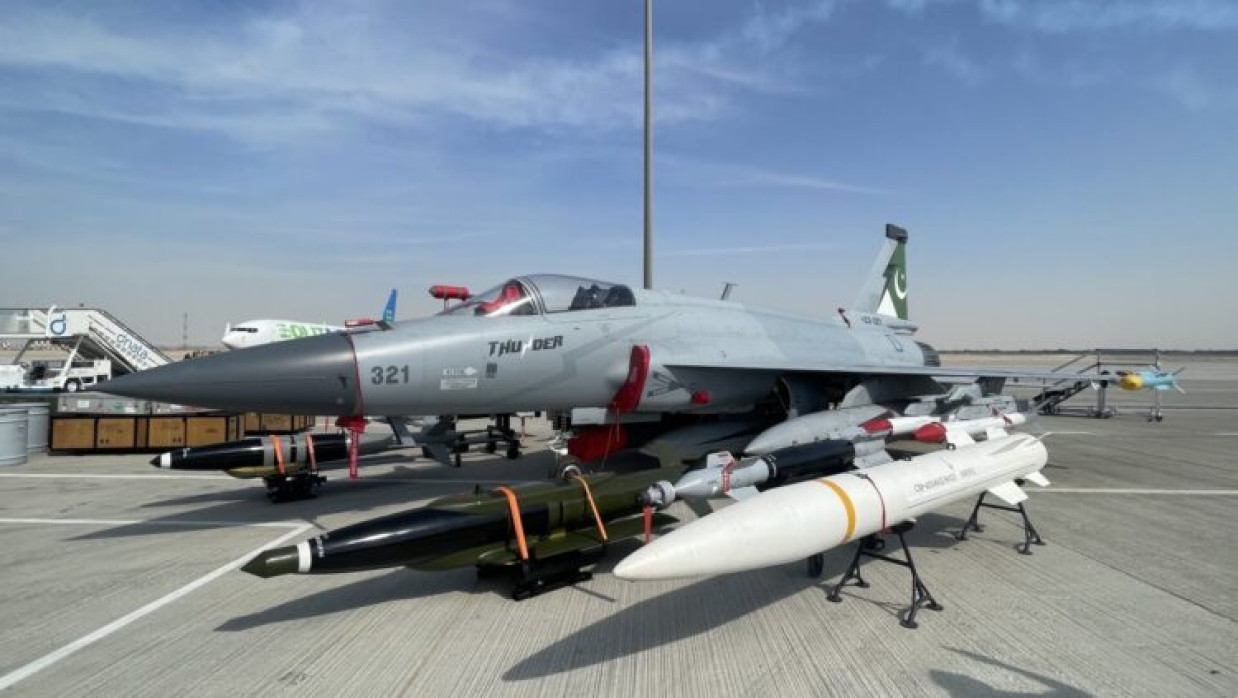
During Azerbaijan’s Victory Day parade on November 8, 2025, newly acquired JF-17 Thunder fighter jets flew over Baku for their public debut. Aircraft took part in a flyover with Azerbaijani Air Force Col. Novruz Tahirov flying the lead aircraft. Those aircraft were a mix of single- and dual-seat fighters. Azerbaijan’s official confirmation of the jets’ participation in the parade marks them as inducted into service and makes Azerbaijan the fourth international operator of the Chinese-Pakistani fighter jet design. The countries currently operating the JF-17 are Pakistan, Myanmar, and Nigeria. Aside from the obvious display of Pakistan pride, the public debut of the jets marks Azerbaijan’s commitment to modernizing its air force with capable, networked aircraft on asymmetric terms.
The deployment of the JF-17s alongside Turkish Air Force F-16s and Azerbaijani Su-25 Frogfoot strike aircraft upgraded by Turkish contractors shows an additional intention of interoperability between Turkish and Azerbaijani air forces during wartime operations.
Developed jointly by the Pakistan Aeronautical Complex and China’s Chengdu Aircraft Corporation, the JF-17 was conceived as an affordable multirole fighter for countries unable or unwilling to bear the enormous acquisition and maintenance costs of Western aircraft. Although China helped design and produce it, the fighter is not operated by the People’s Liberation Army Air Force and is manufactured primarily for Pakistan and the export market.
Azerbaijan had originally agreed to buy the Block III variant in 2024. The exact number of planes bought, nor the deal's worth, wasn't revealed during the announcement of the sale. Reuters claimed that the sale was set to increase defense ties between the two nations as well as boost Azerbaijani air capability. Pakistani officials later claimed the deal included 40 jets as part of a larger defense package worth $4.6 billion.
The Block III is the most advanced JF-17 variant, incorporating an active electronically scanned array radar, modern electronic-warfare systems, improved cockpit displays and beyond-visual-range missile capability. Its relatively low operating costs make it attractive to air forces seeking to replace aging Soviet-era fighters without purchasing more expensive Western alternatives.
For Azerbaijan, the aircraft could eventually replace or supplement its MiG-29 fleet while providing greater precision-strike and electronic-combat capabilities. It also strengthens Baku’s military relationship with Pakistan and complements its close defense partnership with Turkey. Operating the JF-17 alongside Turkish systems could encourage further cooperation in training, data sharing and joint exercises.
The reported $4.6-billion value, however, almost certainly covers more than the aircraft themselves. Weapons, spare parts, training, maintenance facilities and long-term logistical support may constitute a substantial portion of the package. The precise composition has not been publicly disclosed.
Neighboring Armenia and Azerbaijan’s other South Caucasus neighbors will be monitoring these budding air capabilities at the regional level. Military modernization tends to have a significant impact on the already fragile security equilibrium in that region. New military capabilities have the potential to promote deterrence. However, they should also be paired with political gestures and confidence-building measures. For Pakistan, the deal validates its defense industry and its longstanding relationship with China. Pakistan gets a diplomatic win, and Baku can acquire modern airpower on the cheap. However, the fighter’s long-term legacy will depend on more than just fly-overs. Its endurance will be determined by how well it meshes with Azerbaijan’s defense landscape.


0 Comments
LEAVE A COMMENT
Your email address will not be published