

By the time Pakistani Prime Minister Shehbaz Sharif announced a ceasefire between US and Iran on April 8, 2026, India was nowhere in the picture. No seat at the table. No mention in the communiqués. No credit for the outcome. In a conflict that strikes at the very arteries of India's economy, a country that imports nearly 85% of its fuel and relies on the Strait of Hormuz for roughly half its crude oil New Delhi had managed to be diplomatically invisible precisely when visibility mattered most.
What followed was not a dignified silence. It was a spectacle.
On March 25, External Affairs Minister S. Jaishankar arrived at an all-party parliamentary meeting to brief opposition leaders on India's posture in the Iran crisis. Pakistan had just brokered a preliminary ceasefire framework, was hosting US and Iranian delegations, and had been publicly endorsed by Donald Trump on Truth Social. The room was tense. Opposition leaders wanted answers.
What Jaishankar delivered was not a strategy. It was a grievance. "Hum unki tarah dalali nahi kar sakte," he reportedly told the assembled lawmakers roughly translated: "We cannot act as brokers like them." The word dalaal a term carrying heavy connotations of a tout or middleman working for hire was directed at Pakistan's mediation role. In the grammar of diplomacy, it was the vocabulary of a street corner, not a foreign ministry.
The backlash was immediate and came from all directions. Congress leader Shama Mohamed called it "a diplomatic failure." Supriya Shrinate asked pointedly: what then was Modi's repeated positioning as a peacemaker in the Russia-Ukraine conflict? Was that not also brokering? Online, Indians themselves expressed outrage not at Pakistan, but at their own minister. "Such poor choice of words," wrote one commentator. "The word 'Dalal' is the language of street vandals," said another.
In trying to demean Pakistan's achievement, Jaishankar had succeeded only in illuminating India's absence.
The scale of Pakistan's diplomatic coup makes India's frustration more understandable even if the reaction was inexcusable. In under six weeks after the US and Israel launched strikes on Iran on February 28, killing Supreme Leader Ali Khamenei and triggering a global energy crisis, Pakistan had achieved what most middle powers only dream of: it became the indispensable interlocutor in a conflict involving the world's most powerful military and a nation of 90 million.
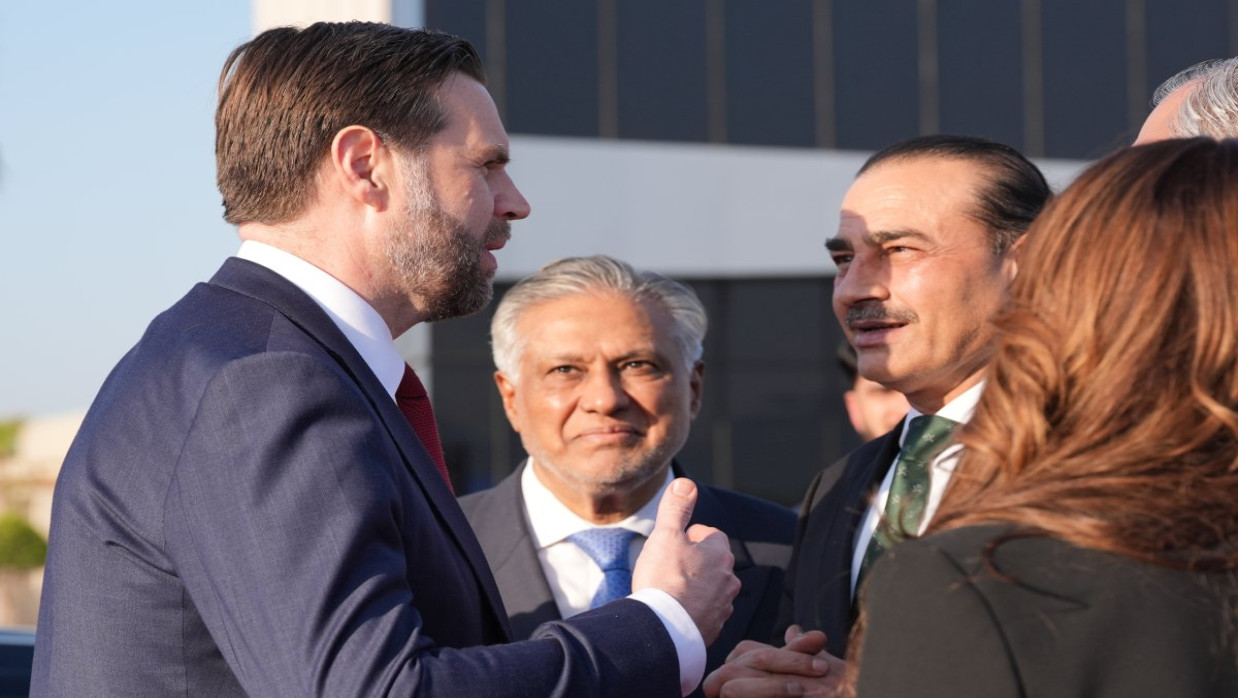
Pakistan formally offered to host talks on March 23. Within days, it had confirmed receipt of a 15-point US proposal to Iran. Then, in the early hours of April 8, Sharif announced on social media that Tehran and Washington had agreed to an "immediate ceasefire everywhere." The Islamabad Talks of April 11-12 followed, with US Vice President JD Vance, envoys Steve Witkoff and Jared Kushner, and an Iranian delegation led by parliamentary speaker Mohammad Bagher Ghalibaf all descending on a city that, just months earlier, most Western commentators were describing as a failing state.
How did Pakistan earn this role? It condemned American and Israeli strikes on Iran while simultaneously condemning Iran's retaliatory attacks on Gulf states. It balanced its mutual defence agreement with Saudi Arabia against its near-thousand-kilometre border with Tehran. It deployed its navy to protect shipping lanes. It engaged in relentless shuttle diplomacy Sharif to Jeddah, Dar to Washington and Beijing, calls to Pezeshkian in Tehran. As former Pakistani ambassador Masood Khan told Al Jazeera: "We did not seek strategic opportunism. We earned their trust."
India neither earned that trust nor, it seems, seriously attempted to.
India's defenders will argue that "strategic autonomy" is a virtue, not a vice that New Delhi's refusal to align with any single power bloc preserves its long-term flexibility. Jaishankar himself, at the Munich Security Conference in 2024, boasted that India should be admired for maintaining "multiple options" in its foreign policy. But as the Iran crisis has exposed, there is a difference between strategic autonomy and strategic ambiguity and India has fallen into the latter.
When the US and Israel struck Iran on February 28, India's response was carefully non-committal. The Ministry of External Affairs expressed "deep concern," urged "avoidance of escalatory steps," and offered to support "existing channels of dialogue." At the BRICS Deputy Foreign Ministers meeting in April, India which had cultivated close ties with Israel reportedly worked to soften criticism of Israeli actions, leading the meeting to collapse without a joint statement. When Iran's Foreign Minister Abbas Araghchi addressed the BRICS foreign ministers gathering in New Delhi on May 14 and urged member nations to formally condemn the "unlawful aggression" of the US and Israel, India again offered no condemnation.
This is the contradiction at the heart of Modi's foreign policy. A country that cannot bring itself to condemn the bombing of a state it has a 75-year friendship treaty with because it fears offending Washington and Tel Aviv cannot credibly present itself as a neutral arbiter of anything. Washington, meanwhile, has grown impatient with India's balancing act. As Foreign Policy noted in late 2025, sustaining strategic autonomy becomes untenable when India is "forced to choose between major powers" a reckoning the Trump administration has pushed through tariffs, sanctions pressure and now through diplomatic marginalisation.
The humiliation is compounded by what India stood to lose. For years, Modi's government invested heavily in the Chabahar port project in Iran as a strategic gateway to Central Asia and Afghanistan, a way to bypass Pakistan and build regional connectivity. Modi visited Tehran in 2016, signing the landmark Chabahar agreement. Relations were warm and the partnership was presented as a cornerstone of India's "extended neighbourhood" policy.
That strategic investment now lies in ruins not because of anything Iran did, but because India could not protect the relationship under American pressure. Successive rounds of US sanctions pushed Indian firms to withdraw from Iranian energy projects. When the war began, India found itself without the diplomatic capital needed to leverage its historical ties into mediating influence. The relationship had been hollowed out precisely when it might have been most valuable.
The BRICS meeting in New Delhi this week is a study in contrasts. Iran's foreign minister is attending, meeting bilaterally with Jaishankar. Yet the conversations are transactional, not transformative. India is hosting the forum, chairing BRICS for 2026, and yet the most consequential diplomacy on the Iran crisis has happened anywhere but New Delhi in Islamabad, in Riyadh, in Geneva.
Perhaps the cruellest irony is that Modi himself created the expectation Jaishankar then tried to disavow. In the years following Russia's invasion of Ukraine, Modi was carefully positioned both by his government and by a compliant domestic media as a potential peacemaker. His meetings with Putin and Zelensky were presented as proof of India's unique diplomatic reach. The phrase "Vishwa Bandhu" friend of the world became a governing ideology.
But if Modi is a "Vishwa Bandhu," what explains the silence when a sovereign nation was bombed in violation of international law? What explains the refusal to take a clear position at the UN Security Council? What explains the language of street-corner resentment when a smaller, poorer neighbour achieved what India could not?
Congress leader Tariq Anwar captured the contradiction plainly at the all-party meeting: "Pakistan, which is smaller than us and weaker in every respect, is today acting as a mediator and playing that role, while we remain mute spectators."
The Finnish President Alexander Stubb no critic of India offered New Delhi an opening in March, publicly urging India to leverage its "trust of both sides" to broker a ceasefire. India did not take it. Whether because of American pressure, Israeli sensitivities, or simple strategic miscalculation, the moment passed.
India will pay an economic price regardless. With the Strait of Hormuz disrupted and oil prices surging, UBS Securities has already cut its forecast for Indian GDP growth in fiscal year 2027 to 6.2%. Modi has publicly urged Indians to reduce fuel consumption, cut overseas travel and pause gold purchases the language of a leader who waited too long to influence events and now can only manage their consequences.
The deeper cost is strategic credibility. India approaches the September BRICS summit in New Delhi as chair of a bloc deeply divided over the war it could not help end. It cultivates ties with Israel while hosting a forum where Iran demands that those ties be condemned. It claims the mantle of Global South leadership while refusing to take positions the Global South expects of leaders.
Jaishankar's dalaal remark will be remembered not for what it said about Pakistan, but for what it revealed about India. When a foreign minister responds to a neighbour's diplomatic triumph with the vocabulary of frustration rather than the composure of confidence, something has gone wrong. Not in the room. In the strategy.

0 Comments
LEAVE A COMMENT
Your email address will not be published