

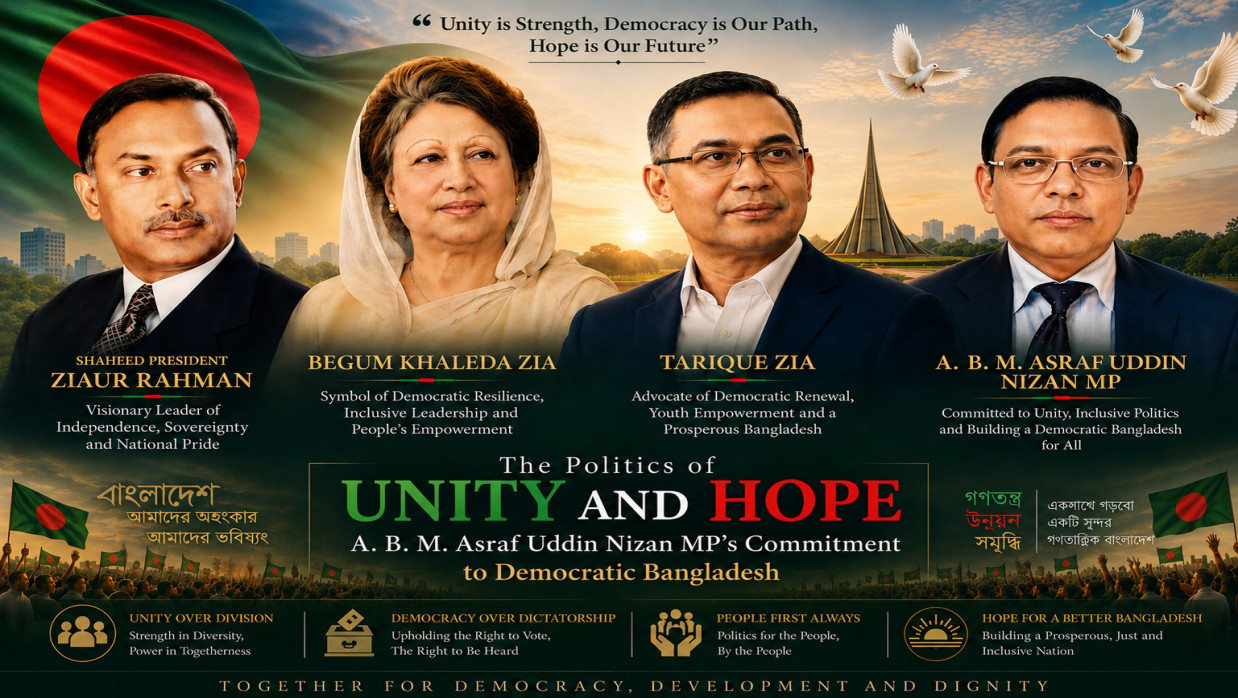
There have been several individuals in each chapter of Bangladesh’s political saga who stand out from the usual fight for political supremacy as voices of people’s hope, national honor, and aspirations. What makes them special is that, instead of focusing solely on their political achievements, they were able to bridge the gap between their dreams and those of ordinary people, thereby representing the democratic, sovereign, and harmonious aspects of nation-building. It is in this background that the political personality of Mr. A.B.M. Ashraf Uddin Nizan MP becomes distinctly identifiable through his nationalism under the leadership of the Shaheed President Ziaur Rahman, and through the traits of Begum Khaleda Zia and Tarique Rahman.
The reflections in this paper emerge from the author's personal experiences, including witnessing the speeches, activities, and behavior of A.B.M. Ashraf Uddin Nizan over the years. His political ideology stems from principles of nationalism, including sovereign, dignity, democracy, and development for the masses. In today’s world, where politics in South Asian nations has become known for its polarizing nature, marked by anger and bitterness, the politicians who still hold true to dialogue, coexistence, and inclusive politics represent an important element in the preservation of democratic and national traditions. It is within this framework that A.B.M. Ashraf Uddin Nizan represents the very best in politics politics that unites rather than divides.
Nationalism Rooted in the Spirit of Bangladesh
The political theory propounded by President Ziaur Rahman brought a change to Bangladesh's politics after independence, as it stressed nationalism grounded in national sovereignty, economic self-reliance, rural development, and democratic pluralism. Ziaur Rahman’s idea gave hope to Bangladeshis regarding their capabilities and national pride when dealing with the international community.
This political ideology is evident in the political career of A. B. M. Ashraf Uddin Nizan. According to his political ideology, political leadership should not be based on dominance or discrimination, but rather on empowerment. Nationalism, in this case, means securing national interests while ensuring that all citizens, regardless of social status or political orientation, have an interest in their country's future.
In the current context of Bangladesh, such a concept is highly relevant, as people have lost patience with a type of leadership that transcends divisions and partisanship. The desire of the common people is for leaders who are capable of being patriotic and tolerant at the same time, who develop their country while being just, and who stay politically committed but not inhuman. In times of great social change and political strife, this sort of leadership has become a necessity of democracy and a source of hope for the country.
The Influence of Khaleda Zia’s Democratic Resilience
Begum Khaleda Zia's political career has always been entangled with the fight for democracy in Bangladesh. The leadership of Begum Khaleda Zia was a great source of inspiration for millions of people who believed in democracy by the ballot box, political diversity, and the power of the masses to freely contribute to the destiny of their country.
A.B.M. Ashraf Uddin Nizan’s political ideology has its roots in this democratic heritage. A.B.M. Ashraf Uddin Nizan’s political image reflects the importance of patience, planning, and the politics of the people. Such politics eschews hatred and vengeance in favor of dialogue and engagement.
It should not be viewed as diluting the strength of political commitment; it should be understood that a country becomes stronger when diversity of thought and belief exists in the context of democracy. The future strength of Bangladesh will not depend upon silencing opposing views but upon nurturing an environment where dissent does not turn into conflict and politics do not divide the nation.
Politics Beyond Personal Gain
The biggest challenge in today's political world is losing trust. It is very difficult for citizens to believe in the political process if the system seems based solely on power games, personal gain, or self-interest. Under such circumstances, politicians who remain close to the common man receive great respect.
The political stature of A.B.M. Ashraf Uddin Nizan is built on factors such as his approachability, organizational commitment, and involvement in grassroots-level politics. In its purest form, politics is nothing but public service. It consists of listening to people and taking steps to ease their problems through proper policies.
The rural people of Bangladesh, its youths, its working class, and the marginalized sections of society still look for leaders who truly know their dreams. The destiny of Bangladesh is very much dependent upon political leadership that inspires confidence, provides chances, and upholds democracy without promoting divisions.
Constructive political leadership is measured not only by speeches or slogans but by sincerity, integrity, and consistency in serving the public interest.
Inclusive Politics as a Path to National Unity
Bangladesh is a country that thrives on sacrifice and struggle, with a society comprising diverse political beliefs, cultures, religions, and even generational gaps. It thus becomes necessary for any country to adopt sustainable political practices that unite its society.
The politics of inclusiveness, practiced under the nationalist ideology spearheaded by Ziaur Rahman and later continued by Khaleda Zia, now PM Tarique Zia promoted national unity rather than division. It created room for discourse from all segments of the population.
This is evident from the political image of the former Bangladesh politician A. B. M. Ashraf Uddin Nizan. It becomes necessary for a country’s development that all parts of the society remain integrated in political matters. Democracy can only succeed when there is mutual respect among political leaders.
The young generation of Bangladesh desires a politics of hope over fear, of optimism over pessimism, and of unity over divisiveness and conflicts. The younger generation dreams of leaders who can instill confidence in their countrymen, show respect and commitment to democratic values and practices, and lead with wisdom, tolerance, and a deep sense of responsibility towards future generations. For them, politics should be an instrument to foster growth and prosperity, dignity and harmony.
This desire is very much in tune with the dreams of Shaheed President Ziaur Rahman, who believed in the power of the people, particularly the youth of Bangladesh, to make the country strong and prosperous through their energy, patriotism, and resolve. As he had said at one time, “The power of the people is the source of all political power.” This spirit continues to guide generations of young people of Bangladesh.
Youth, Leadership, and the Future of Bangladesh
The future of Bangladesh lies with its younger generation. Never have the country’s youth been more politically conscious, technologically savvy, and ready to help advance the nation. At the same time, they are looking for examples of good, responsible citizenship in their leaders.
Leaders like A. B. M. Ashraf Uddin Nizan can play an important role in encouraging youth participation in democratic processes through positive engagement rather than polarization. Young citizens must be inspired to believe that politics can still be honorable, service-oriented, and transformative.
The need for educated responsible leaders, innovators, and peacemakers is essential to a healthy democracy. The impressive economic, social, and international success Bangladesh has achieved will be preserved only when there is an enduring, open democracy.
A Politics of Hope and Responsibility
Bangladesh is currently in a very critical time in its history. There are tremendous opportunities in Bangladesh stemming from youthfulness, entrepreneurship, culture, and significance in South Asia. However, tapping into this great potential requires responsible, humble leaders.
The political philosophy reflected in the leadership traditions of Ziaur Rahman and Khaleda Zia continues to inspire many Bangladeshis who believe in sovereignty, democracy, and inclusive nationalism. A. B. M. Ashraf Uddin Nizan represents a continuation of this political tradition—one that seeks to combine patriotism with compassion and political conviction with democratic tolerance.
In accordance with the political ideology represented by the Shaheed President Ziaur Rahman, Begum Khaleda Zia, and Tarique Rahman, being a leader should not be associated with exerting control over political opponents. Only then can it be called true statesmanship when it enhances the country's capacity, inspires its citizens, respects democracy, and encourages the next generation to serve their country with patriotism, integrity, and compassion.
Following this political ideology, Mr. Ashraf Uddin Nizan believes that politics should transcend revenge, division, and partisan politics altogether. The real objective of a political leader, according to Mr. Ashraf Uddin Nizan, is to unite all citizens behind a national vision, uphold the sanctity of the democratic process, and shape the destiny of Bangladesh in accordance with the principles of justice, opportunity, and equality.
During this period of regional instability and global change, as Bangladesh moves further along in its development, leadership qualities such as wisdom to reconcile differences, courage to defend democracy, and humanity to prioritize the interests of the people will remain essential attributes for all politicians. The power of patriotism does not come from division, conflict, and prejudice, but from unity, empathy, advancement, and dedication to the well-being of each individual member of the society as a whole. The source of nationalism must not be based on hatred or fear, but on the common aspiration of creating a better future for the country. Such beliefs continue to motivate MP A.B.M. Ashraf Uddin Nizan.
“The best way to find yourself is to lose yourself in the service of others.” — Mahatma Gandhi.


0 Comments
LEAVE A COMMENT
Your email address will not be published