

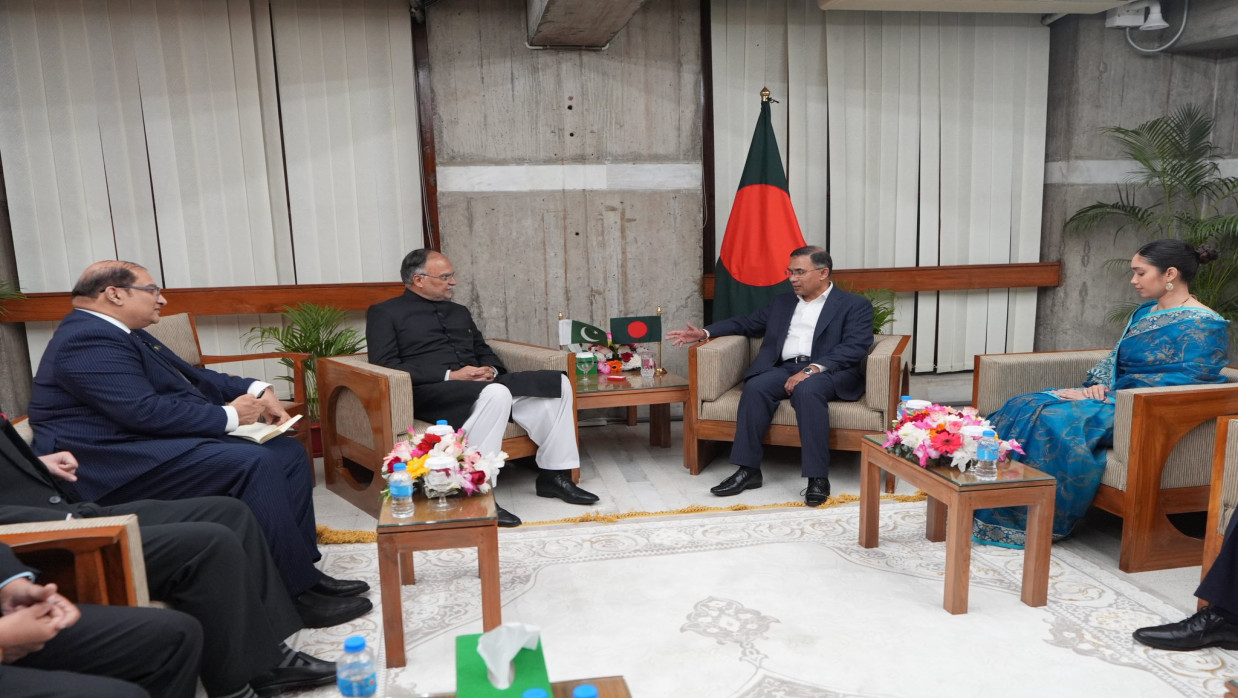
The fact that the invitation to a newly elected Prime Minister of Bangladesh, Tarique Rahman, was made by the Federal Minister of Planning of Pakistan, Ahsan Iqbal, is a significant and promising step in South Asian diplomacy. The gesture, which immediately followed the oath-taking ceremony of Rahman in Dhaka, is an indication of Pakistan willingness to engage more in the new leadership in Bangladesh and to enhance bilateral cooperation in a progressive and positive way.
The sweeping victory of Tarique Rahman in the February 12 elections is a clear cut political mandate. Rahman, being the leader of the Bangladesh Nationalist Party, BNP, and a long serving political leader with decades of experience, comes into office at a time when regional cooperation is becoming more critical in terms of economic stability and growth. The fact that Pakistan was present in the swearing-in ceremony by Ahsan Iqbal shows how Islamabad values its relationship with Dhaka. The federal minister, by delivering the congratulations of Prime Minister Shehbaz Sharif in person and inviting the official visit to Pakistan, emphasized the importance of high-level political dialogue that Pakistan attaches to it.
Leadership-level diplomatic activity usually preconditions the further collaboration. A visit to Pakistan by Prime Minister Rahman would give a chance to broaden the discussion on trade, investment, education, technology, and cultural exchange. It would also enable the two governments to find viable mechanisms to improve the economic connectivity and institutional cooperation.
In the process, the two leaders are said to have talked about how to improve bilateral relations and the cooperation in the region. Ahsan Iqbal noted the need to rejuvenate the South Asian Association for Regional Cooperation, SAARC, as a forum of facilitating connectivity and common development in the region. SAARC, which was created to promote economic and social development of the South Asian countries, has a great potential to be used. Through the new political will and coordination, the member states can use the forum to facilitate trade, connect infrastructure, and integrate the region.
Two of the most populous economies in South Asia, Pakistan and Bangladesh have a lot to benefit through increased coordination. The two nations have a growing consumer base, a rising industrial base, and a development agenda. More trade between the two countries would open up new prospects to exporters, investors and entrepreneurs. Improved connectivity, be it by sea, online, or business relationship, can lower the costs and market accessibility in both directions.
One of the most promising fields of collaboration is the digital economy. The technology sectors of both Pakistan and Bangladesh are booming at a very high rate due to the high energy levels among the youths. The skills development, entrepreneurship, and innovation that the two leaders have emphasized on can be attributed to the fact that they have a common realization that the future of economic growth is in the knowledge based industries. Through encouraging the partnership of tech companies, startups, and educational establishments, both nations will be able to speed up the digital revolution and generate high-value jobs.
One of the most prominent themes of the new narrative of bilateral engagement is youth empowerment. The population of Pakistan and Bangladesh is young and it is a great demographic strength of both countries. This demographic strength can be transformed into a sustainable economic momentum through investments in vocational training, higher education, digital literacy, and innovation ecosystems. The cooperation can be enhanced further through joint activities like student exchange, technology incubators and entrepreneurship forums which will help to enhance mutual understanding between younger generations.
Along with economic cooperation, the people-to-people contacts may be crucial in enhancing the ties. Familiarity and goodwill between the citizens of the two nations can be established through cultural exchanges, academic partnerships and tourism programs. Increasing educational scholarships and research partnership would not only increase knowledge sharing but also strengthen institutional connections over the long term.
The engagement is in a positive context due to the peaceful democratic transition in Bangladesh as Ahsan Iqbal has mentioned as a significant move towards democratic stability. Firm political grounds bring confidence to both investors and policymakers. The leadership has indicated a desire to focus on constructive diplomacy by reaffirming Pakistan commitment to develop a strong partnership founded on mutual respect and common interests.
At the regional level, more knowledge and collaboration between Pakistan and Bangladesh can make a positive contribution to the overall development of South Asia. Better coordination among the members of SAARC can lead to better cooperation in the field of climate resilience, disaster management, food security, and population health. These common problems need regional solutions and the bilateral relationship can be enhanced to become a basis of multilateral cooperation.
The invitation given to Prime Minister Tarique Rahman is not symbolic. It is a chance to map a new stage of interaction characterized by economic practicality, youth empowerment, and regional interconnection. Through mutual developmental ambitions and realistic cooperation, both governments can transform the goodwill in diplomacy into tangible development.
With South Asia facing the changing global economic landscape and the changing geopolitical dynamics, positive relations within the region are gaining more significance. The efforts of Pakistan to reach out to Bangladesh show that the country understands that long-term stability and prosperity are impossible without a long-term dialogue and cooperation. As long as the engagement on the high-level is maintained, and the intentions to develop each other are shared, Pakistan and Bangladesh can establish a sustainable and mutually advantageous relationship that will help them achieve their national development goals and contribute to the development of the region.

0 Comments
LEAVE A COMMENT
Your email address will not be published