

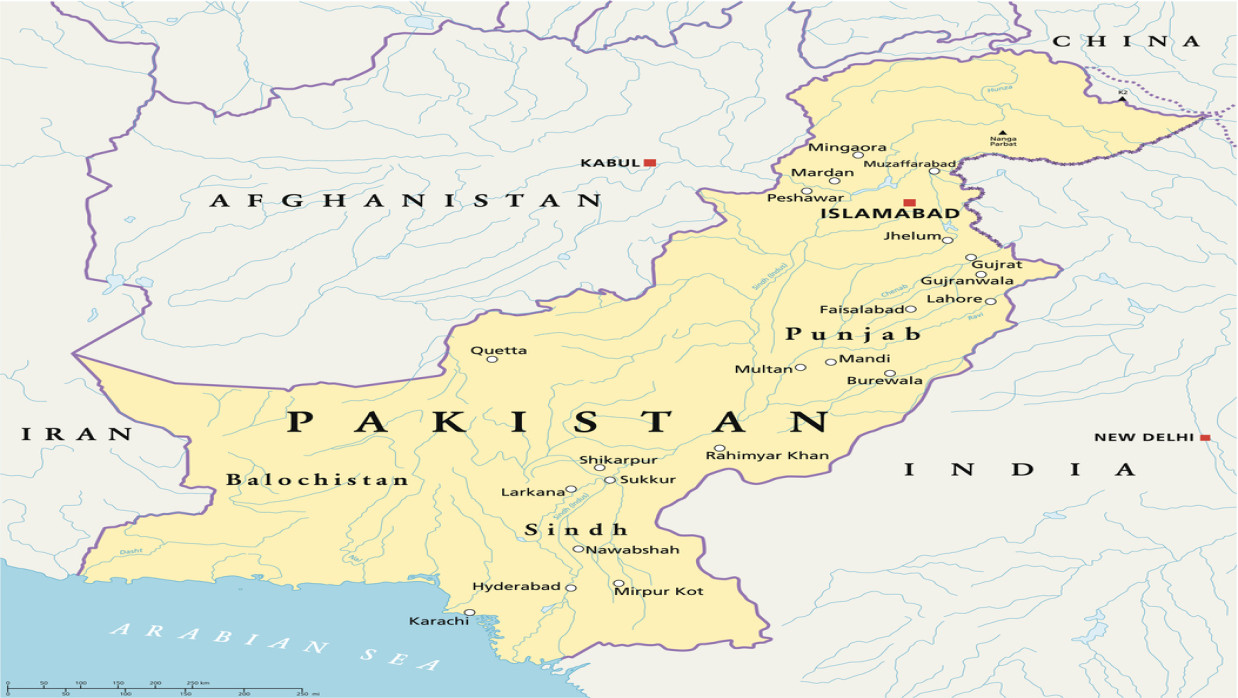
Baluchistan has been described in many ways: a periphery, far-flung and sparsely populated; a frontier, perpetually unsettled. But Baluchistan is also a crossroads. Where great empires collided and hardened borders, where geopolitics today casts the longest shadow. You’ll find similar complexity in its conflict. There’s a story of disputed accession, uneven development, identity politics, insurgency, and counterinsurgency; it’s one played out over and over by homegrown and outside actors alike, actors with the opportunity and, occasionally, the inclination to weaponize pain for political ends. But here’s one place to start viewing such conflicts with more even-handed lenses: Outside intervention can exacerbate turmoil, but locals rarely take up arms because someone else told them to.
History
Two opposing forces have shaped Baluchistan’s borders for well over a century. Local forces resisted incorporation, clinging jealously to tribal autonomy. Empires looked on, then pushed, hardening that patchwork political landscape with what would become modern borders.
Loosely known today as Baluchistan, much of what is today Pakistan’s largest province operated less like a centralized authority and more like a nebulous region of tribal territories, local confederations, and semiautonomous principalities. The British Raj formalized that notion through the Baluchistan Frontier: Baluchistan, which fell under the direct administration of British India, was known as “British Balochistan,” while several Baluch states existed as princely states with local monarchs.
The Khanate of Kalat was the largest and most prominent of these, but several others existed, including Las Bela, Kharan, and Makran.
Whether and how those boundaries were solidified during Partition would matter greatly in 1947; legal technicalities around accession gave nationalists several avenues for political discourse around their sovereignty. For the federal government in Islamabad, accession was synonymous with state-building. For many local nationalists, accession felt like the unilateral elimination of frontier autonomy, treated with little dignity, representation, or opportunity.
Development and Deployment: Dispelling the “Backward Province” Fallacy
Pakistan’s largest province by landmass has also consistently ranked among the least developed. Baluchistan’s moniker as “backward” consequently has a basis in reality; when used to describe Baluchistan’s institutions, accurate or otherwise, it’s both lazy and cruel.
The gap between resource extraction and service provision is gaping.
Baluch nationalists justifiably complain not only about poverty but also about economic extraction by outsiders who come for Baluchistan’s resources, gas, minerals, fisheries, roads, and leave behind nothing but bad governance.
With heavy security footprints, they point out, serving in governance tends to produce brittle systems: narrow politico tribal patronage networks rather than robust social safety nets; contractions and checkpoints rather than connectivity; informal brokers and coercion rather than citizen outreach. Outsiders aren’t required to accept this framing. Skeptics are free to disagree. But speak to enough Baluch, whether political leaders or everyday citizens, and you’ll hear that the true meaning of “underdeveloped” hinges on a question: Is Baluchistan a partner in the Pakistani federation, or a frontier that must be kept at arm’s length and under management?
The Future We Want to See: Baluchistan’s Geographic Potential, If It’s Shared
Far enough into the future, you could make an argument that Baluchistan’s development concerns won’t matter as much. Baluchistan will always have pull by geography alone: it’s a coastal province with prized port access at Gwadar and lies along major sea lanes. The China-Pakistan Economic Corridor and ancillary projects have also latched onto Belt and Road ambitions in Baluchistan. Pakistan and Iran share a border. Afghanistan lies to the northwest. There’s potential transit value to that. Minerals and gas provide long-term energy security if projects like Reko Digges ever come online.
That potential can only be realized if Baluchistan is stable, though. Megaprojects can become targets overnight if locals don’t feel included in economic opportunities. Militants can blow powerlines; protesters can vandalize infrastructure; countries can start retaliating in kind. When conflicts happen on foreign investments, local optics become the bottleneck. Investors must demonstrate credible benefit-sharing when they come to Baluchistan: good local jobs and transparent training pipelines, verifiable royalties and municipal shares, environmental protections, and public expenditure that people can see and aspire to be part of.
Checkmate and Escalation: India Factor in Baluchistan?
Pakistan has long accused India of involvement in Baluchistan by training, financing, arming, and providing a safe haven to militant groups. Most of these claims cannot be publicly verified either way. India vehemently denies them, but has used rhetorical openings to refer to Baluchistan unrelated to insurgency. Accusations come and go based on major militant attacks against the backdrop of larger India-Pakistan tensions over Kashmir.
Parsing can be done in three ways here. First is incentives. Baluchistan is Pakistan’s largest province by geography, and China’s window to the Indian Ocean. Insurgency undermines economic projects by raising costs and diverting Islamabad’s spending away from other priority areas. Proxy conflict hasn’t happened before in the region? That doesn’t mean the concept is outright dismissible. But third and most importantly: plausibility != proof. Pakistan has made allegations against India over the years that, to this day, have not been proven publicly.
Weaponizing foreign fighters and external financing is politically convenient. If Pakistanis are being killed by a faraway extremist group, that automatically lessens the pressure on Pakistani policymakers to improve how citizens are faring, instead shifting blame to India as the sole antagonist. India doesn’t have to support insurgency to needle Pakistan at every turn. Nor would staying quiet if violence were occurring really benefit New Delhi’s long-term interests. That said, plenty of actors are stirring the pot Pakistan would very much like to see emptied.
Baluchistan’s Hard Truths: State Versus Nonstate Violence
Baluchistan’s current is best understood by holding two hard truths at once.
The first concerns the government overreacting. Raiding villages. Intimidating political figures. But worst of all in Baluchistan: committing alleged enforced disappearances, and closing space for legitimate civil society work only further empowers extremist recruiters. Terrorism doesn’t end by giving terrorists what they want. Terrorism that’s done right isolates violent extremists. Counterterrorism that flouts the rule of law ensures you’ll have tomorrow’s insurgents.
The second concerns nonstate violence. Organizations like the Baluchistan Liberation Army have committed violence against civilians and civilian infrastructure. Any attempt to excuse such attacks is excuse-making: exploiting grief for political capital, exploiting complex politics for simplistic division, and exploiting human suffering for more violence. Violence incites fear, which incites public demand for a heavier security state. It won’t be long until the entire province is trapped by escalatory logic, where neither side can credibly offer peace.
The cycle of extremism isn’t Baluchistan’s only identity, nor is it fated to be. When women pick up guns. When doctors join militant ranks. When activists are met with pressure rather than outreach, it’s a sign to everyone who cares about Baluchistan that we’ve started to accept defeatist thinking: that we don’t believe people in Baluchistan deserve their safety and the right to have their rights upheld through politics.
Baluch identity crosses international borders
Pakistan, Iran, and Afghanistan have long traded accusations at one another about militants finding sanctuary on their respective sides of the border. Baluch identity does not adhere to these borders. There are ethnic Baluch living in southeastern Iran, mostly concentrated in the Sistan and Baluchestan province. Afghanistan hosts Baluch ethnic kin as well. This reality affords strong cultural and linguistic ties between Eastern Iran, Southern Afghanistan, and Pakistan’s Baluch population. But it also creates security headaches: militants, drug traffickers, you name it, along the Baluchistan border often care about topography far more than they do political demarcations.
The accusations Pakistan lodges against Iran and Afghanistan look a lot uglier when one looks east. Border communities don’t get to pick which side of the line they fall on. For them, cross-border Baluch identity creates not just opportunities for cultural exchange, but incentives for who they identify as. When governments weaponize a locality, it becomes a liability for the people who live there.
Political outreach won’t be credible unless it’s coupled with real demonstrations of civilian control. The federal government's insistence that Baluch nationalist parties, activists, and journalists are simply extensions of foreign influence forecloses the possibility of political dialogue before it can begin. Pakistan Armed Forces will always have a role to play in keeping Baluchistan safe. But using oppressive force to “solve” a problem only ensures you’ve created many more problems than you started with.
Islamabad and Tehran need strong frameworks for conflict-sensitive development if they ever hope to disarm the appeal of chaos. Enforcement should also be tied to any development initiative: public disclosure of contracts, credible and enforceable benefit-sharing, environmental oversight, job programs that clearly link training to local hires, and so on. Conflict-driven patronage networks in both Iran and Pakistan also require governance reforms that undermine their perverse incentives to keep battling on Baluch soil.
Finally, foreign actors should stop weaponizing Baluchistan. Pakistan can and should address foreign interference through intelligence sharing and evidence-driven diplomacy. But meta-narratives that place all the blame on outside actors solve nothing. Advocating for Baluch human rights isn’t disingenuous if India can afford to do it sincerely. But uttering “human rights” while simultaneously signaling public support for violence against the Pakistani state only undermines conversations about reform before they can begin. Regularized coordination channels between Iran and Pakistan are needed to de-escalate border tensions and begin building trust on otherwise contentious security issues.
Baluchistan will never truly progress if its people fear their government. Pakistan faces a classic challenge in countering insurgencies: extending the state’s credibility where only violent spoilers may have grassroots support. But Pakistan and Iran also bear a joint responsibility not to abuse the people they claim to be protecting. If we ever want a stable, prosperous Baluchistan, that journey must begin with respect for political expression.


0 Comments
LEAVE A COMMENT
Your email address will not be published