

Pakistan’s defense sector is quietly emerging as an unlikely but potent driver of economic revival. A new KTrade Macro Research report estimating a $13 billion defense export pipeline suggests that military production—long viewed primarily through a security lens—may soon play a central role in strengthening Pakistan’s external accounts, accelerating investment, and catalyzing technological development. If managed prudently, defense exports could become a strategic pillar of economic stability rather than a peripheral byproduct of geopolitics.
The timing is significant. In the aftermath of Bunyan-e-Marsoos, Pakistan’s diplomatic and strategic profile has seen a noticeable lift, translating into renewed defense engagements and negotiations. According to the report, these engagements are already materializing into concrete defense deals and long-term agreements. Unlike ad hoc arms sales of the past, the current pipeline reflects structured, state-to-state cooperation anchored in credibility earned through operational performance and sustained indigenous capacity.
The economic implications are substantial. A $13 billion export pipeline could result in an 82 percent jump in foreign exchange reserves, a critical buffer for a country historically vulnerable to balance-of-payments shocks. More importantly, it could significantly advance Pakistan’s ambition to reach $60 billion in exports by 2029 under the Uraan Pakistan framework. In an economy where export diversification has long been elusive, defense manufacturing offers a rare combination of high value, relatively inelastic demand, and strong state backing.
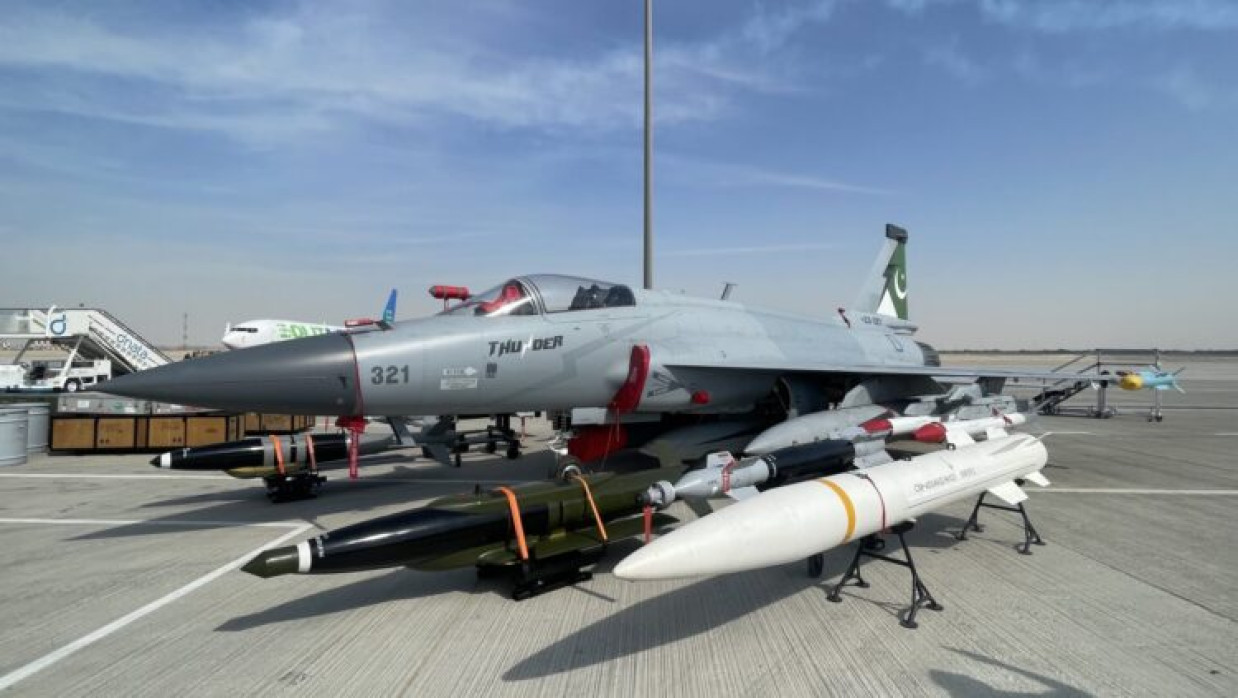
What distinguishes this moment from earlier attempts at leveraging defense production is the breadth of Pakistan’s portfolio. Defense exports are no longer confined to a single platform or category. From JF-17 Thunder fighter jets and Al-Khalid tanks to drones, armored vehicles, naval systems, and small arms, Pakistan now fields a multi-domain defense offering tailored to diverse operational environments. This diversity expands market reach and reduces dependence on any single buyer or system.
At the heart of this export push lies the JF-17 Thunder, a 4.5-generation multirole fighter jointly developed with China and produced domestically. Its performance in the May 2025 conflict with India dramatically elevated its international profile, converting years of incremental marketing into tangible interest. Countries across Asia, Africa, and Latin America—including Iran, Sri Lanka, Zimbabwe, Algeria, Ethiopia, Argentina, and Uzbekistan—have either expressed interest or engaged in exploratory talks. The aircraft’s appeal lies in its cost-effectiveness, adaptability, and ease of maintenance—attributes particularly attractive to air forces operating under budget constraints.
Institutionally, Pakistan is well-positioned to capitalize on this momentum. Organizations such as Pakistan Aeronautical Complex (PAC Kamra), Heavy Industries Taxila (HIT), Pakistan Ordnance Factories (POF Wah), and Karachi Shipyard & Engineering Works (KSEW) form an integrated defense-industrial ecosystem with decades of experience. Export-led growth would not only enhance their utilization rates but also incentivize modernization, quality upgrades, and supply-chain localization.
The spillover effects could be transformative. Defense exports rarely operate in isolation; they pull along a web of supporting industries—component suppliers, avionics manufacturers, software developers, precision engineering firms, and training services. This industrial clustering creates skilled employment, boosts manufacturing depth, and nurtures technical expertise that can migrate into civilian sectors. As the KTrade report notes, a strong defense-tech base can have a positive multiplier effect on the broader technology sector, particularly in electronics, materials science, AI-enabled systems, and aerospace engineering.
Geopolitically, global conditions are also favorable. Defense spending is rising worldwide amid protracted conflicts, strategic rivalries, and shifting threat perceptions. Many countries—especially in Africa and parts of the Middle East—seek reliable, affordable alternatives to Western defense suppliers, whose exports are often constrained by political conditionalities. Pakistan occupies a niche space: competitively priced systems, combat-tested platforms, and flexible partnership models that include training and maintenance.
Africa, in particular, presents a promising frontier. Interest from Libya and Sudan could open doors across conflict-affected regions such as Nigeria, Congo, and Rwanda, where demand for drones, armored vehicles, and surveillance systems is growing. These markets value functionality and reliability over prestige branding—an area where Pakistan’s offerings are well aligned.
Yet, this opportunity comes with caveats. Defense exports must be integrated into a coherent national industrial policy rather than treated as transactional windfalls. Transparency, compliance with international norms, after-sales support, and long-term client relationships will determine sustainability. Equally critical is ensuring that export success feeds domestic innovation rather than stagnating into assembly-line production.
Pakistan stands at an inflection point. The defense sector—once viewed as fiscally burdensome—is now positioned to contribute meaningfully to economic resilience, export growth, and technological advancement. If leveraged strategically, the $13 billion pipeline could mark the beginning of a structural shift: from crisis-driven economic management to capability-driven growth. The challenge is not whether Pakistan can sell weapons—but whether it can convert strategic credibility into lasting economic strength.


0 Comments
LEAVE A COMMENT
Your email address will not be published