

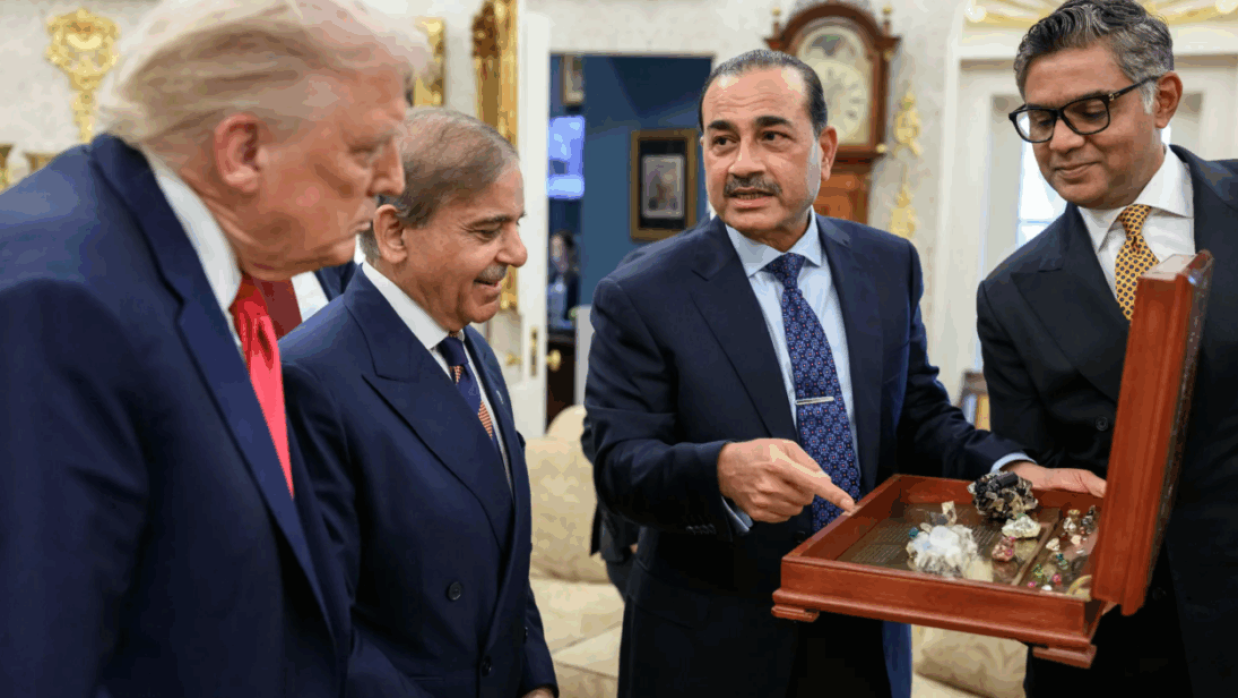
The return of Donald Trump to the White House in 2025 has effectively killed the era of "strategic patience," and replaced it with a form of cold, transactional pragmatism that feels more like a corporate merger than traditional diplomacy. For Pakistan, this change is neither a going back to the "war on terror" alliance nor a complete abandonment. Instead, it is the birth of a relationship characterized by "Resource Realism"[1] and "Geopolitical Hedging." To make sense of the contours of this second term, we will need to look beyond the erratic social media posts to focus on the structural drivers that now dictate Washington's moves: the obsession with critical supply chains, a cooling romance with New Delhi, and a ruthless focus on the American bottom line.
The key force behind the 2025 strategy of President Trump is the transformation of the US-China conflict into a containment strategy into a competitive decoupling. The United States is not as interested in the Indo-Pacific in the new era in terms of democratization but resource denial. This has given rise to what can be referred to as Resource Realism. Washington has come to perceive the geography of Pakistan in the perspective of the undeveloped critical mineral resources and its geo-economic buffer capacity. The reason is simple, in case the United States cannot fully draw Pakistan out of the China-Pakistan Economic Corridor (CPEC), it will instead strive to dilute Chinese influence[2] by bidding the most valuable parts of the Pakistani scenery. The September 2025 signing of the $500 million[3] framework with US Strategic Metals (USSM)[4] and the subsequent $1.25 billion Exim Bank financing for the Reko Diq project in Balochistan are not merely commercial deals. It is the first in decades that the table of the deal is not about counterterrorism aid but is about ensuring American access to the lithium and rare earth elements needed to rejuvenate US industry.
Right after this economic mercantilism comes a second powerful force, the cooling of the US-India strategic honeymoon.[5] Although the last ten years have been marked with an evident pro-India tilt, the 2025 Trump administration has brought a new era of de-hyphenation based on friction. The Indian tariff policy of aggression by Trump and his open attacks on the New Delhi trade protectionism have left a vacuum in strategy. Besides, the claim of President Trump to have been the architect of the May 2025 ceasefire after the four days kinetic combat between India and Pakistan has once again placed Pakistan at the center of the regional security calculus. The current administration considers third-party mediation as a brand-building asset. The Pakistani establishment has re-established some form of diplomatic access which was unimaginable before through the endorsement of Trump as the Nobel Peace Prize and the optics of a peacemaker that he desires. Trump is not making these diplomatic concessions to the region by offering to mediate disputes there or by softening some of the diplomatic pressures, out of a sudden affection with Islamabad. He is employing Pakistan as a strategic balance[6] to make sure that no single state in South Asia gets too comfortable or too independent of the American demands.
The third contour is the “Securitization of the Deal”. In the Trump 2.0 model, the previous model of a “War on Terror” has been supplanted with a new model called “Selective Stability.” The administration has realized that an entirely abandoning of Pakistan would prove to be too expensive, with the emergence of the ISIS-K and[7] the instability over spilling into Afghanistan. Nevertheless, the present strategy is constructed on a logic of “Service-for-Support,” in contrast to the period of the “Do More.” Bilateral relations have become organized as a high stakes flow chart: in case Pakistan offers an actionable intelligence and regional containment which safeguards American interests the US would offer aids to the IMF, World Bank and military hardware updates, including the $686 million F-16 modernization package. Washington has also come to the realization that it cannot fix the region hence it has opted to rent stability. This renders the relationship so fluid.
Nevertheless, the downside of this strategy is the fact that it is highly volatile. Due to the excessive impact of the personalist-style of Trump and his metrics of “America First,” the policy does not have an institutional floor. The bilateral involvement of 2025 is a wire walking act. In case of failure on the side of Pakistan on the resource front or when the security situation in Balochistan poses a threat to the American investments, it might be a timely and punitive withdrawal. The relationship outlines that are currently in place indicate that Washington is no longer asking what type of a country Pakistan is but asking what type of assets it has.
To sum up, the primary motivation of the 2025 policy of President Trump to Pakistan lies in the need to have won the economic race with China in the global arena and unwillingness to offer free security to the region. These drivers have made the bilateral engagement to be cold, result-oriented exchange of resources to be recognized. It is no longer a question of Islamabad wanting to show its allegiance to a western-led order, which is itself in transition. The challenge is navigating a Washington that views foreign policy as a zero-sum game, where the only currency that matters is the one that can be measured on a balance sheet. The future of US-Pakistan relations will not be decided by shared values, but by the precise intersection of American domestic economic needs and Pakistan’s ability to remain useful in an increasingly transactional world.

0 Comments
LEAVE A COMMENT
Your email address will not be published