

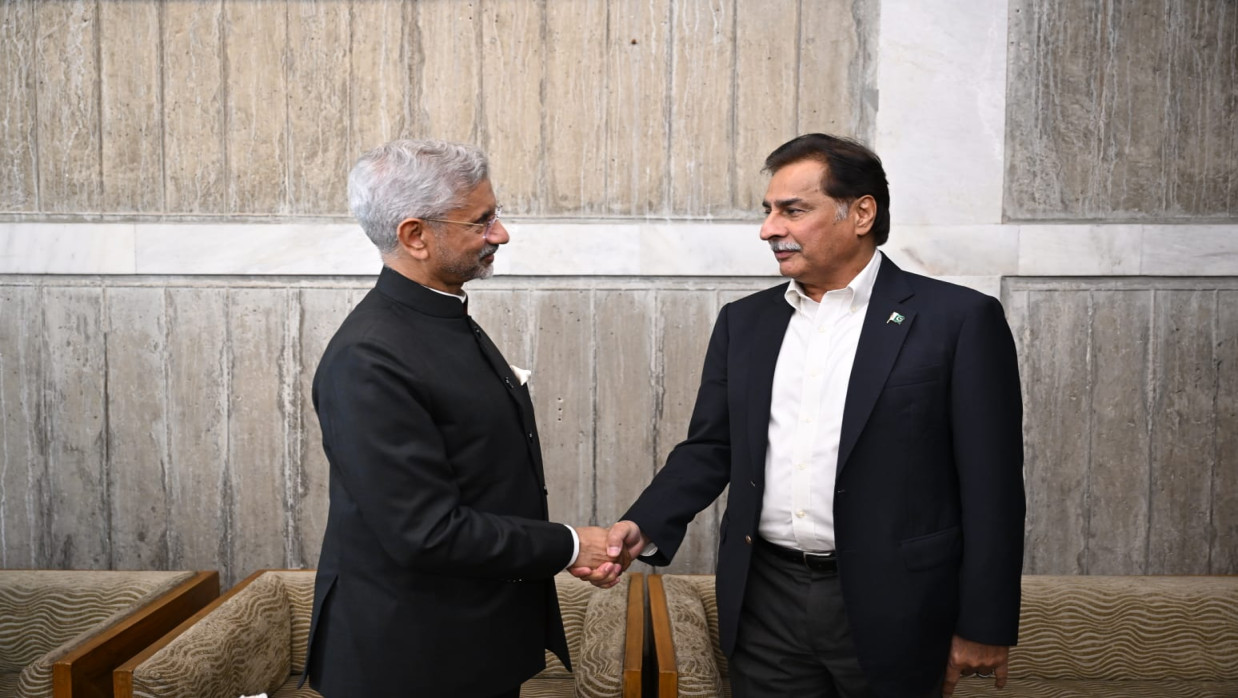
On December 31, 2025, a brief yet symbolically charged interaction in Dhaka quietly conveyed a powerful message about the enduring relevance of diplomacy in South Asia. India’s External Affairs Minister, Dr. S. Jaishankar, and Pakistan’s National Assembly Speaker, Sardar Ayaz Sadiq, met at the residence of the late former Bangladeshi Prime Minister Begum Khaleda Zia. Though short and informal, the encounter marked the first high-level exchange between India and Pakistan since the military escalations of May 2025—underscoring how statesmanship can persist even amid unresolved hostilities.
Begum Khaleda Zia’s passing brought together leaders and representatives from across South Asia and beyond. Delegations from India, Pakistan, Nepal, Sri Lanka, Bhutan, and the Maldives attended her funeral, reflecting her stature as one of the region’s most influential political figures. India was represented by Dr. Jaishankar, while Pakistan entrusted Sardar Ayaz Sadiq with conveying its condolences. What could have remained a purely ceremonial event instead evolved into a moment of understated but meaningful diplomacy.
The meeting itself was modest—limited to courteous greetings and polite exchanges—but its implications were far-reaching. In a region where symbolism often speaks louder than official statements, the sight of senior Indian and Pakistani representatives acknowledging one another with composure and respect carried weight. It illustrated a fundamental truth of diplomacy: that professional conduct and human decency need not be hostage to political disputes.
India and Pakistan’s relationship has long been shaped by wars, crises, and deep-seated mistrust. The military confrontation earlier in May 2025 once again highlighted how quickly tensions can escalate. Yet the Dhaka interaction demonstrated that diplomatic decorum does not require the prior resolution of disputes. Instead, it reaffirmed that channels of communication—however subtle—can remain open even during periods of heightened strain.
The symbolic value of this encounter lies in its restraint. Dr. Jaishankar’s composed demeanor and Sardar Ayaz Sadiq’s reciprocal courtesy set a quiet but important benchmark for bilateral conduct. In contrast to episodes in other arenas—particularly sports—where political tensions have spilled over into unnecessary acrimony, this exchange showed that state-level diplomacy can rise above performative hostility. Past incidents involving visible snubs and unsporting gestures on cricket fields stand in sharp contrast to the maturity displayed in Dhaka.
Beyond bilateral optics, the moment also reflected a broader principle of regional respect. Khaleda Zia’s legacy transcended Bangladesh’s domestic politics; her leadership resonated across South Asia. By engaging respectfully at her funeral, Indian and Pakistani representatives acknowledged a shared regional history and the importance of honoring democratic figures irrespective of political rivalries. Such gestures reinforce the idea that respect for institutions and leaders can serve as neutral ground for engagement.
From a strategic perspective, even limited interactions convey signals. This meeting suggested that leadership maturity is measured not only by policy positions but also by conduct under pressure. Diplomacy does not begin at the negotiating table alone; it is practiced through everyday gestures that reduce mistrust and prevent miscalculation. Small acts of civility can function as confidence-building measures, lowering the risk of misunderstanding in volatile environments.
Crucially, the Dhaka encounter offers a lesson for the future of India–Pakistan relations. Professional, courteous engagement—even when substantive disagreements persist—creates space for dialogue on issues ranging from security to trade and people-to-people contact. When senior leaders model restraint, it encourages similar behavior at lower diplomatic and institutional levels, gradually normalizing communication over confrontation.
The contrast with sports diplomacy is instructive. Sporting bodies and athletes have, at times, allowed political tensions to overshadow basic principles of sportsmanship. The Dhaka meeting sends a corrective message: if statesmen can maintain decorum amid conflict, there is little justification for symbolic hostility elsewhere. Courtesy, whether in diplomacy or sport, strengthens rather than weakens national standing.
Ultimately, the brief interaction between Dr. Jaishankar and Sardar Ayaz Sadiq serves as a reminder that diplomacy is as much about behavior as it is about policy. While no breakthrough emerged from Dhaka, the encounter reaffirmed that civility and mutual recognition remain possible even in the shadow of conflict. In a region often defined by discord, the lesson is clear. Respectful diplomacy sets a higher benchmark than confrontation. It proves that even the most entrenched rivalries can coexist with professionalism and restraint—an essential prerequisite for any lasting peace in South Asia.

0 Comments
LEAVE A COMMENT
Your email address will not be published