

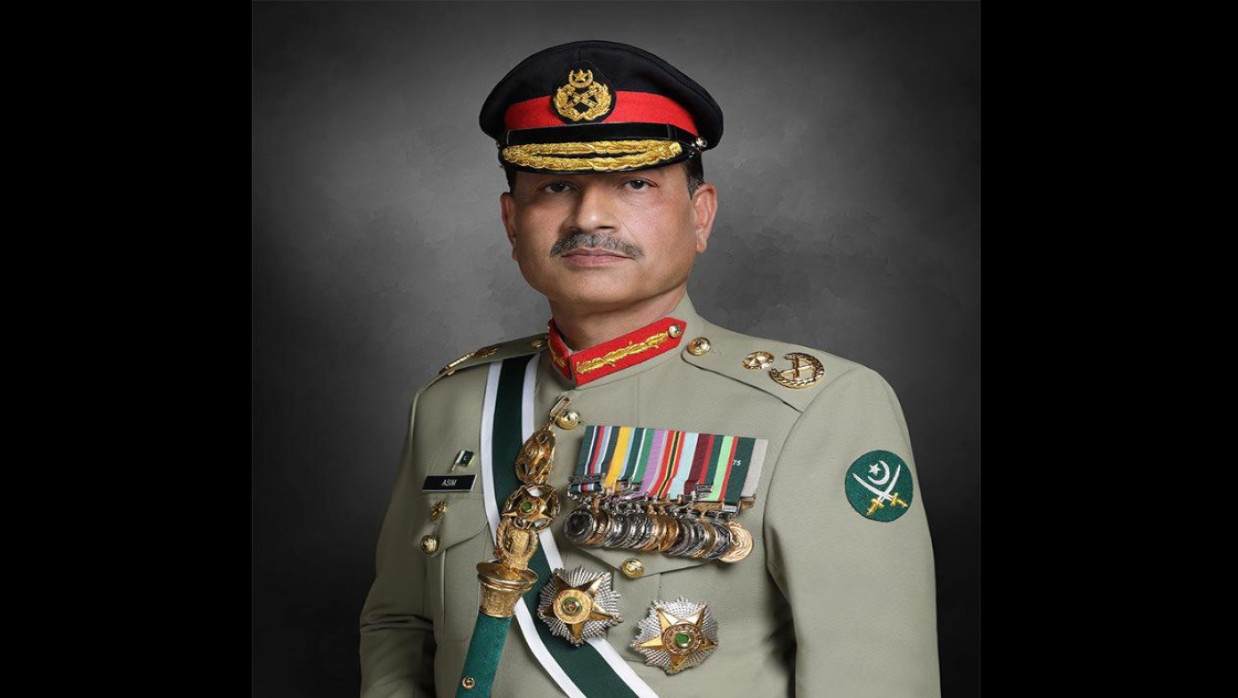
Quite contrary to the earlier phases of fragile democratic regimes and distinct periods of authoritarian rule under military dictatorships, Pakistan is currently witnessing growing fusion of military and civilian institutions under the direction and supervision of Field Marshal Syed Asim Munir. In fact, moving beyond the security issues, Munir is taking key political, economic and diplomatic decisions for Pakistan.
Reversal of Military’s Prominence
Since popular leader Imran Khan came to dominate Pakistan’s political scene as the Prime Minister in 2018, the clout of the military to influence civilian administration in the aspects of key decision-making process began to dwindle.
Even while Khan was kept outside the corridors of power from 2022, his popularity prevented Shehbaz Sharif’s Pakistan Muslim League-Nawaz (PMLN) party and any other mainstream parties from forming the government with a clear majority as candidates loyal to Khan won majority of seats chipping away at the success of mainstream parties. The PMLN party forged alliance with several other parties including the main opposition party- Pakistan Peoples Party (PPP) to form the government under Sharif’s leadership. Since coming to power in March, 2024, Sharif has overly counted on the military to corner the political influence of Khan’s loyalists, to keep them divided and remove the possibility of Khan's returning to the corridors of power.
Pakistan’s military gained prominence and popularity following the military confrontation with India in this year Summer. A narrative of military’s success against India informed the Pakistani people and shaped their perception in a positive light. It helped restore the military’s prominence in political affairs reversing its visible decline under Khan.
Apart from selling the success stories of Pakistan's befitting retaliation to Indian offensives under the rubric of ‘Operations Sindoor’, Asim Munir could please President Trump by asserting the latter's instrumentality in defusing the conflict between India and Pakistan although India refused to admit Trump’s mediation in persuading it to halt its offensives. This apart, Pakistan was among a few countries to nominate President Trump for Nobel Peace Prize, 2025.
Consequently, Munir was invited to the Oval Office on June 18 this year for a lunch hosted by President Trump closely following the conflict with India. Amid its tariffs spree, the Trump administration cut lucrative investment deals with Pakistan and imposed a moderate level of tariffs (19 percent) on Pakistan compared to India primarily because of cosy relations that Munir could cultivate with President Trump. By the end of September, Munir was again invited to White House along with Prime Minister Sharif. President Trump said: “In fact, we have a great leader coming, the Prime Minister of Pakistan coming, and the field marshal [of] Pakistan. Field marshal is a very great guy and so is the Prime Minister, both. And they’re coming”.
A Break With Past
Usually, whenever the elected government has been in place, the people’s representatives formulate foreign policy, cut the trade and investment deals and forge deals for infrastructure development in the public domain even while the backdoor influence of military has been a recurring phenomenon in Pakistan. However, politics within Pakistan is changing as the civilian and military functions are getting fused and many functions of the civilian administration have been taken over by the military in public view since the bonhomie between Trump and Munir has grown in the background of Indo-Pak conflict in this year Summer. Previously, when democracy prevailed, only elected heads of Pakistan for instance, Prime Minister Nawaz Sharif in 2015 and Imran Khan in 2019 visited White House in official capacity while the military leaders played a second fiddle or a supportive role. This time around, it was Munir alone in June and then both Shahbaz Sharif and Munir in September made visits with equal capacity.
Pakistan’s upward spiral in relationship with the US under Munir and his popularity following the conflict with India made him Pakistan's field marshal- the commander of three defence forces. Through a constitutional amendment, Munir was promoted from the position of Army Chief General to Field Marshal being the second officer in Pakistan’s history to hold the rank.
The constitutional amendment has bestowed upon Munir lifetime legal immunity, coupled with a renewed mandate to serve as the country's leader for another five years. This unprecedented consolidation of power is a testament to Munir's unwavering influence. Munir has been instrumental in securing vital IMF loans for Pakistan, enticing Chinese investors to pour their resources into the country's burgeoning economy and forging stronger bonds with the Gulf Countries. Munir has become the driving force behind the country's quest for economic resurgence and regional prominence.
Munir has emerged as the key decision-maker in Pakistan's burgeoning economic diplomacy, spearheading pivotal trade and investment negotiations with the US. His strategic acumen and leadership yielded a landmark agreement, wherein Pakistan will supply the US with critical minerals and rare earth elements, prized resources that hold the key to the future of technology and innovation. This growing partnership between the US and Pakistan under Munir's watch has already attracted a significant investment of $500 million from a US firm, keen to tap into Pakistan's rich mineral reserves.
Munir was also instrumental to President Trump's commitment in July this year to collaborate with Pakistan in unlocking its vast oil reserves driving the country from its crisis-ridden state to economic resurgence. As the linchpin of the Special Investment Facilitation Council (SIFC) through which investments in energy, minerals and infrastructure are being routed and finalized, Munir has bridged the gap between civilian administrators and military personnel. As a key member of its Apex Committee, his influence extends far beyond, for he is the de facto leader of this supreme decision-making body who is steering the country's economic destiny in the public domain and in full public view.


0 Comments
LEAVE A COMMENT
Your email address will not be published