

As global power dynamics continue to shift, Che Guevara’s 1964 address to the UN General Assembly retains striking relevance. In that speech, he denounced U.S. imperialism—exposing economic coercion, political interference and military aggression across Latin America, Africa and Asia, along with support for dictatorships and the suppression of liberation movements. His call for dignity and sovereignty in the Global South echoes sharply today as nations confront new forms of domination, especially in the struggle for climate justice.
The crisis is no longer only about rising temperatures. It is about eroded trust. For much of the Global South, the deepest wound is not climate change itself but the long memory of exploitation under Northern imperialism. The sense of betrayal, especially over finance, adaptation and diplomacy, shapes today’s negotiations as much as science.
Nowhere is this historical injustice more evident than in the lived experience of Pakistan. As the world edges toward 2.5°C of warming, Pakistan stands on the frontlines of a crisis it did not create. The science is unambiguous: climate change is accelerating, extreme weather is intensifying, and the window to avoid catastrophic impacts is rapidly closing. But beyond these scientific realities lies a deeper political truth. Climate change today is a story of unequal power, of broken promises, and of a global economic order that continues to privilege the interests of the North while exporting risk to the South.
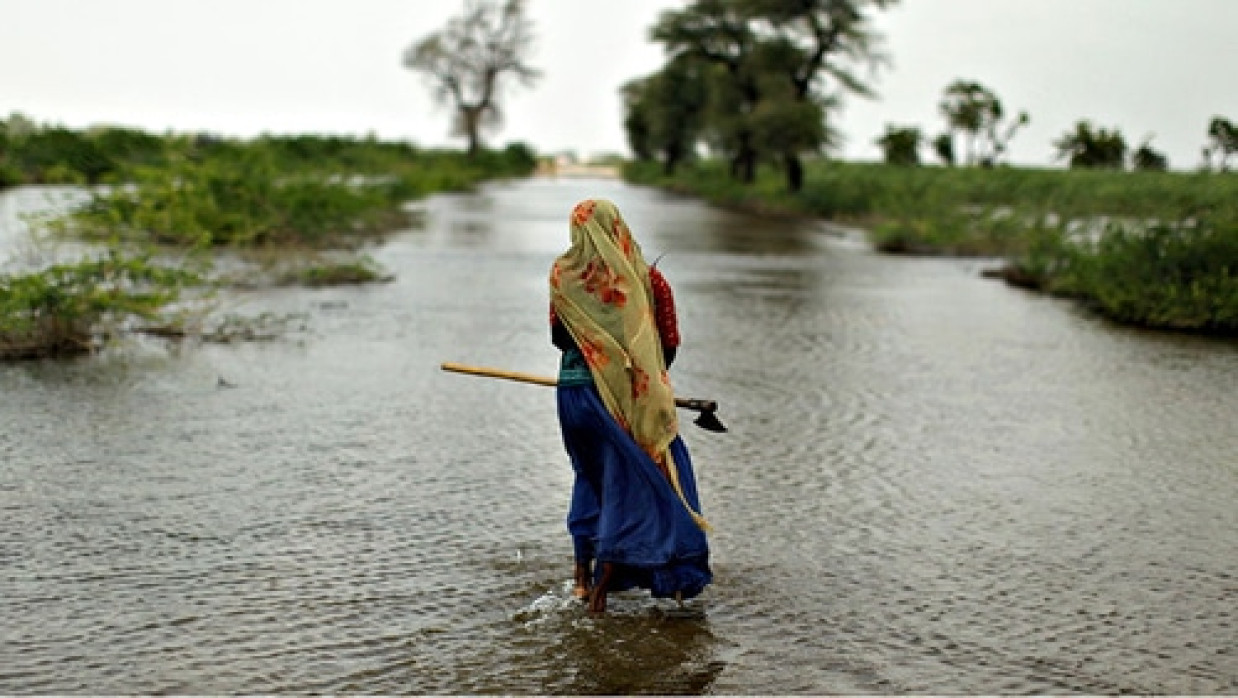
For Pakistan, this imbalance is not theoretical. It is the difference between life and death, between development and collapse, between the possibility of a stable future and the threat of perpetual crisis. The 2022 floods demonstrated this with brutal clarity. A single season of rainfall submerged one-third of the country, displaced millions, destroyed schools, hospitals, homes, and livelihoods, and exposed the profound fragility of Pakistan’s infrastructure and governance systems. Yet the country contributes less than one percent of global emissions. This mismatch between responsibility and vulnerability lies at the heart of Pakistan’s claim to climate justice.
Global climate diplomacy, shaped disproportionately by the political and economic power of wealthy states, has repeatedly failed to account for the specific vulnerabilities of countries like Pakistan. The absence of major powers from crucial climate negotiations, the slow pace of emission reductions, and the chronic failure to deliver on climate finance commitments have left much of the Global South in a perpetual state of uncertainty. Despite repeated announcements of “solidarity,” wealthy nations continue to prioritize their own energy security and geopolitical interests over global responsibility.
Pakistan’s dilemma is further complicated by its internal political economy. The country faces a unique intersection of heightened climate exposure, rapid demographic growth, fragile institutions, high inequality, and persistent governance challenges. Urbanization continues to proceed without adequate planning; informal settlements expand without infrastructure; and water, agriculture, and energy systems are stretched beyond capacity. These structural weaknesses magnify the effects of climate shocks. When a flood or heatwave strikes, it does not strike a level playing field—it tears through layers of social and economic marginalization that have taken decades to build.
The problem is not only that Pakistan is climate-vulnerable. It is that climate vulnerability is layered upon pre-existing injustices. Rural farmers in Sindh and Punjab face crop losses not simply because of rainfall patterns but because of land inequality, lack of credit, and absence of crop insurance. Urban laborers in Karachi do not suffer during heatwaves only due to rising temperatures but due to the lack of basic services, green spaces, and emergency systems. Coastal communities lose land not just to sea intrusion but to unchecked industrial expansion and ecological degradation. Climate change intensifies every existing inequality, turning development gaps into life-threatening vulnerabilities.
As the world becomes more unstable, Pakistan finds itself at the intersection of multiple geopolitical tensions. Global rivalries have narrowed diplomatic space for climate action. The United States’ fluctuating engagement, China’s mixed record on coal dependency, and Europe’s slow progress on energy transition reveal a world divided between rhetoric and action. Major powers continue to shape climate outcomes based on strategic considerations rather than shared responsibility. For Pakistan, this means that relying on external actors as the primary drivers of climate resilience is no longer tenable.
The failure of the global system to protect climate-vulnerable nations forces Pakistan to confront the uncomfortable but necessary reality that it must strengthen domestic resilience even as it continues to demand global justice. International support may arrive, but it cannot be the foundation of national survival. Pakistan must develop a self-reliant, justice-oriented climate strategy rooted in democratic participation, institutional reform, and community empowerment.
At the core of this transformation lies the question of governance. Local governments in Pakistan remain severely constrained. Municipalities lack fiscal autonomy, suffer from overlapping mandates, and operate under systems that centralize authority in provincial and federal bureaucracies. In Punjab, the absence of elected local councils has created a democratic vacuum in which early warning systems, land-use planning, and disaster preparedness remain fragmented. Sindh, KP, and Baluchistan face similar challenges, with marginalized communities bearing the heaviest burden.
Strengthening local governance is not simply an administrative reform—it is a justice imperative. Effective adaptation requires decision-making power to reside where impacts are felt. Communities must have the authority and resources to build embankments, manage evacuation shelters, regulate local development, and monitor environmental risks. The constitutional promise of Article 140A, which mandates elected local governments, remains largely unfulfilled. Its implementation, coupled with meaningful fiscal decentralization, is essential for building climate-ready institutions. Without empowered local structures, even the best national climate policies will remain disconnected from the realities of those they aim to serve.
Pakistan’s climate challenge is also deeply tied to political economy. Strategic competition in the region influences domestic policy in ways that often undermine climate priorities. The example of Baluchistan’s mineral wealth is illustrative. While resource extraction is frequently framed as a development opportunity, it rarely benefits local communities, who continue to face water scarcity, displacement, and ecological degradation. Development, when driven by external interests or elite negotiation, fails to produce genuine resilience. Climate-affected communities must not be treated as passive recipients of external solutions but as central agents of change.
A justice-centered climate strategy for Pakistan requires a fundamental shift in national priorities. It demands long-term investment in water security, sustainable agriculture, decentralized renewable energy, reforestation, and climate-resilient infrastructure. It requires rethinking how cities are planned, how land is governed, and how communities participate in decision-making. It also necessitates recognizing the role of women, youth, minorities, and Indigenous groups as frontline leaders rather than peripheral stakeholders. Climate adaptation cannot succeed without confronting social inequality, gender disparities, and structural exclusion.
Equally important is the need for Pakistan to articulate a clear and principled position in global climate negotiations—one that aligns with broader Global South demands for accountability, fair finance, and technology access. Pakistan must advocate for predictable, adequate, and just climate finance; for transparent mechanisms to deliver the Loss and Damage Fund; and for the phasing out of global fossil fuel expansion. At the same time, the country must develop its own roadmap for transitioning away from high-carbon development pathways that are both economically unviable and environmentally destructive.
True climate justice for Pakistan lies in the recognition that environmental sustainability is inseparable from social justice, democratic participation, and economic transformation. Climate politics cannot be separated from questions of labor rights, land ownership, access to water, and the right to dignified living conditions. Nor can adaptation be siloed from broader struggles for equity and autonomy. Pakistan must reject short-term, elite-driven approaches and instead build a long-term national climate vision anchored in people’s needs and rights.
Pakistan stands at a defining crossroads. It can continue down a path shaped by global inequities and domestic fragmentation, or it can chart a bold, sovereign path toward climate justice—one that is rooted in resilience, equity, and democratic renewal. The stakes could not be higher. The most vulnerable citizens of Pakistan can no longer bear the consequences of a crisis created elsewhere. The world may continue to delay, but Pakistan cannot afford to wait.
The future demands decisive leadership, grounded in justice and guided by the principle that climate resilience is not merely an environmental goal but a profoundly human one. Pakistan’s people deserve nothing less.


0 Comments
LEAVE A COMMENT
Your email address will not be published