

When Nepal goes for national polls on Thursday, political observers across the Asian region are looking for Pushpa Kamal Dahal (popularly known as Prachanda), who led a decade long anti-monarchy Maoist movement in the Hindu majority Himalayan nation that dethroned the last king Gyanendra Bir Bikram Shah Dev in 2006. Within the next two years, the poverty-stricken country of over 30 million people abolished the 240 years old monarchy to emerge as a multi-party federal democratic republic and Prachanda became the prime minister in 2008. The septuagenarian leader now leads an alliance of several leftist groups under the banner of Nepali Communist Party. Engaging other prominent Marxist leaders like Madhav Kumar Nepal, Prachanda now hopes for reviving his popularity and influence in the country. The Maoists promised many things, but in reality, the people of Nepal only witnessed high level corruption in public life inspired by the new found political system. Moreover, frequent changes of governments in Kathmandu as 14 premature reshuffles among political leaders were recorded within two decades depressed the common Nepali nationals.
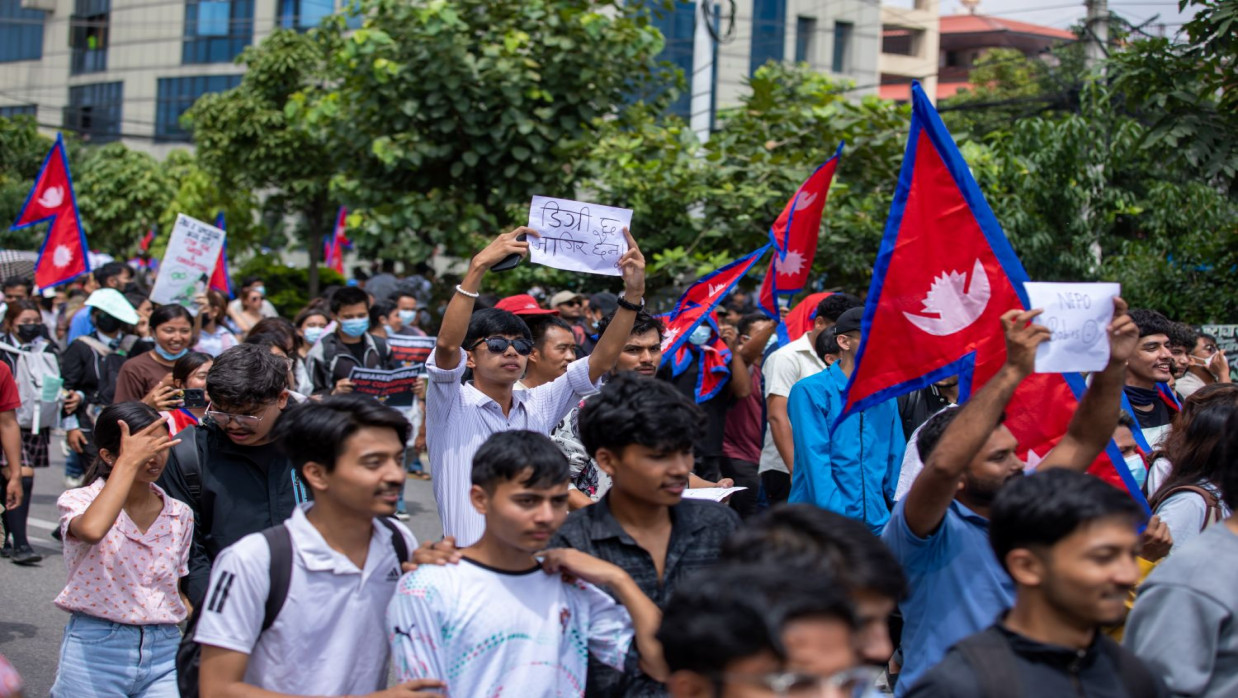
When former premier KP Sharma Oli (leading the Communist Party of Nepal–Unified Marxist Leninist), young politician Balendra Shah (representing Rashtriya Swatantra Party) and Gagan Thapa (of Nepali Congress) are vying for the coveted post of Nepal government chief, a section of hardcore Hindu nationalists demands the restoration of monarchy even as a ceremonial head of Nepal (in place of the President). At least one mainstream political outfit named Rastriya Prajatantra Party (National Democratic Party) has raised a voice for bringing back the constitutional monarchy and restoring Nepal’s political status of a Sanatani Hindu Rashtra. The right-wing RPP, which put a number of candidates across the country, used to organize public rallies supporting the last Nepal king, who now lives a private life in Kathmandu. Whenever he makes visits to rural areas, the pro-monarchists hit the streets waving national flags, placards and chanting slogans in favour of the septuagenarian royal scion.
Nepal interim premier Sushila Karki, the election authority and human rights commission have urged everyone to make the election free, fair and clean so that the voters can exercise their franchises in a peaceful ambience. The political parties and candidates are also being asked to comply with election codes of conduct helping the people to elect their representatives without any misled versions. The engagement of minors in election campaigns or any form of electoral promotions is strictly prohibited, arguing that these actions violate both the election code of conduct and child protection laws. Regarding the process of vote/ballot counting, the election authority assured that the outcome will be declared as early as possible. Once the 7 am to 5 pm polling concludes on 5 March, the ballot boxes will be immediately shifted to Kathmandu and the result for the direct voting system (for 165 seats) will be declared within 24 hours. The rest (under proportional representation for 110 seats) will be announced within two to three days.
Amid the electoral preparations on the final stage, the former Hindu monarch Gyanendra Shah made a stunning statement expressing his dissatisfaction with the country’s political situation and the behavior of existing political leadership. On the occasion of 74th National Democracy Day, the ousted king even questioned the necessity of elections in the present circumstances without resolving various burning national problems through broad national consensus. Ahead of Nepal Prajatantra Diwas, observed on 19 February to commemorate the end of 104 years old autocratic Rana regime in 1951, Shah viewed that if the election is pushed ignoring the widespread disagreement and protests, it will not find a lasting solution to the current political crisis in Nepal.
“In a democracy, it is appropriate for the state system and processes to function according to constitutional principles. While periodic elections to select representatives are a natural process in a democratic system, the current public sentiment is that it would be more appropriate to proceed toward the electoral process only after first solving the national problems,” said the former king, adding that in the present situation, a tendency to seek rights without considering duties has been flourishing. Only a system and structure suited to Nepal’s geography and the nature of its society can yield sustainable and positive results, asserted Shah. Paying tribute to Tribhuvan Nripati and all the martyrs for their sacrifice in harnessing democracy in the Himalayan republic, Shah finally called for a system that can safeguard the Nepali identity on the global stage.

0 Comments
LEAVE A COMMENT
Your email address will not be published