

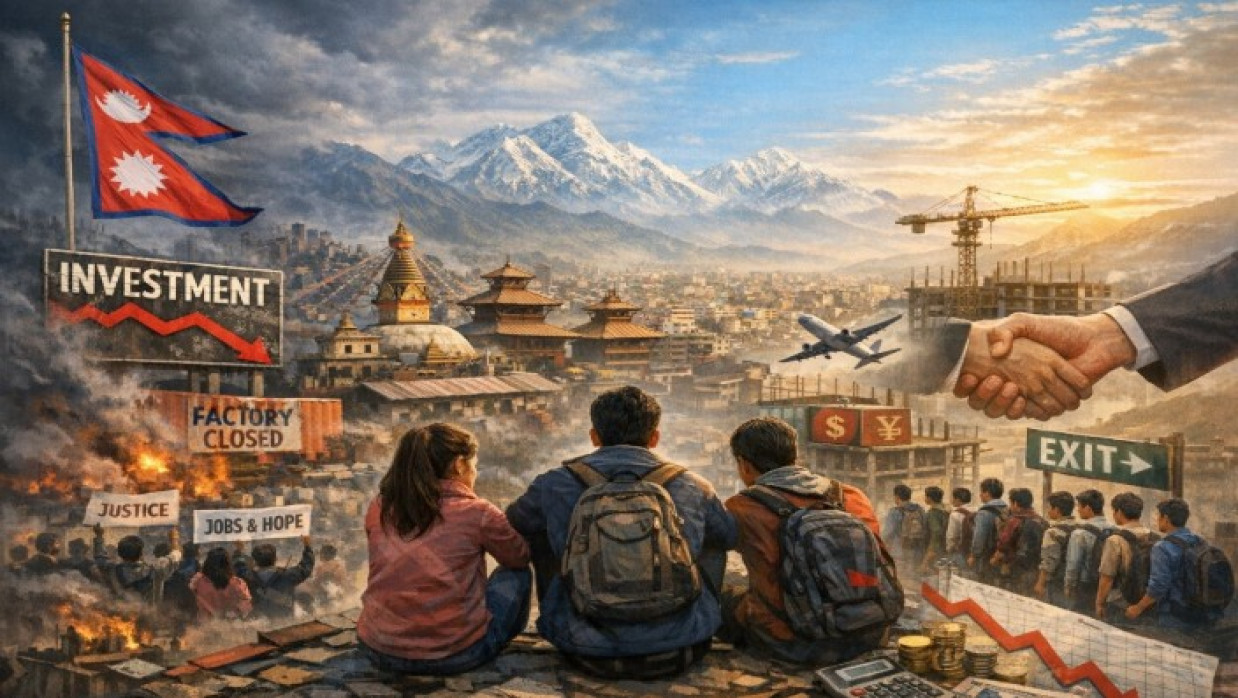
A Nation in Recovery After Youth Unrest
This is Nepal’s current political economy outlook in early 2026: It hasn’t fallen off the edge yet, but it isn’t steady either. Months of youth-led protests in September of 2025 revealed systemic failures in governance, employment, and social cohesion between the government and the governed. While Nepal avoided a macroeconomic meltdown during the unrest, the political tumult upended years of slow but steady growth. Nepal now sits at a tenuous political status quo of uneasy calm: wary investors, an anxious government, and an increasingly frustrated youth.
Nepal has mostly returned to normality three months on. Law and order have been restored. Macroeconomic growth hasn’t tanked (yet). However, the long-term impacts of September’s civil unrest are still playing out. Investor confidence is shaky, private-sector growth has stalled, and Nepal’s political machinery will be under pressure to implement reforms ahead of the March 2026 election. Nepal is stuck in limbo between stagnation and catastrophe.
Political Fragmentation and a Fractured Social Contract
Coalition governments, political horse-trading, and gridlock have been hallmarks of Nepal’s post-monarchy political structure. Protesters during last year’s 2025 youth protests made it clear that they were no longer willing to accept this status quo. Fed up with nepotism and corruption, demonstrators across Nepal voiced grievances about a lack of opportunities and jobs, as well as broader frustrations with politics disconnected from the will of everyday Nepalis.
The protests unsettled Nepal’s delicate political balancing act and led eventually to the establishment of an interim government that will shepherd the country through elections later this March 2026. So far, the caretaker government has been successful in terms of getting the machinery of government functioning again. However, it has done little to repair Nepal’s underlying structural malaise. Political parties are still deeply divided, and overall trust in Nepal’s political institutions remains very weak.
Can the current caretaker government enact policies that will convince young Nepalis that the system can provide tangible economic opportunities? The government formally employs less than 5 percent of Nepal’s workforce. Hundreds of thousands more Nepalis apply each year for jobs overseas as migrant laborers, flocking to Qatar, Singapore, South Korea, and elsewhere in search of work. Emigration has long been Nepal’s pressure-release valve. When jobs at home have been hard to find, Nepalis have been able to rely on employment opportunities abroad.
Last year’s youth protests show that Nepal can no longer take this safety valve for granted. The four-week protests constituted a political earthquake, revealing profound weaknesses in Nepal’s social compact among the government, business, and young people.
Nepal’s Macroeconomy Masks Low Confidence
Fortunately for Nepal, its recurring political crises have not yet translated into macroeconomic crises. Nepal’s externalities remain impressive. Thanks to high levels of remittance inflows, Nepal’s foreign exchange reserves are at record highs. Inflows from abroad have also helped keep a lid on inflation. Data from Nepal Rastra Bank (NRB) through January 2026 show Nepal’s foreign exchange reserves hovering around US$22.47 billion, equivalent to more than 18 months of imports. Inflation has also remained subdued, coming in at around 2.4 percent year-on-year.
Remittance flows, in particular, continue to drive Nepal’s economic stabilization. Over the first six months of Nepal’s current 2025-26 fiscal year, inflows increased by more than 30 percent in USD terms, reaching approximately US$7.5 billion. Strong remittance inflows have helped underpin household consumption while contributing to Nepal’s balance of payments and current account surpluses in recent years. Nepal’s balance of payments also recorded a comfortable surplus of nearly 5 percent of GDP.
By most measures, Nepal should have considerable latitude to absorb domestic shocks. But beneath this facade of macroeconomic strength lies a troubling reality: Nepal simply isn’t growing through productive channels. Consumption and remittance-led growth have insulated Nepal from macroeconomic shocks, but they’ve also left Nepal trapped in what analysts call “stability without confidence” – an economy with healthy macroeconomic buffers but anemic private-sector growth.
Weak Investment Signals Low Confidence
Perhaps the most obvious symptom of Nepal’s low-confidence economy is the bifurcation between liquidity and actual investment. Nepal’s banks and financial sector institutions have enjoyed years of deposit growth as a result of strong remittance flows into the country as well as rising rates of household savings. Those deposits, however, have not led to commensurate growth in private sector loans.
As of early 2026, Nepal’s private sector credit growth is running at a soft pace of just around 3.6 percent for the first half of FY 2025-26, while non-performing loans have ticked back up to above 5 percent. Nepal’s banks have liquidity but are unwilling to lend it to businesses and households due to high perceived credit risks and uncertainty about Nepal’s economic outlook. Businesses, in turn, don’t want to borrow or invest due to political uncertainty and concerns over the government’s willingness to guarantee policy continuity and uphold property rights.
In short, Nepal has developed a liquidity trap. Liquidity and low interest rates aren’t sparking demand for productive investment. Stimulative monetary policy isn’t having its usual effect because businesses don’t feel confident that the current government will respect contracts and property rights moving forward. Without confidence in the future, firms have little incentive to grow.
Surveys from Nepal’s Federation of Nepalese Chambers of Commerce and Industry have found that business confidence is at rock-bottom levels. Foreign direct investment (FDI) inflows have struggled to grow past 1 percent of GDP.
Confidence but Not Crises: Nepal Since the Protests
The fundamental issue underlying Nepal’s economic outlook is not liquidity, growth, or inflation; it is jobs. Hundreds of thousands of new entrants join Nepal’s labor force each year. Domestic economic activity has not generated enough employment opportunities to meet this demand, resulting in substantial labor migration to the Gulf countries, Malaysia, and other labor-receiving nations.
Migrant worker remittances support Nepal’s growth model of household consumption. However, they also contribute to a dynamic where young people believe they cannot succeed without migrating themselves. This belief reinforces reliance on remittance-driven consumption while discouraging participation in industries that struggle to attract labor because of Nepal’s institutional shortcomings.
If Nepal cannot provide productive avenues for its youth to earn income domestically, it will face recurring waves of youth-led agitation. The youth-led movement of 2025 tapped into young people’s frustrations about their inability to find good jobs in Nepal. Some young Nepalis even question the value of education if they cannot find employment after graduation. While economic growth has resumed since 2025, confidence in the future has not recovered. This could pose a threat to stability down the road.
Contextual Factors: Regional and Geopolitical Dynamics
Geopolitics also plays a significant role in Nepal’s outlook. Nepal lies between two giants: India and China. Nepal must balance its relationships with others while maintaining its autonomy. Nepal’s physical infrastructure development depends on connectivity with either or both of its giant neighbors. Ports, transit access, and trade privileges are all currently dominated by India. However, China has been steadily increasing its presence in Nepal, especially with the inception of the Belt and Road Initiative.
The upside of this relationship is that Nepal can and should leverage its unique position to attract investment from both countries. However, Nepal must also avoid becoming a pawn in the strategic competition between China and India.
Potential Policy Continuity and Electoral Uncertainty
One last structural headwind that will likely impact Nepal’s near-term to mid-term economic growth trajectory is that the nation will hold elections in March of 2026. Similar to many developing countries, elections in Nepal have historically been accompanied by government expenditures to cover logistical needs, election security forces, and even campaigning. These expenditures can lead to bumps in growth rates, as occurred in 2026.
However, while government consumption can provide a jolt to GDP, Nepal cannot go to elections every time it wishes to see improvement in its economic fortune. Most election-related expenditures in Nepal come from murky sources and lack clear accountability. Nepal’s challenge is not excessive government consumption; it’s insufficient investment.
These investments need to be productive, improving incentives for investment and job creation. Until political elites can make credible commitments to change, elections will just be another round of politics as usual.
The Key Issue: Confidence
At this stage, Nepal is not facing an immediate crisis. But that does not mean Nepal is out of the woods. Nepal’s biggest challenge is a lack of confidence. Without trust in the government and its policies, private citizens and businesses are unlikely to trust banks with their savings or make sizable investments. How Nepal tackles its challenge of youth unemployment will determine whether Nepalis grow their confidence in the state or continue to lose it.
Policy-wise, ensuring that citizens' investments and properties are safe is crucial. Protecting property rights and enforcing contracts should be top priorities for Nepal if it hopes to increase investor confidence. Additional reforms that could help build confidence include improving the investment approval process and addressing issues within Nepal’s financial sector. Nepal’s banks face high levels of nonperforming loans, and cleaning up these legacy loans would help restore confidence in the financial sector.
Youth unemployment is crucial to tackling confidence. Linking Nepal’s long-term industrial plans with vocational training, accelerating growth in labor-intensive export industries, and supporting entrepreneurship would help Nepal reach its demographic dividend. As long as Nepal cannot provide jobs for its youth, disgruntled youth will look for ways to express their frustration with the system.
Will Nepal drift towards Stability or Stagnation?
At this point, Nepal has avoided all crisis scenarios. In fact, Nepal’s economic growth is back on track. Foreign Exchange reserves are at an all-time high, and remittances keep consumption going. Nepal may not face a crisis in the short run, but continuing down a path of Stability without Confidence is unsustainable. Nepal’s window to restore trust with its citizens is open. If Nepal can use that time effectively, it can maintain stability in the long run. If not, Nepal may face stagnation or instability in the coming years.

0 Comments
LEAVE A COMMENT
Your email address will not be published