

Sohel Sarkar
IN 2020, at the height of the Covid-19 pandemic, a 17-kilometre bicycle lane was laid along Bengaluru’s Outer Ring Road to serve commuters in the city’s IT corridor. Within two years, the plastic bollards demarcating the track were removed, and by 2023 much of the lane had been dug up to make way for a new metro line. Only a fading “Cycles Only” signboard marked its brief existence. Meanwhile, the Bengaluru Metro, the expansion of which consumed the cycling track, has become India’s most expensive mass transit system, pricing out low-income communities even as it claims to ease congestion. Two decades of unfinished construction have left rubble, felled trees, fractured public spaces and recurring protests in their wake.
Cycling tracks and metro lines are not just transport solutions but sites of urban politics, offering vantage points from which to examine how cities are produced, contested and lived. Four recent works on Mumbai, Delhi, Lahore and neo-urban India illustrate this through different modes of mobility and spatial experience. Taken together, they ask what mobility as practice, infrastructure and embodied experience reveals about the making of Southasian cities today. How does walking in gated enclaves, cycling through busy heterogeneous streets, or riding the Delhi or Lahore Metro expose who belongs, who is excluded, and how gender and class shape the ways people inhabit the city amid shifting infrastructures of movement?
These works use mobility as a lens for urban critique, focusing less on transport policy than on how infrastructures and movement reshape material and social life in post-liberalisation cities. They show that mobility infrastructures reflect and reproduce gender and class inequalities while also opening spaces of negotiation, aspiration and belonging. Across these accounts, infrastructure projects appear not so much as solutions to existing needs but as aspirational symbols of “world-class” modernity, highlighting how everyday life, desire and inequality intersect in the Southasian city.
JONATHAN SHAPIRO ANJARIA’S Mumbai on Two Wheels: Cycling, Urban Space, and Sustainable Mobility opens with a simple provocation: if you want safer, more widespread cycling in Indian cities, stop assuming that bicycle lanes are the universal fix. While the disappearance of Bengaluru’s 17-kilometre cycling track spurred campaigns for more segregated lanes, Anjaria shows why that default solution misrecognises how movement actually unfolds on Indian streets. In Mumbai, traffic is heterogeneous, streets are mixed-use and the street edge is a dense zone of overlapping claims. Segregated lanes modelled on Amsterdam or Copenhagen rarely work in this context. What matters more are the “microinfrastructures” and tacit grammar of everyday mobility. This includes the composition of traffic, the unspoken rules through which people negotiate space and speed, and norms governing the use of the curb.
To underscore the case for context-specific mobility planning, Anjaria outlines Mumbai’s USD 40-million Green Wheels along Blue Lines, as well as short-lived bicycle lanes in Bandra Kurla Complex (BKC) and Carter Road as three emblematic projects. Each failed in predictable ways, with bollards pried out or crushed, lanes filled with parked cars, and routes disconnected from neighbourhoods and the nearest local train station. Anjaria argues that these failures show that transportation planners and policymakers imagine bicycle lanes as islands, sealed off from the frictions and livelihoods that make the city streets function. They are symbolic of “world-class” modernity, more about aspiration than usability.
Such aspirational visions, however, rarely account for the realities of those who cycle, and Anjaria’s ethnography restores those experiences to view. His counter-proposal is simple: follow the cyclists. He rides hundreds of kilometres with food delivery workers, dabbawalas or workers who collect and deliver hot lunches, knife sharpeners, mechanics, cycling advocates, ride organisers and endurance riders. The lesson is consistent. Surface conditions like potholes, bumpy paver blocks, poorly aligned drainage grates and the raised seams between concrete and asphalt are more dangerous than so-called “chaotic traffic”. Fixing these microinfrastructures would improve safety far more than isolated, expensive tracks. Riders also describe Mumbai’s streets not as a battlefield of territorial lanes but as a negotiated field of adjustment. At traffic signals and during peak congestion, scooters and bicycles segregate to the left while cars, buses and trucks bunch to the right, creating a fluid “virtual lane” without physical dividers or road markings. This, Anjaria writes, is the “effect of road users adjusting to changing road conditions rather than claiming prior allocations of space.”
The principle of adjustment baked into Mumbai’s streets also explains why a hard-segregated lane can be exclusionary. In a mixed-use environment, carving out space for one group displaces others who informally occupy and use the street edge. That edge is central to the book’s analysis. In Mumbai, it is not a neutral margin but a dense zone of competing claims – a place to park and wash cars, walk, sell vegetables, push handcarts, eat, sleep or wait for a fare. These uses do more than “clutter” space; they compose it through friction, slowing drivers and forcing attentiveness. Harden the edge into a single-use corridor and you undercut the livelihoods of those who depend on its flexibility, particularly street vendors and autorickshaw drivers. What may appear as a safety amenity for cyclists can, if pursued as an isolated fix, threaten the poor. Even where bicycle lanes succeed for cyclists, their benefits accrue largely to recreational riders, who are middle or upper class. Without last-mile connectivity to trains, buses and dense neighbourhoods, such lanes bypass the majority who cycle for work.
Crucially, Anjaria resists a lazy sociology that casts working-class riders as “captive” and middle-class riders as “choice” users. Instead, his ethnography complicates both. For many utility riders, the cycle is both a tool of survival and a claim to autonomy, offering freedom from a boss’s monitoring, the ability to pause for tea or lunch, and the chance to build a client base by going door-to-door. He calls these “messy freedoms” that don’t necessarily yield neat political or practical outcomes but that matter nonetheless. For middle-class and upper-class riders, cycling can be a route out of the sanitised interiors of offices, gyms and malls into the smells, sounds and textures of the street. That reconnection is enabled by privilege, Anjaria concedes, but it is an encounter in its own right, often generating small acts of empathy. Watching utility cyclists push massive loads uphill can reset the recreational rider’s sense of effort and risk.

In these portraits, the freedoms of cycling are shaped just as much by gender as they are by class. Women riders describe cycling as exposure in every sense, to heat, rain, rough terrain and an unpredictable public – stares, unsolicited help, unwanted touch. Yet cycling is also a way for women to inhabit public space on their own terms, including the “chosen risks” that come with it. The activist Firoza Dadan – dubbed Mumbai’s first “Bicycle Mayor” – recalls how, as a teenager, a bicycle opened doors to income and autonomy. She could traverse the neighbourhood to tutor children even as her visibility on a cycle provoked censure. The point of Anjaria’s female interlocutors is not to romanticise danger but to acknowledge how they convert a precarious freedom into presence, purpose and often joy.
Another of the book’s quiet interventions is its recognition of invisible infrastructure. Long before any ribbon-cut lane, working-class cyclists normalised the presence of cycles at the street edges, teaching drivers to expect them and creating what Anjaria calls “a figurative space for cycling in the collective imagination of the city.” Group rides also stage a kind of virtual track, where experienced riders cocoon novices just enough to build confidence without insulating them from the realities of shared streets. A stretch of road near local train stations, reserved for dabbawalas to park bicycles, sort dabbas or eat lunch, shows that small, durable accommodations already exist and matter more than photogenic megaprojects.
What follows from all this is not a blanket rejection of street-design thinking but a call for planners to reorder priorities. The work needs to begin with surface repair; the formalisation of low-cost bicycle parking at stations and markets; a willingness to work with the street’s existing rhythm, including its curbside economies and peak-hour self-segregation, rather than against it. Proposed lanes should connect to trains and buses and avoid “island” segments that exist only as proof-of-concept. Above all, planners must treat everyday cyclists as producers of knowledge rather than users to be disciplined.
This is also why Anjaria keeps returning to the “politics of deferral”, the assumption that people will cycle only once they have world-class infrastructure. His interlocutors flip the timeline to assert that Mumbai is already a cycling city and that the task is to recognise and “build on the bicycle worlds that exist”. That stance has implications beyond cycling. It reframes sustainable mobility as a question of fit rather than of mimicry, so that whatever gets built does not merely look modern but actually serves the needs of those who move.
MORE THAN BICYCLE LANES, metro rail networks are mobilised to perform “world-class” modernity, and at a far larger scale. In India, the Delhi Metro – now in its fourth phase and 28th year of construction – is reportedly on track to surpass New York City’s 399-kilometre subway by the end of 2025. India’s housing and urban affairs minister Manohar Lal recently claimed that the latest 12-kilometre Golden Line expansion would make the Delhi Metro the world’s largest single-city rail network. That claim is questionable, given that metro systems in cities like Shanghai, Beijing and London already cover much larger areas, but it points to something deeper. Mega infrastructure projects are deployed not only as practical modes of transport but as aspirational symbols. The metro is celebrated as proof that Delhi is catching up with “developed” cities, whether or not the comparison holds.
Rashmi Sadana’s The Moving City: Scenes from the Delhi Metro and the Social Life of Infrastructure traces this aspirational urbanism through the symbolic life and lived experience of the Delhi Metro, showing how it represents a vision of world-class modernity even as everyday interactions on its trains and platforms reveal entrenched hierarchies of class and gender.
What makes The Moving City stand out is the way Sadana grounds these broad claims in lived experiences. She demonstrates that the metro is not simply infrastructure but an ethnographic site where ideas of citizenship, modernity and inequality play out. Her argument that the metro cements elite interests – by promising speed, mobility, technological prowess and a globalised aesthetic – helps explain why even those who rarely ride it are invested in its success.
The symbolic desire for the metro becomes stark when set against the fate of Delhi’s Bus Rapid Transit (BRT) corridor. Though buses account for nearly 60 percent of the city’s trips, the BRT – a system of dedicated bus lanes designed to make public transport faster and ease congestion – was dismantled within a decade, largely because it unsettled elite claims to road space. The metro, by contrast, which carries only about 5 percent of Delhi’s trips and has already cost billions, continues to expand. As one interlocutor put it: “The government and technocratic class wanted a Metro, they got it.” The contrast is telling. Whose mobility counts, and at what cost?
This question of “whose mobility” resonates with Anjaria’s focus on the street as a site where competing claims to the city are negotiated on a daily basis. For him, the right to the city is not secured through abstract policy or grand projects but in the mundane negotiations that allow people to inhabit space. In that sense, the dismantling of the BRT and the valorisation of the metro tell us that ultra-modern, high-tech projects are privileged not because they serve the majority but because they represent the kind of city elites imagine as legitimate. The metro embodies a sanitised, ordered and closely surveilled urban ideal, while the bus corridor and the street – with their messy negotiations among drivers, cyclists, vendors, rickshaws and pedestrians – represent precisely the “unruly” everyday that elite urbanism seeks to erase.
Sadana’s ethnography, however, resists reducing the metro to a story of elite capture. The system dwells in contradiction. It is at once a social leveller and a classed and class-making space. Inside its sleek carriages, everyone pays the same fare and rides in the same car, and for many commuters, it offers affordable, reliable mobility. Yet this surface equality is coupled with surveillance, rules and a disciplining culture of orderliness – what Sadana calls a demand for “bodily comportment” – that implicitly mark working-class riders as needing reform.
This is where Sadana’s account complements Anjaria’s. While he emphasises the informality and negotiation of the street, Sadana highlights how order is manufactured inside the metro. Yet both point to the same urban truth: that infrastructures are never neutral. They actively create publics, either through daily negotiation and tolerance (the street) or through discipline and exclusion (the metro).
For many of Sadana’s interlocutors, the metro is a “distancing mechanism” that is too expensive, unnecessary, and in some cases, actively resented for its role in displacing families and neighbourhoods. Still, she carefully traces counter-narratives, like Amudha, a working-class woman who finds the metro indispensable for visiting her daughter across the city, for whom the ride is “a commute of the heart”. These portraits complicate a simple story of top-down imposition.
The gendered experience of the metro is one of the most evocative threads in Sadana’s account, pushing beyond the celebratory language of mobility and safety often attached to it. The ladies’ coach, in particular, emerges as both liberating and disciplining. On one hand, it offers women an unprecedented claim to urban space; in a city where public spaces are often hostile, it is a zone of safety, sociability and even pleasure. As one woman tells Sadana in the book’s opening vignette, “she would not be on the Metro at all if it were not for ‘the ladies’ coach’.” Yet this very space also encodes middle-class norms of femininity, order and propriety. Queuing, comportment and etiquette in the ladies’ coach often demand that women embody a “respectable” modernity, disciplining them into a sanitised vision of the public.
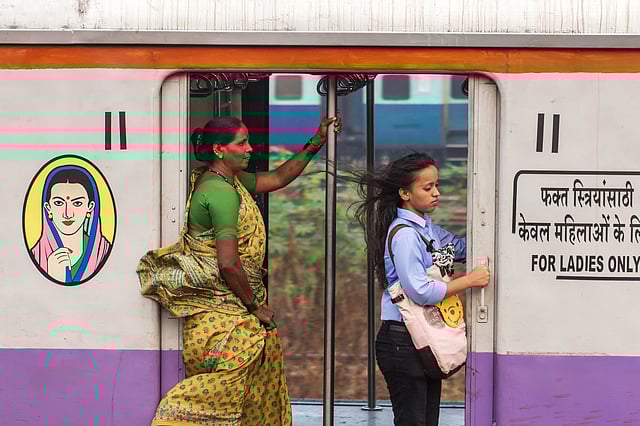
Sadana also extends this argument beyond the ladies’ coach. In debates over subsidised fares for women, their mobility is framed variously as a tool of empowerment, preferential treatment, a financial burden or a political bargaining chip. By placing these debates in dialogue with her ethnographic portraits of women commuters, Sadana shows that the metro is not simply a tool of access, but a contested site where gender, class and ideas of governance and justice intersect.
At its best, The Moving City reveals how the Delhi Metro is not only a transport project but a stage for producing what Sadana calls “Metro publics”, or collectives of riders, aspirants and critics whose sense of citizenship is shaped in and through the system. These publics can be docile, adhering to rules of comportment, but they can also be defiant, as seen in early neighbourhood protests against elevated lines or the metro’s role in facilitating mass gatherings in Delhi during the 2011 anti-corruption protests led by the social activist Anna Hazare and the 2019-2020 Shaheen Bagh movement against discriminatory citizenship laws. Yet the same infrastructure can be shut down at the state’s command, turning a space of public assembly into a mechanism of control.
Crucially, these publics also emerge through everyday acts of inhabiting the metro. Although the system is designed to be climate-controlled, surveilled, sanitised and set apart from the street’s messiness, riders constantly bring the street inside by sitting cross-legged on the floor, interacting with the opposite sex across the gangway separating the ladies’ coach from the general coach or lingering in stations. Such practices subvert official rules and blur the boundary between order and informality. The metro, then, does not simply impose discipline; it absorbs the city’s rhythms and becomes a lively space of negotiation, where infrastructures of modernity are remade by their users.
This duality makes the metro a revealing lens through which to view Delhi’s urban condition. Sadana’s ethnography captures this complexity without collapsing it into a single narrative. The result is a book that reads both as an account of a transport system and a broader meditation on the remaking of urban spaces in India. Like Mumbai’s bicycle lanes, but on a far more ambitious scale, the Delhi Metro demonstrates how infrastructure is less about meeting existing needs than about producing new urban imaginaries that privilege some and marginalise others.
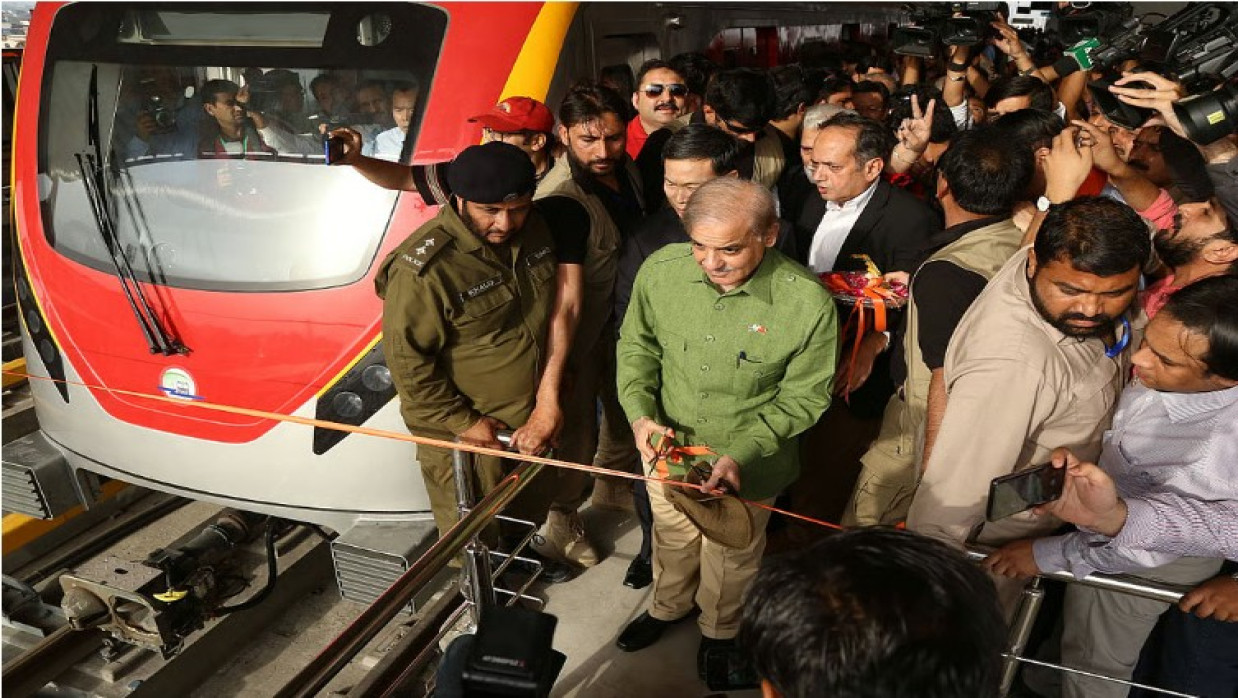
IF SADANA reads the Delhi Metro as a site where “world-class” aspirations, gendered mobility and embodied practices collide, Lahore in Motion: Infrastructure, History and Belonging in Urban Pakistan, edited by Ammara Maqsood, Chris Moffat and Fizzah Sajjad, turns to the Orange Line – Pakistan’s first driverless metro and currently Lahore’s only metro line – as a window into how urban change is experienced and felt. The book also explores how infrastructure projects are incorporated into the city and the frictions and fragmentations that underlie such processes. Like Delhi, Lahore’s Metro is propelled by aspirational urbanism. This includes the desire for swift, air-conditioned mobility and recognition as a “modern” and “world-class” city. Unlike Delhi, the Orange Line coexists with a BRT system, similar to the short-lived one in Delhi. Yet here, too, hierarchies persist. The BRT, disparaged as the jangla bus (“caged bus”) in elite circles and relegated to side roads, shows how different transport modes are unevenly valued in both cities.
The novelty of the metro in Lahore, as in Delhi, produces new forms of comportment, particularly around women’s mobility. While the system expands women’s capacity to move through the city, it also reinscribes older codes of gendered respectability. For instance, women rarely linger outside stations, unlike men. Riders distinguish between “suljhe hoye log” (decent people) on the metro and the “awara” (wayward) and “jahil” (uncouth) who travel on buses, echoing Delhi’s discourses of propriety and safety. In both cities, inadequate last-mile connectivity spawns an informal economy of autos, rickshaws and motorcycle rickshaws (qingqis), derided by elites but indispensable for most riders, while expanding metro lines constantly redraw the boundaries between “urban” and “rural”.
Where Sadana occasionally gestures to workers, Lahore in Motion foregrounds them. A 2017 fire that killed several labourers building an Orange Line station becomes an entry point into the city’s history of weak labour rights, migrant precarity and the erosion of unionisation under privatisation. We also meet Mariyam, a 20-year-old security guard whose story complicates narratives of women’s mobility. Employed at a workplace that touts its contribution to women’s urban access, Mariyam walks 30 minutes on unsafe roads to her 6 am shift, faces cuts to her already minimum wage and has no power to refuse overtime work. When her hostel curtails its hours, she loses her only foothold in the city and is forced back to the peripheries, the very fate she had sought to avoid. As the scholar Nida Kirmani observes, women like Mariyam may find a place in the urban economy “but only at the bottom rungs where they exist in a state of constant precarity.” If Sadana acknowledges the classed and class-making aspects of the Delhi Metro, this volume delves deeper into workers’ disposability and the hidden costs of mega-infrastructure.
Where this book departs most significantly from Sadana’s account is in its method. Rather than always centring the metro, the Orange Line often recedes into the background, sometimes becoming a spectral presence, as authors step off the train and look around. This approach gives the book a wider framework for tracing how people negotiate large-scale urban change. Organised around a specific station on the Orange Line, each chapter takes us on a different journey. The metro becomes a stepping stone for mapping non-heritage monuments across the city, questioning the meaning of conservation when 21st-century infrastructures jostle against Mughal-era monuments, exploring how new infrastructures unexpectedly spark personal memories, contesting notions of authentic belonging, spotlighting governance failures and the state’s culture of “aadha kaam” (half-kept promises), or simply rediscovering old markets and shrines.

Like Delhi, Lahore’s Metro produces exclusions. Despite low fares, many remain unable to access it, and its construction often entailed violent displacement. By attending to the city around the metro, the authors foreground its human costs more sharply. This includes the dispossession of working-class households, the breaking of care networks and the physical splitting of markets and mohallas by elevated tracks. Some chapters trace how compensation enabled a few families to move into more upwardly mobile spaces, complicating displacement narratives. Others situate the metro within Lahore’s broader shift from dense, communal neighbourhoods to isolated gated enclaves, linking mobility infrastructure to transformations in both urban form and sociality. This is a perspective that Sadana’s Delhi ethnography does not explicitly develop.
THAT IDEA – how gated societies produce exclusion, segregation and anonymity – sits at the heart of Smriti Singh’s The Middle Class in Neo-Urban India: Space, Class and Distinction. Turning to Gurugram, a satellite city of Delhi located just across the border in the northern Indian state of Haryana, she offers a sharp ethnography of how post-liberalisation urbanisation has produced a new middle class of educated, skilled migrant professionals tied into global circuits of capital, and how this class is reshaping the spaces it inhabits.
Singh’s choice of Gurugram is telling. In New Gurugram, the rapidly developing southern part of the satellite city, private developers, aided by state acquiescence, converted large tracts of farmland into gated high-rises from the 1990s onward. These enclaves house the new educated middle class (EMC), who live in uneasy proximity to the local ancestral agrarian community (LAAC) of Old Gurugram. Singh persuasively shows how this spatial juxtaposition makes visible a shift in power. The EMC displaces the LAAC as the new elite, not so much through sheer wealth as through different ways of inhabiting the world – anchored in property rights, citizenship and cosmopolitan dispositions.
Beyond complaints of road rage or pub brawls, Singh’s interlocutors express open disdain for the LAAC. They mock their ownership of foreign-brand cars whose names they cannot pronounce or their belief that simply acquiring Rolex watches confers “class”. Against this backdrop, the high walls and gates of the enclave promise order, safety, and above all, separation. Singh is at her strongest when she shows how architecture doubles as social logic. The enclave is less a neutral form of housing than a deliberate mechanism for drawing boundaries.
Placed alongside the other books under review, Singh’s contribution is distinct. She is less concerned with mobility than with immobility: how walls, gates and guards work to keep people and practices out. Enclaves, in her account, are not just residences but “islands of globality” that decontextualise the space while deepening fissures with their immediate surroundings. Singh’s interlocutors value them precisely for their erasure of peri-urban messiness and for their perceived resemblance to New York rather than to Old Gurugram. This makes for a powerful argument about how middle-class urbanism reproduces exclusion. Singh points to similar dynamics in peri-urban zones such as Whitefield and Electronic City in Bengaluru and Cyberabad in Hyderabad, suggesting that Gurugram exemplifies a broader pattern of enclave urbanism in India.
Singh also refuses to portray enclaves as seamless havens. She documents the fractures and hierarchies that persist within their walls between owners, tenants and transient residents, and between those empowered in Resident Welfare Associations and those subject to their discipline. Even LAAC members who live inside are domesticated into rigid codes of conduct. Equally striking is her attention to what she calls the “outsider–insiders”, including maids, drivers, nannies and guards who service the new middle class. They are indispensable to enclave life yet tightly regulated. They are issued identity cards, checked at gates, and instructed to speak softly, avoid “crass” language or learn a few words of English to address children. In one nuanced account, Singh describes how guards are implicitly called upon to use their knowledge of the “underclass” to police others, such as maids suspected of stealing and smuggling small items out of the enclave. These episodes reveal that enclaves are not impermeable fortresses but carefully managed spaces where underpaid care labour is incorporated and controlled.

Her conceptual interventions are sharpest in the “partial exit hypothesis”, which argues that the middle class withdraws from shared infrastructures such as water, electricity, transport and public space, while investing in the enclave as a privatised commons. The result, Singh shows, is not just a decay of public resources but a deepening of inequality, as the state loses incentive to maintain services that the middle class no longer uses. Her account of “active placemaking” projects such as IAmGurgaon, a citizen-led movement that launched Raahgiri, a car-free Sunday initiative, is similarly pointed. Though framed as inclusive, these initiatives privilege the EMC’s vision of safety and order while marginalising other ways of inhabiting the city. Singh’s critique of middle-class voluntarism as a form of exclusion is both timely and compelling.
What emerges from Singh’s ethnography is not absolute separation but carefully managed inclusion, an identity secured not only through walls and gates but through the regulation of those who must pass through them. The Middle Class in Neo-Urban India shows that what is being built in Gurugram is not just housing stock but a middle-class identity, premised on elective belonging and the exclusion – and conditional inclusion – of others.
This emphasis on immobility and enclosure makes Singh’s book a sobering counterpart to the mobility-centred urban imaginaries explored in the other works under review. It is in her own vignettes of walking, however, that Singh drives home the stakes of her argument. In a city where “cars are the way the middle class moves,” she observes, walking marks one as underclass. In her encounters with security guards while interviewing her interlocutors, Singh discovers how the arrival of middle-class women like her on foot disrupts the enclave’s carefully curated order. If Anjaria traces how cycling in Mumbai, and Sadana and Lahore in Motion show how metro-riding in Delhi and Lahore redraw urban boundaries, Singh demonstrates that in Gurugram even the most basic act of walking reveals the spatial and classed order of enclave urbanism.
Read together, these books underscore that, across Southasian cities, mobility and immobility alike illuminate how aspiration, class and gender are being remapped through the built environment. Infrastructure is never just about movement from point A to B; it is about symbolic projects and everyday negotiations that determine who count as rightful urban subjects and who are cast as surplus or unruly.
The article appeared in the himalmag

0 Comments
LEAVE A COMMENT
Your email address will not be published