

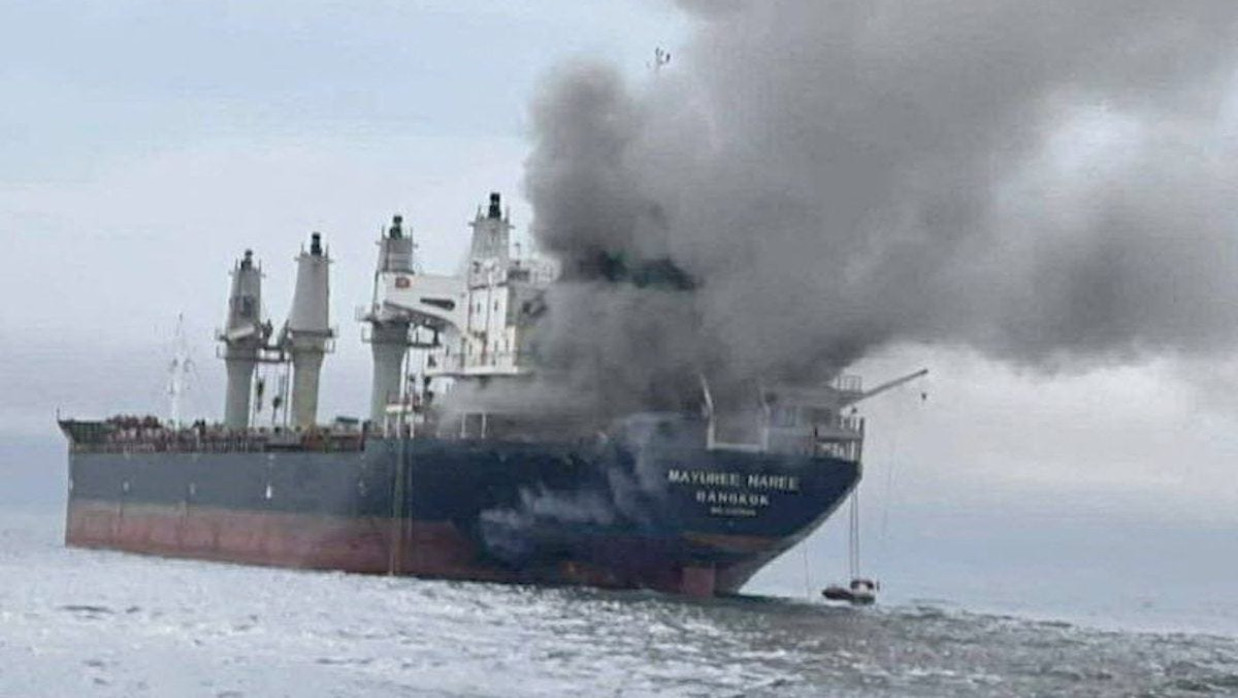
The “Hormuz Risk” is no longer an abstract exercise for Riyadh. A prolonged disruption in the Strait of Hormuz, which is now effectively paralyzed following U.S.-Israeli military strikes and Iranian threats of mining, would expose structural vulnerabilities for Saudi Arabia that have long been masked by the seeming stability of Gulf shipping lanes.
Although the global oil market keeps framing conditions to remain tight but manageable, potential closure of the Strait, in reality, means the consequences would run far deeper for the kingdom. Hormuz isn’t just a maritime corridor through which Gulf oil flows to global markets. For Saudi Arabia, the world’s largest oil exporter and de facto OPEC leader, it remains the central artery through which the bulk of the kingdom’s export economy still moves.
The Bypass Myth
Saudi Arabia exports roughly 7 million barrels per day (bpd) of crude oil, the backbone of a state budget that still relies heavily on petroleum revenues. Most of that oil leaves the kingdom through terminals in the Persian Gulf and has to traverse the Strait before reaching international markets. Riyadh does however have a strategic bypass: the East West Petroline, which runs across the kingdom to the Red Sea port of Yanbu. Built during the Iran-Iraq war in the 1980s, the pipeline was designed precisely to reduce Saudi reliance on Hormuz in times of crisis.
However, there’s a catch. The Petroline’s capacity, estimated at roughly 5 million bpd, falls well short of the kingdom’s total export potential. Even if fully utilized, total production capacity of 12 million bpd would be severely bottlenecked, leaving millions of barrels stranded. Furthermore, Yanbu’s loading facilities would become a massive single point of failure and a primary target for aerial or missile interdiction.
 |
Flawed economic model
Notably, the gap between production and export capacity reveals a critical reality. Saudi Arabia’s economic model still depends heavily on uninterrupted maritime access to global markets. A prolonged disruption wouldn’t simply drive and keep oil prices higher. It would choke Saudi export revenues at the very moment global markets are demanding much-needed supply. That pressure would come at a fragile time for Riyadh. Crown Prince Mohammed bin Salman’s Vision 2030 economic program is designed to diversify the kingdom away from oil dependence through massive infrastructure investments, industrial projects and tourism development.
Yet, those ambitions remain financed largely by oil income.
Ostensibly, nothing has changed for the Saudis, even as they try a hard pivot away from over-reliance on petrodollars. A sustained disruption of export flows would therefore strike at the financial foundation of the kingdom’s economic transformation strategy. The crown prince’s grandiose US$1.5 trillion flagship projects are already in trouble, including the 170-km-long linear city, with 500-meter-high towers, originally budgeted at US$500 billion. Costs have ballooned to as much as US$8.8 trillion, with only 2.4 km expected to be completed by 2030, housing fewer than 300,000 residents instead of the projected 1.5 million.
 |
More fundamentally, the vulnerability extends beyond state revenues. Saudi Arabia’s domestic infrastructure, particularly its water supply, depends heavily on energy. It relies extensively on desalination plants along its coasts to produce fresh water for cities and industry alike. These facilities are energy intensive and depend on stable flows of oil and natural gas to power them. In other words, oil exports are not merely a source of wealth for Saudi Arabia. They are also embedded in the broader system that sustains daily life in the kingdom. Any prolonged disruption in oil flows would therefore carry implications not just for fiscal stability, but also for the infrastructure that underpins the country’s domestic social contract.
The China Connection
The implications wouldn’t stop at Saudi Arabia’s borders. Asian economies, particularly China, have become the primary destination for Gulf oil exports over the past two decades. China is now one of the largest importers of Saudi crude, and Gulf supply remains a cornerstone of the country’s energy security strategy. If Hormuz were disrupted for an extended period of time, which is appearing increasingly likely, Beijing would face tough choices. China has diversified its energy supply in recent years through pipeline connections with Russia and Central Asia as well as becoming the world’s largest renewables developer, leading the US by a more than 2:1 ratio. Moreover, imports of pipeline gas from Russia, Turkmenistan and other regional suppliers have expanded steadily. Is it enough? Not at all. Pipeline supplies simply can’t fully substitute for seaborne crude flows from the Gulf.
Nor is China in a position to guarantee the security of maritime energy routes in the same way that the US has historically done. Beijing has invested heavily in naval modernization, but projecting sustained military power into the Gulf remains far from its core strategic priorities. The argument that China has yet to develop a true blue-water navy rings true when compared to the logistical footprint required for Persian Gulf escort operations.
In the event of a prolonged disruption, China would likely rely on a combination of strategic reserves, alternative supply contracts and increased pipeline imports. But problematically, none of these measures would fully replace the scale of energy that normally flows through the Strait of Hormuz.
Finally, a prolonged shutdown of the Strait would force the global market to adapt quickly to constrained supply and heightened geopolitical risk. Energy markets have long treated Hormuz as a theoretical vulnerability. The Strait has remained open through decades of regional tension, reinforcing the assumption that flows will ultimately continue. Nonetheless, the concentration of global energy trade through a single narrow corridor has never disappeared.
A disruption in Hormuz wouldn’t simply be a shipping story or a temporary spike in prices, it would expose how much of the global energy system, and particularly the economic stability of Gulf producers, still depends on the uninterrupted flow of oil through one of the world’s most strategically sensitive waterways. While the Saudis grapple with getting their oil to market, Beijing also faces hard choices as the conflict stretches into its second week. It is a structural trap that both Riyadh and Beijing have yet to escape.
The article appeared in the asiasentinel


0 Comments
LEAVE A COMMENT
Your email address will not be published