

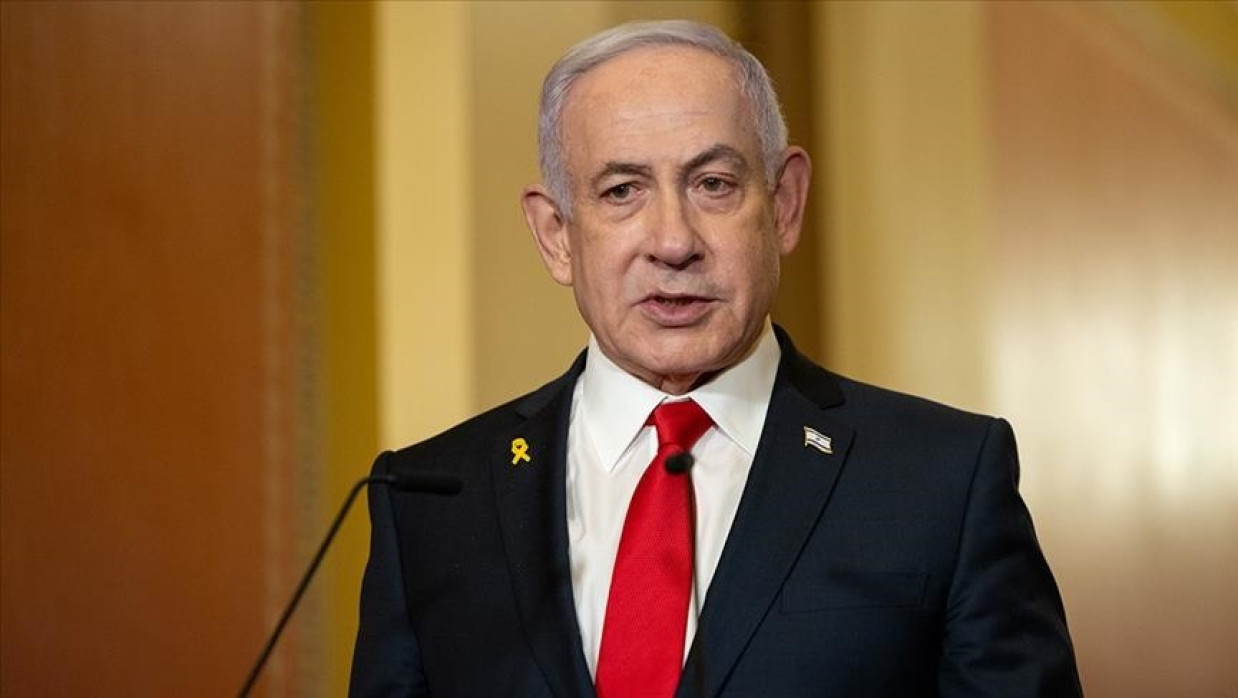
Former Israeli peace negotiator Daniel Levy on how Trump's incoherence has allowed a small settler-colonial state to pursue a far-reaching mission of domination in the region.
Daniel Levy
This has not been subtle. Across multiple decades, Israel, and Benjamin Netanyahu in particular (he has been Israel’s premier for almost 20 of the last 30 years), have tried to pull America into a war against Iran.
Netanyahu briefly succeeded last June when Trump launched the one-and-done Operation Midnight Hammer strikes. That appeared to only whet appetites.
Israel’s campaign to induce a full-scale American assault on Iran became relentless. Netanyahu visited Trump twice in the roughly eight weeks preceding the launch of this illegal war of aggression (and that’s a total of seven Netanyahu meetings with the president in the second term so far).
This week, Secretary of State Marco Rubio let slip that America’s supposed case for pre-emptive use of force in the face of a threat was, in fact, necessitated by Israeli (rather than Iranian) imminent military aggression. But the collective gasp in response was not one of surprise at the content of his remarks, but rather at the fact that the quiet part had been said out loud.
Attempts by leadership on both sides of the Zionist-American axis to walk the comment back failed the credibility test. Netanyahu frequently embraces Donald J. Trump as the best friend Israel has ever had in the White House. Perhaps what Israel’s premier is really telling us is that while all previous US presidents have been easy for Israel to manage and manipulate, none has been so easy to dupe into launching this long-attempted war.
 Subscribed
The idea that this is a war to serve American rather than Israeli interests resonates primarily in three spaces: the gullible, the true believers (especially of end times religious eschatology), or those who are paid-up members of Israel’s echo chamber.
There is also a geopolitical case that is guiding a cohort of DC policymakers – after all, one should not dismiss the agency of deceitful and delusional US officials across multiple administrations – Democrat and Republican. In this iteration, the US addiction to primacy and preponderance is embedded in a paradigm of imperial resurgence, the promise of resurrected colonial glory offered to Europeans by Secretary Rubio at this year’s Munich Security Conference. It is a notion driven by decline-anxiety, which is leading to the metastasization of global instability and insecurity. In this context, the Iran war is a geo-economic and geo-political move to assert hegemony in this strategic hinge area of Eurasia, with China an undeclared target.
Even combined, those echo chambers are not convincing the American public. The transparent “Israel First” impetus has never been so visible. And it is unprecedented for the US to launch a war that is so unpopular on Day 1 – not the nearly 90% support when the US attacked Afghanistan or the over 70% support when it attacked Iraq. Barely a quarter of Americans back this operation, according to polls. There is growing dissent inside the MAGA base and almost zero traction on the Democrat side.
What is more, a war widely considered to be for the benefit of a foreign state is being launched at a time when support for Israel among the American public has hit a historic low point, now expanding deep into core areas of Republican support and with significant signs even of a shift in Evangelical opinion and theology. It is unquestionably the case that this war will serve to accelerate and intensify that trend.
Surely that is a high-risk strategy for Israel given its dependence on the US. One has to assume Netanyahu would be aware of this. Which begs the question – why was Israel so willing to go out on a limb in pushing for this war?
Why Now?
Israel’s leadership describes this as a war of no choice – the threat from Iran so palpable and dire. That claim resonates across the Zionist political spectrum and with the Jewish-Israeli public. There is, though, little evidentiary basis to Israel’s position. Israel, not Iran, has initiated the only occasions in which there have been direct exchanges of fire, including this one. Iran considers allied armed groups bordering Israel as part of its defensive posture in the face of Israeli threats, and even when Hezbollah came under Israeli assault and throughout the Israeli military’s genocidal campaign against the Palestinians, Iran did not directly join the fray (only responding when under Israeli attack).
Being an implacable ideological foe is not the same as being an existential security threat.
Israel is the regional power with nuclear weapons.
Netanyahu, in particular, has spent decades fear-mongering that Iran is on the precipice of nuclear weaponization – it is worth seeing how youthful Netanyahu looks in some of the videos currently circulating where he makes this propagandist claim.

A narrower interpretation might emphasize Netanyahu’s domestic political calculation. Israel is in an election year, Netanyahu’s coalition still lags in the polls, and his political survival and personal freedom – given his ongoing court trials – are intimately intertwined.
Successfully pulling the US into his war and removing the Iranian leadership would embellish Netanyahu’s credentials as the indispensable war leader, willing to stare down international outrage and able to play Pied Piper to Washington, DC.
Perhaps Netanyahu is simply dismissive of Israel’s reputational slippage in US public opinion. After all, Israel still has the administration and Congress on its side. Israel’s tools for managing the American political scene are tried and tested (pro-Israel PAC leverage, especially in an era of independent expenditure campaigns, is not a thing to be sniffed at – even if defeats have become more frequent).
While there is a growing Republican constituency and an overwhelming majority of Democratic voters uncomfortable with existing policy, Israel can lean on a highly effective infrastructure of intimidation. Perhaps the internal MAGA drama will wash over, and the likes of Tucker Carlson, Marjorie Taylor Greene, and Candace Owens will be forgotten. It is surely reassuring and not coincidental that Israel’s supporters are buying up so much of both legacy and new media. The deeply pro-Zionist Ellison family is hoovering up US TikTok, CBS, and now Warner Bros. Discovery, appointing the likes of Bari Weiss as editorial shills.
Or has Israel itself abandoned business as usual?
Are we witnessing a fundamental inflection point – a premeditated winner-takes-all gambit from an Israeli PM who has shed risk aversion and is doubling down on a high-stakes strategic play?
To briefly speculate – Netanyahu may have factored in and accepted a dual premise. First, that Israel’s weakening hold on US politics is a trend rather than a blip, that the eradicationist zero-sum agenda towards the Palestinians is not going to change, and will not be a recipe for reclaiming popularity. Second, an Israeli acknowledgment that America itself is in geopolitical decline – best for Israel to use American power while it still can.
Israel is apparently willing to accelerate that American decline by drawing the US into the kind of expansive military adventurism currently on display.
Unlike Trump, Netanyahu has a gameplan, not the fairy tale fantasy of a Venezuela 2.0 with an American hand-picked successor and subservience.
Iran is not America’s Western Hemisphere backyard. Israel is not interested in an Iran that holds together under a different leadership, capable perhaps within a short time of reasserting itself as an independent actor. Netanyahu’s goal is clear – regime collapse and state implosion.
What Success Looks Like to Israel
A scenario of chaos that has been unleashed (not always by Israel) elsewhere in the region – Israel, protected at a sufficient distance, and by continuing to seize and expand illegal “buffer zones” in surrounding states (see under Lebanon and Syria), and by its permanent matrix of control across all Palestinian territories.
The Israeli government’s position was summarized by a former defense intelligence official (currently faculty at the Institute for National Security Studies), Danny Citrinowicz: “If we can have a civil war [in Iran], great. Israel couldn’t care less about the future…[or] the stability of Iran.”
 |
In this scenario, not only would Iran collapse as a state, but its neighbours would be impacted and absorbed by the spillover – Turkey, the Gulf states, Iraq, as well as Pakistan and beyond. That, of course, would further shift the military balance in the region in Israel’s favor.
For the last two years, Israel has set out on a kind of hegemonic project based on overwhelming regional military domination. A number of states, among them Turkey, Egypt, Saudi Arabia, Qatar (with possible support from the likes of Somalia and Pakistan, given the extent of Israel’s ambition), have begun a loose security cooperation based on an understanding of how Israel’s radical and destabilizing project impacts their own national security.
The message it hopes to send is that with the US ready to do its outlandish bidding, Israel’s domination is irresistible and insurmountable. Regional states have no choice but to accept this outcome and bend the knee. This is the Abraham Accords on nuclear steroids. And central to the project is that Israel will not be challenged in its end game towards the Palestinians – eradication, ethnic cleansing, and permanent disenfranchisement. The impetus for Israel’s total victory plan is its insistence on a Zionist ideology in which the Palestinians can have no future.
Israel may consider that if this mission against Iran is successful, then even if it adversely affects US power and the US ends up withdrawing from the region, Israel would have advanced an irreversible power play – in which Gulf and other states have no alternative but to acquiesce. Netanyahu, just days before the launching of operation Epic Fury, openly talked about a future axis that would start with the existing UAE-Israel relationship, build beyond that in the Gulf, and bring in other powers in the broader Asia, Africa, and Europe neighbourhood – India, Ethiopia, and Greece, for instance.
Assuming this Israeli play is not actualized, the Gulf Cooperation Council (GCC) states will have their own dilemma. Having seen their own sovereign territory targeted by Iran (there is that score to settle) – can America be a security guarantor for the GCC when its own, let alone their interests, are so manifestly subsumed to Israel’s extremist fundamentalism?
In order to maximize the degradation of Iran and advance state collapse, Israel needs to keep the US in this war for as long as it can. This plan likely includes attempts to start the dismantling and fracturing of the Iranian state. Israel has backed secessionist movements, partition, and division across a number of regional states (it has not been alone).
The model of externally backed ethnically-geographically based armed secessionist movements is now being applied to Iran – hoping to promote those trends, for instance, among the Kurdish, Baluchi, and Ahwazi communities. It is the Kurdish component that is currently getting the most attention. Presumably, the calculation is that if a territorial foothold can be gained by a military group inside Iran, then the process of state fragmentation is begun and will be easier to advance (even across many years) than to reverse.
There are existing Kurdish groups, such as the PJAK (Kurdistan Free Life Party), who are reported to have received Israeli and US training and assistance, and it seems that part of the bombing campaign by Israel and the US aims to erode Iranian border control and to ease the infiltration of foreign-based fighters. This model was used elsewhere – in Iraq, for instance, and in different ways (and recently dramatically reversed) in Syria.
Focusing on Kurdish separatism has the added advantage for Israel of being a move that would challenge Turkey, a state the Israeli establishment has increasingly identified as Israel’s next multi-year target to take down after Iran (a position clearly expressed by former and perhaps future prime minister, Naftali Bennett).
In the most far-reaching scenario, this could segue into creating a so-called “liberated territory” inside Iran, tempting the US into setting up bases with local militias, as it did in Syria, Iraq, and elsewhere.
Limited special operations could become a more permanent American (or even Israeli) presence on the ground in Iran.
Far-fetched?
Israel has pursued, undisturbed and with US backing, a genocidal war in Gaza, where, despite a so-called ceasefire, daily killings and destruction continue; it is in the midst of a most extensive military campaign of devastation and displacement in the West Bank while simultaneously (again) displacing large swaths of Lebanon’s population, including parts of its capital and is holding more territory in Syria.
Israeli Over-Reach Meets American Incoherence
Let me state clearly that I am not suggesting this will play out as Israel imagines or that it can succeed – that is highly doubtful. I’m asserting that there is a far-reaching Israeli ambition. Core elements of this assessment can hold water even if one dismisses the idea that Netanyahu’s strategy is premised on either the future loss of American support, or the future weakening of America itself.
When two militaries jointly go to war (even if there is a vast gap in power between them), with one party having a clear strategic endgame, and the other entirely incapable of coherently defining its goals and subject to the whims of an unstable leader, then it is clear who has the upper hand.
This analysis is not about how this might end but rather how Americans should understand the dynamic and different interests at play between the US and Israel.
Of course, Trump may yet surprise and declare early victory (whatever the circumstances on the battlefield), and end this; equally, in his incoherent planning, absent serious advisers and with his frail ego, Trump may sustain and expand this war and even pursue elements of a Gaza-style campaign of wanton destruction and cruelty.
It should be noted that Iran, too (again, unlike the US), has a coherent strategy – to establish deterrence by making this war sufficiently costly that it is not something anyone involved would like to repeat. It can do so, of course, without matching US-Israeli firepower toe to toe.
One question hovering over all of this is the strategic judgment and even sanity of the leadership of a small settler-colonial state in pursuing such a far-reaching mission of domination and humiliation of an entire region.
Daniel Levy is a Zeteo contributor, political commentator, and the president of the U.S./Middle East Project. He has served as an Israeli negotiator in peace talks and is a former adviser in the Israeli Prime Minister‘s Office.
The views expressed in this article are the author’s own and do not necessarily reflect those of Zeteo.

0 Comments
LEAVE A COMMENT
Your email address will not be published