

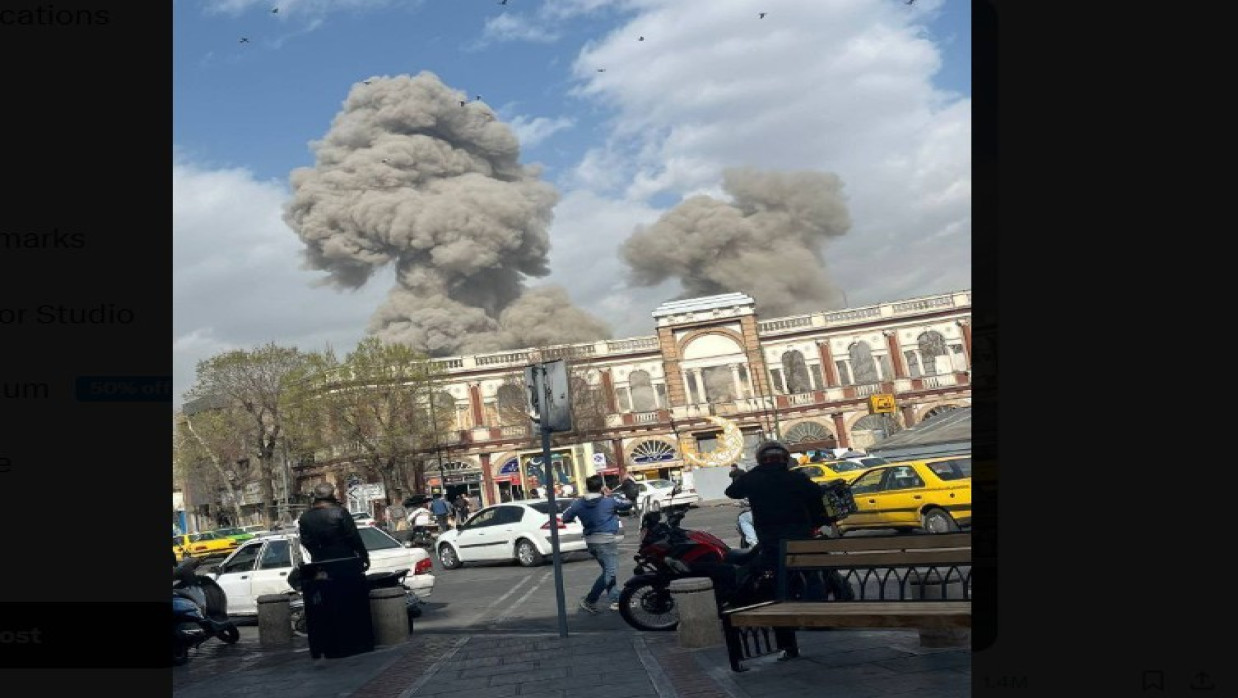
The US and Israel have launched “major combat operations” against Iran reportedly killing its defense minister Amir Nasirzadeh, Revolutionary Guards commander Mohammed Pakpour and at least 53 civilians at a girls' school. Iran has launched retaliatory strikes targeting American military and naval bases around the Middle East such as in Qatar, Kuwait, Dubai and Bahrain.
The US may have been emboldened by its recent military actions leading to toppling and arresting of Nicolas Maduro – then President of Venezuela without any significant push back against it. Second, President Donald Trump’s open threatening to annex Greenland even as that spelled serious threat to the Transatlantic alliance did not place sufficient pressures on him to backtrack from this kind of rhetoric. The administration’s imposition of massive tariffs against allies and adversaries alike without sufficient countervailing force to help it roll back or make serious amends to its policies or change its tack also made the US more confident that it can push Iran to a corner through demands that the latter cannot fulfill providing Washington with an opening for military intervention and plausibly for bringing about a regime change in Iran. President Trump’s such ambitions cannot be ruled out by the fact that Iran currently does not pose an imminent threat to the US. So far, history has strongly sided with the US and its attacks on Iran’s nuclear sites in June, 2025 significantly compromised Tehran’s military capabilities. Iran’s reactions to these strikes were rather muted making President Trump believe Washington can take stern military action against Iran and yet exit without domestic and international opprobrium. However, such actions of Trump administration to degrade Iran’s nuclear facilities along with Israel engendered deep-seated misunderstandings between Iran and the US that reached its nadir as the attacks and retaliation to these offensives suggest.
US’s Superpower Hubris
President Trump rightly believes that the US is the lone superpower and it can bully other states to fulfill its narrowly defined interests. Reasons are many to believe so. The European countries under the Trump administration’s pressures have ramped up their defence budgets but they still have resisted the temptations of forming a collective force independent of the US. They are aware of the fact that they need sustained supply of American technology, defence equipment, missiles and surveillance and logistics support for years to come. Despite the tariff war waged against many countries, no permutations and combinations of adversarial powers have been able to undercut the dominance of dollar and outsize influence of the US in the financial markets and supply-chains.
Hence, the Trump administration has been experimenting with its bullying strategy without noticeable push back against it. In a similar vein, it is coercing Iran to unconditional surrender its nuclear weapons and ballistic missiles programmes without taking cognizance of the fact that with this power the fate of Islamic Republic is intrinsically interwoven. These abilities are the essential elements of Iran’s bargaining chip vis-a-vis any external powers. Iran understands that its proxies in the Middle East such as Hamas and Hezbollah have been degraded. What counts more and ultimately is its own military power.
Can the Iranian regime be forced to sign its own suicidal note? It knows by surrendering these powers would automatically bring in a regime change. Trump’s penchant for business interests and his reliance on cronies such as special envoy Steve Witkoff and his son-in-law Jared Kushner to negotiate a nuclear deal with Iran chip away at the technical and incremental aspects involved in the deal making exercise. Any nuclear deal to be successful needs to be an outcome of a reciprocal process. The US needs to link lifting of sanctions with each step at denuclearization by Iran.
While Trump wants massive concessions from Iran’s supreme leader Ayatollah Ali Khamenei without offering anything concrete hoping for a spike in popularity as he has pledged to protect Iranian protesters in a Truth Social post the latter is unlikely to yield to Trump’s demands as succumbing to such pressures would plunge his acceptability among the hardline supporters. Trump administration does not have either a clear roadmap to execute the regime change operation or any master-plan to manage the consequences.
The administration blinded by US’s superpower hubris is likely to ignore the consequences of reckless military escalation. The US has stationed around 40,000 to 50,000 military personnel spreading across 19 military bases around the Middle East apart from the current escalation. The military personnel could be soft targets for Iran. Iran may choose the Gulf countries for its attacks to cause instability, distort supply of natural resources and disrupt the financial synergies with the US. The Iranian proxies - Shiite groups in Iraq and Houthis of Yemen retain the capabilities to lunch asymmetric attacks and clandestine operations in the Middle East. They may help close the Strait of Hormuze or strike American naval assets. Houthis may be propelled to resume attacks on the commercial ships in the Red Sea. Iran with assistance of Russia and China may choose the cyber domain to incapacitate or partially damage the critical infrastructure of the US and Israel.
Post-War Tinderbox
The Trump administration needs to reckon with the fact that the US has been more successful in removing anti-American rulers in many countries than in post-war stabilization initiatives.
In these countries, the earlier regimes were either replaced by far more authoritarian regimes or much weaker pro-western regimes which palpably failed to subdue dominant ethnic and religious groups emerged in the war-torn societies and contain the resultant prolonged civil wars. The US, on the contrary, remained militarily entrenched and overstretched in these areas giving way to more instability and chaos without settling the political futures of these societies.
Evolution of history suggests how the revolutionary tides spread with the advent “the Arab Spring,” in West Asia in 2010-11, propped up by the US that deposed the regime of Egypt headed by Hosni Mubarak paved way for more authoritarian rule. Similarly, the overthrow of Yemen’s government gave way to dominance of Houthis who later turned against the interests of the West. The US-supported insurgency in Afghanistan against the Soviet Union following the latter’s intervention in 1979 gave rise to the emergence of the Taliban. The American enhanced footprint and ever-increasing involvement in West Asian geopolitics led to formation of radical Islamist groups such as Al Qaeda and ISIS.
A new regime emerged from the internal political dynamics following the toppling of the current regime may continue to be as hostile to US and Israeli interests as the current regime and pursue the nuclear ambitions as fervently as the current regime. The leaders in these countries increasingly acknowledge how lacking the possession of nuclear weapons can be a threat to their survival. The regimes of Saddam Hussein, Gaddafi and Assad were uprooted perhaps because they did not possess nuclear capabilities. The Kim Jong Un’s regime in North Korea on the other hand, continues to persist without any external threat of regime change.


0 Comments
LEAVE A COMMENT
Your email address will not be published