

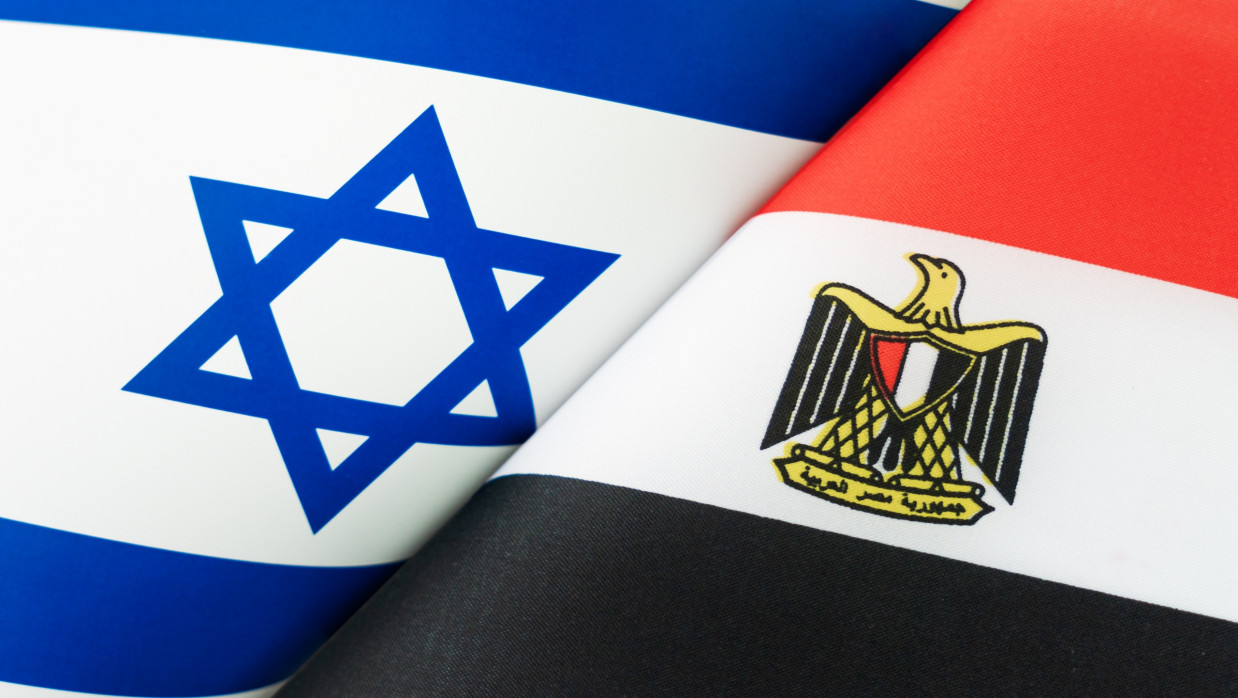
Egyptian President Anwar Sadat broke the mould of Middle Eastern geopolitics when he made a groundbreaking visit to Jerusalem in 1977.
Two years later, Egypt became the first Arab state to sign a peace treaty with Israel. The treaty envisioned Palestinian autonomy in the occupied West Bank and Gaza Strip.
 |
Fast forward to 2020, when the United Arab Emirates, Bahrain, and Morocco established diplomatic relations with Israel with, at best, scant reference to Palestinian national aspirations.
Egypt paid a heavy price for its taboo-smashing move.
Egypt was condemned and ostracised by its Arab brethren. Islamist militants assassinated Mr. Sadat two years after the signing of the peace agreement.
It took 15 years before another Arab state, Jordan, followed Egypt’s example in recognising Israel and establishing diplomatic relations with the Jewish-majority state.
In the meantime, the Arab world launched a peace plan that envisioned Arab states agreeing to peace with Israel in exchange for a Palestinian state in Israeli-occupied lands and an Israeli withdrawal from Syria’s Golan Heights.
Today, none of that is on the table as far as Israel is concerned. Prime Minister Binyamin Netanyahu rejects anything that even reeks of catering to Palestinian rights.
Even so, the United States and Israel are pressuring Egyptian President Abdel Fattah al-Sisi to make a move as bold as his predecessor and UAE President Mohammed bin Zayed did.
Only this time, Mr. Al-Sisi would be going out on a limb in a far more emotionally charged environment after more than two years of Israeli destruction of Gaza and the killing of 70,000 Palestinians if he succumbs to the pressure.
 |
US President Donald Trump and Mr. Netanyahu are pushing for a meeting when the Egyptian and Israeli leaders travel to the United States for separate talks with Mr. Trump later this month.
Mr. Netanyahu is scheduled to meet Mr. Trump in Florida on December 29. Mr. Al-Sisi’s travel dates have yet to be finalised.
Mr. Al-Sisi cancelled a visit in February after Mr. Trump suggested removing Palestinians en masse from Gaza and turning the Strip into a Mediterranean Riviera.
The United States emerged as the venue for a proposed meeting after the Israeli prime minister attempted unsuccessfully sought to elicit an invitation to Cairo to sign a controversial US$35 billion agreement to supply Israeli natural gas to Egypt.
A Netanyahu visit to Cairo would have been even more controversial than a meeting in the US.
Even so, Arab leaders and public opinion would not look kindly on Mr. Al-Sisi meeting a man for whom the International Criminal Court has issued an arrest warrant without having secured significant Israeli concessions, irrespective of the venue.
For now, Mr. Al-Sisi has not ruled out a meeting, Instead, he has set conditions.
 |
Egyptian officials insist a meeting would only be possible once differences with Israel over Gaza’s future, the Rafah crossing between Egypt and Gaza, and security are resolved.
Working in Egypt’s favour is the fact that the differences go to the core of Mr. Trump’s efforts to see the second phase of his Gaza ceasefire proposal implemented and are shared by most potential contributors to an international stabilisation force in Gaza whose exact mandate has yet to be defined.
In addition, Egypt, a Gaza ceasefire mediator alongside Qatar, Turkey, and the United States, objected to a recent Israeli announcement that it would reopen the Rafah crossing but only for Gazans vetted by Israel, leaving the Strip, but not for those wanting to return.
Israel rejects any role for Hamas or the Palestine Authority, the West Bank-based internationally recognised representative of the Palestinians, in post-war Gaza.
In addition, Egypt, a Gaza ceasefire mediator alongside Qatar, Turkey ,and the United States objected to a recent Israeli announcement that it would reopen the Rafah crossing but only for Gazans vetted by Israel leaving the Strip, but not for those wanting to return.
 |
Also, to bolster Egypt’s defence posture in the wake of the Gaza war and cushion public sentiment, Egyptian officials suggested Mr. Al-Sisi wants amendments to his country’s peace treaty with Israel that restricts the number of troops and type of weaponry Egypt can deploy in parts of the Sinai Peninsula that border on Gaza.
Many Egyptians view the restrictions as impeding on Egyptian sovereignty.
Even if it may not be enough to persuade Mr. Al-Sisi, the Egyptian president will likely have taken heart from the administration’s scolding of Mr. Netanyahu for last week’s killing of a senior Hamas commander, Raed Saad.
“If you want to ruin your reputation and show that you don’t abide by agreements, be our guest, but we won’t allow you to ruin President Trump’s reputation after he brokered the deal in Gaza,” the White House said in a private message to Mr. Netanyahu.
“Netanyahu has turned over the last two years to a global pariah. He should ask himself why Sisi refuses to meet him and why five years after the Abraham Accords he still hasn’t been invited to visit the UAE,” a US official added.
“If you want to ruin your reputation and show that you don’t abide by agreements, be our guest, but we won’t allow you to ruin President Trump’s reputation after he brokered the deal in Gaza,” the White House said in a private message to Mr. Netanyahu.
A meeting between Messrs. Al-Sisi and Netanyahu would be the first public encounter between the prime minister and an Arab head of state or government since the Gaza war erupted.
With public anger at Israel across the Arab and Muslim world and widespread support for boycotts of Israel, it’s hard to imagine any other Arab leader entertaining the thought of meeting Mr. Netanyahu without a sustainable Gaza ceasefire in place and tangible progress towards the creation of a Palestinian state alongside Israel as the solution to the Israeli-Palestinian conflict.
Concerned that manifestations of anger at Israel could be destabilising, most Arab states, including Egypt, have banned demonstrations and gatherings in support of Palestine.
Israel’s wars in Gaza, sparked by Hamas’s October 7, 2023, attack on Israel, Lebanon, provoked by Hizbollah’s firing of missiles and drone attacks in support of the Palestinians, and Syria in a bid to emasculate the country’s new rulers militarily, have prompted Saudi Arabia to stiffen its conditions for recognition of Israel.
Before the Gaza war, Saudi Crown Prince Mohammed bin Salman was inching closer to recognition of Israel as part of a three-way deal with the United States.
Today, Mr. Bin Salman is demanding that Israel agree to an irrevocable pathway to Palestinian statehood, while suggesting that a deal with Israel’s current government, the most far-right, ultranationalist in Israeli history, may not be possible.
Speaking in Doha earlier this month, Egyptian Foreign Minister Badr Abdelatty became the first senior Arab official to publicly suggest that the stabilisation force should be deployed to police the ‘yellow line’ that separates Israeli and Hamas-controlled areas of Gaza without a clear timetable for the complete withdrawal of Israeli troops.
 |
“We need to deploy this force as soon as possible on the ground because one party, which is Israel, is violating the ceasefire every day,” Mr. Abdelatty said.
Mr. Abdelatty appeared to assume that deployment of the force would ensure that Mr. Trump would obligate Israel to halt its daily strikes.
Egypt’s moves may be in part designed to upgrade its status in the Trump administration’s pecking order of Middle Eastern partners, which favours wealthy Gulf states alongside Israel.
Sources in the United Arab Emirates suggested that the UAE could support the Egyptian approach by funding Colombian mercenaries’ participation in the international stabilisation force.
The UAE has a long-standing relationship with the mercenaries dating back more than a decade, when it hired Blackwater founder Eric Prince to assemble a force made up of mostly Latin Americans to be based in the Gulf state.
 |
A video posted by fighters with the Joint Force of Armed Movements of Darfur after a battle with the Rapid Support Forces near the Libyan border shows documents belonging to a Colombian mercenary who was part of a caravan traveling from Libya to support the RSF. Credit: Sudan Tribune
The US Treasury last week sanctioned a network it said was recruiting and training Colombian mercenaries for combat in Sudan in support of the rebel Rapid Support Forces or RSF.
The UAE has denied backing the RSF or funding the involvement of mercenaries in Sudan’s 2.5-year-old civil war.
The UAE-backed Egyptian proposal is likely to be discussed this week at a a conference in Qatar of 25 partner nations convened by the US military to discuss the stabilisation force.
With most countries rejecting Israel’s notion of the force being mandated to disarm Hamas, the Trump administration, like with Hezbollah in Lebanon, appears inclined towards a definition of disarmament propagated by Egypt.
The Egyptian notion would see Hamas putting what is left of its heavy weaponry after two years of Israeli bombardment in the custody of Egypt or the Palestine Authority, while allowing the group to hold on to its sidearms.
“As in Lebanon, so in Gaza, it seems that the American administration no longer considers (Hamas’s arms) as an existential security threat to Israel, and as in Lebanon, it could likely adopt in Gaza the position that total disarmament is ‘not reasonable,’ and it’s therefore hard to see the demand for total disarmament as an obstacle to a diplomatic solution,” said journalist Zvi Bar’el.
 |
Mr. Bar’el was echoing US Special Envoy to Lebanon and Syria Tom Barrack’s recent assertion that it was “not reasonable’ to pressure Lebanon to disarm Hezbollah, the country’s Iran-backed militia and political party.
Meanwhile, Israeli media reported that Aryeh Lightstone, the Trump administration’s envoy charged with implementing Mr. Trump’s Gaza ceasefire plan, has been pressuring Israel to completely withdraw from Gaza rather than maintain control of substantial Gazan territory.
“Trump wants the Board of Peace, which he will chair, to supervise post-war arrangements in all of Gaza, not just part,” said a Western diplomat.
Under Mr. Trump’s ceasefire plan, the Board, whose members the president said he would announce in January, would oversee a Palestinian committee that would run Gaza’s day-to-day affairs, as well as the international stabilisation force.
Seeking to capitalise on Mr. Trump’s effort to move to the second stage of his plan and Egyptian manoeuvring, an Israeli-backed militia positioned itself as the force that could facilitate a post-war Gaza void of Hamas.
“The anti-Hamas forces in Gaza stand with (Trump) so we can together secure a permanent change for the good during the next phase. The choice before the international community is whether to support this new Gazan security force or watch as Hamas undermines and eventually overturns any progress,” said Hussam Al Astal, the commander of the Counter-Terrorism Strike Force and a former Palestine Authority security operative., in a Wall Street Journal op-ed.
Israel is likely to welcome Mr. Al Astal’s offer.
Even so, Egypt and other potential Arab, Muslim, and European contributors to the international stabilisation force are unlikely to switch horses by dropping their insistence that the internationally recognised representative of the Palestinians play a key role in post-war Gaza.


0 Comments
LEAVE A COMMENT
Your email address will not be published