

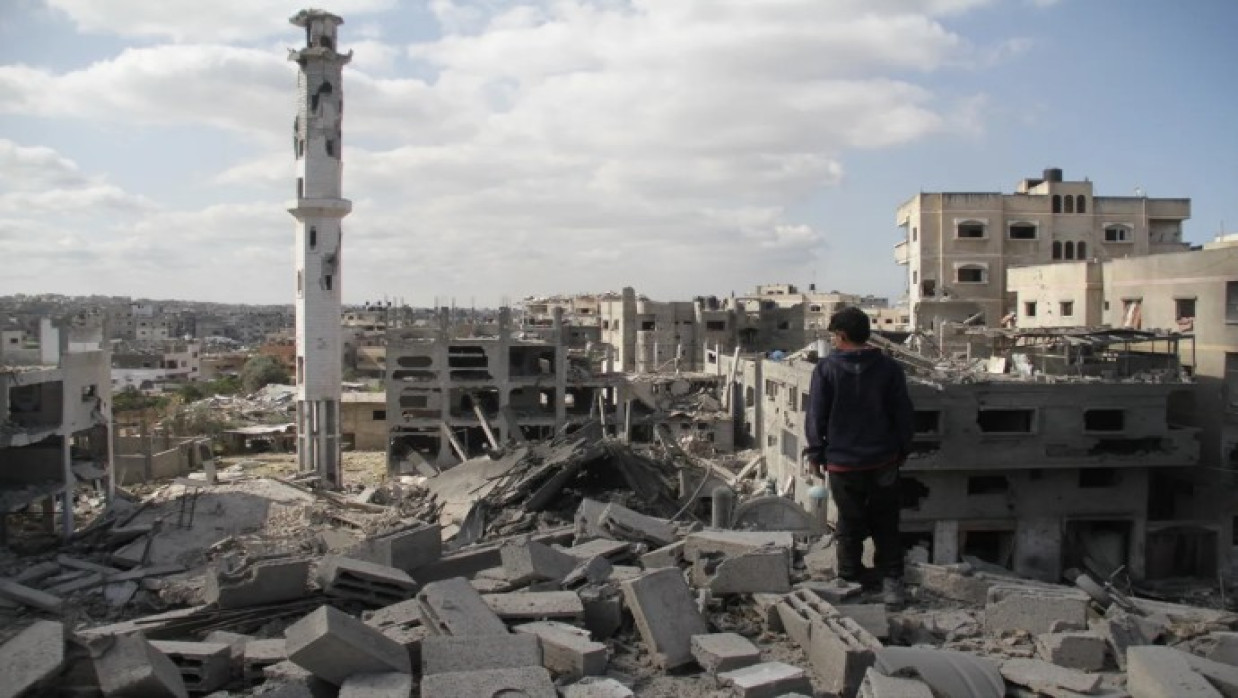
The October 2025 much hyped Gaza ceasefire, brokered by US President Donald Trump, is a fragile pause in a decades-long conflict, lacking the institutional scaffolding necessary for sustainable peace. Noted Indian security expert and former Army Commander Gen Syed Ata Hasnain aptly describes it as “a ceasefire without architecture”—a temporary silence devoid of verification, enforcement, or political vision. Since the truce began on October 10, Israel’s reported killing of 98 Palestinians and wounding of 230, alongside Hamas’s October 19 attack that killed two Israeli soldiers, underscores its fragility. Silence, as Hasnain notes, is not peace. Therefore transforming this ceasefire into lasting stability requires a robust institutional mechanisms, economic interdependence, ecological cooperation, and inclusive governance, grounded in political economy and human security frameworks. The absence of such architecture perpetuates a cycle of violence, undermining Palestinian aspirations and Israeli security. For India, a rising global power with stakes in Middle Eastern stability and good friendship and bilateral relations with Israel, this presents an opportunity to leverage its non-aligned legacy and technological prowess to foster peace, aligning with Sustainable Development Goals (SDGs) 16 (Peace, Justice, and Strong Institutions) and 17 (Partnerships for the Goals).
Structural Deficits: Why the Ceasefire Falters
The Gaza ceasefire’s instability stems from its lack of structural mechanisms, a flaw rooted in the political economy of conflict management. Unlike the 1998 Good Friday Agreement or the 2016 Colombia Peace Accord, which succeeded through independent monitoring and phased de-escalation, the Gaza truce lacks neutral oversight bodies to verify compliance or enforce accountability. This creates a “verification vacuum,” enabling selective interpretation of ceasefire terms. Israel’s reported 80 violations and Hamas’s retaliatory actions exemplify this dynamic, fostering mutual distrust. Without independent monitoring, blame-shifting persists, undermining trust-building critical to peace processes.
Moreover, the ceasefire transitions abruptly from conflict to an undefined “peace” without intermediate benchmarks. Gaza’s 60% unemployment rate and humanitarian aid reaching only 20% of needs fuel socioeconomic despair, historically driving youth alienation and social crises. The truce sidesteps strategic questions about Gaza’s political future, Hamas’s governance role, and the Palestinian Authority’s (PA) administrative capacity. This absence of a political vision, coupled with regional dynamics, waning Arab influence and global disengagement renders the ceasefire a tactical pause rather than a transformative process. Sustainable peace, as security scholars argue, requires not merely the absence of violence but the presence of economic opportunity, legitimate governance, and hope—none of which Gaza currently possesses.
Institutional Architecture for Sustainable Peace
To transform this fragile pause into lasting peace, a robust institutional framework is essential, rooted in political economy and human security principles. First, an independent Gaza Peace Monitoring Commission (GPMC), mandated by the UN Security Council and comprising neutral nations (like Switzerland, Norway, Indonesia) alongside regional actors (Egypt, Jordan), should provide real-time violation reporting with 48-hour investigation protocols. The GPMC must have authority to impose graduated sanctions, from diplomatic censure to aid suspension, and publish transparent monthly reports to counter misinformation. Such mechanisms ensure accountability and deter violations by providing neutral verification.
Second, phased security protocols spanning 12 months are critical for de-escalation. Phase one should consolidate the ceasefire through verifiable Israeli withdrawal from Gaza’s urban centers and Hamas’s disarmament of heavy weapons under GPMC supervision, establishing 5-km demilitarized zones. Phase two should implement confidence-building measures: prisoner exchanges via Egyptian mediation, reopening Rafah and Kerem Shalom crossings with biometric security, and pilot economic projects showcasing cooperation benefits. Phase three should address governance through PA-Hamas reconciliation talks mediated by Egypt and Norway, culminating in municipal elections under international observation. These steps foster incremental trust, addressing the psychological and political barriers to coexistence.
Third, economic interdependence must complement security measures. Joint Israeli-Palestinian ventures in water management, expanded fishing zones tied to compliance, and cross-border industrial parks create shared stakes in peace. When communities rely on each other for resources, conflict becomes costlier, aligning with theories of economic peace-building.
Ecological Diplomacy: The Green Gaza Initiative
Gaza’s environmental crisis is a reality since 97% of its coastal aquifer is contaminated; further 12-hour daily power cuts presents a strategic opportunity for peace-building through ecological cooperation. The Green Gaza Initiative proposes a $2 billion investment in three solar-powered desalination plants, producing 150 million cubic meters of clean water annually, funded by Arab states, the EU and Asian donors (like India, Japan, South Korea). This would create 3,000 construction jobs and 800 permanent positions, addressing Gaza’s water crisis. Installing 500 MW of solar capacity by 2028 would reduce reliance on Israeli electricity from 95% to 40%, enhancing autonomy. Coastal restoration and marine protected areas could generate $100 million annually for fishing communities, benefiting thousands of families. Urban agriculture, including vertical farms, could produce 30% of Gaza’s vegetables, bolstering food security.
These projects foster contact theory dynamics, where collaborative environmental efforts build interpersonal trust across conflict lines. For Gaza’s youth (65% of the population under 25), green jobs offer alternatives to militancy, leveraging the territory’s 96% literacy rate. Regional integration through water and energy corridors linking Gaza to Egypt and Jordan raises the cost of conflict, embedding peace in practical interdependence.
India’s Role as a Neutral Mediator
India’s unique position—robust defense ties with Israel ($10 billion annually), a 9-million-strong diaspora in the Gulf, and historical solidarity with Palestinians enables it to play a pivotal role. Its non-aligned legacy and absence of colonial baggage lend credibility unmatched by Western powers. India can contribute 2,000 peacekeepers to a UN Gaza Stabilization Force, drawing on its 75-year peacekeeping record. Technologically, India’s reverse osmosis systems ($60,000 per plant) and community solar grids (via Tata Power, Adani Green) can deliver decentralized water and energy solutions. Also training 5,000 Gazan farmers in drip irrigation and climate-resilient crops through the Indian Council of Agricultural Research enhances food security is a viable option.
India’s IT sector offers further potential. Coding academies partnered with Infosys and TCS could train 10,000 youth annually, creating a knowledge economy. Diplomatically, India can host the ‘New Delhi Dialogue,’ convening Hamas, PA, and Israeli civil society for neutral mediation. Funding $100 million for cultural preservation for restoring Gaza’s Al-Omari Mosque and Byzantine ruins that aligns with India’s cultural diplomacy, fostering employment and collective identity and consequently peace in the region.
China’s Infrastructure and Diplomatic Leverage
China’s October 2025 stance supporting Palestinian self-determination while maintaining pragmatic ties with Israel positions it to advance peace through economic statecraft. A $5 billion Gaza Economic Corridor under the Belt and Road Initiative, linking Gaza to Egypt’s Sinai via rail and road, could create thousands of jobs. Upgrading Gaza Port to handle 2 million tons annually would reduce Israeli maritime control, enabling trade. Chinese firms could build industrial zones and desalination plants, addressing ecological crises while showcasing green technology. Diplomatically, China’s 2023 Saudi-Iran rapprochement demonstrates its convening power. Hosting Hamas-PA unity talks with Arab League participation, incentivized by Belt and Road access, could foster compromise. Co-chairing donor conferences with Egypt ensures equitable aid distribution, balancing Western influence.
Arab States: From Normalization to Solidarity
Arab states can redirect normalization dividends toward Gaza’s reconstruction. A $20 billion Gulf commitment (UAE, Saudi Arabia, Qatar) over five years, disbursed through a Gaza Eco-Development Authority with block chain tracking, ensures transparency. Egypt’s role includes permanently reopening Rafah with advanced security to address Israeli concerns. Jordan’s water diplomacy, reviving the Red Sea-Dead Sea Canal with a Gaza component, fosters interdependence. Qatar’s funding for 20 hospitals and 100 clinics addresses Gaza’s healthcare collapse, while Morocco and Bahrain can leverage normalization to advocate for Palestinian rights, conditioning trade benefits on reconstruction progress.
Beyond Trump: Institutionalizing US Engagement
Trump’s 20-point ceasefire plan lacks sustainability, relying on transactional diplomacy. The US must shift from perceived pro-Israel bias to balanced engagement, conditioning $3.8 billion in annual Israeli aid on ceasefire compliance, humanitarian access and a West Bank settlement freeze. A US-funded Gaza Civil Society Forum, amplifying women’s and youth voices, follows the Helsinki Process model. A $10 billion ‘Gaza Marshall Plan’ for infrastructure and governance reforms, incentivizing US tech firms to establish innovation hubs, harnesses private sector dynamism. A revitalized ‘Quartet Plus’ (including China, India, Arab League) ensures multilateral coordination. Bipartisan Congressional legislation, like a ‘Gaza Reconstruction and Peace Act,’ insulates peace efforts from electoral cycles.
Empowering Women and Youth
Women (49% of Gaza’s population) and youth (65% under 25) are critical to peace-building but marginalized. Women-led resilience councils can manage aid and mediate conflicts, drawing on Rwanda’s model where women drove post-genocide recovery. A $500 million microfinance fund for women entrepreneurs could employ 20,000, boosting household incomes. Youth tech incubators and cultural workshops can leverage Gaza’s tremendous literacy, creating alternatives to militancy. Exchange programs and youth parliaments channel energy into nation-building, breaking cycles of despair.
Conclusion: Toward a Living Peace
The October 2025 ceasefire risks becoming another temporary pause unless transformed into a living peace. This requires institutional mechanisms (GPMC, phased protocols), economic interdependence (Green Gaza Initiative), and inclusive governance empowering women and youth. India, China, Arab states, and the US must leverage their unique strengths like peacekeeping, infrastructure, capital, and diplomacy to build this architecture. Failure perpetuates a cycle of violence, condemning Gaza’s 2.3 million people to poverty and Israeli communities to insecurity. Success offers a model for post-conflict reconstruction, aligning with global priorities of peace, justice, and sustainability. The choice between perpetual conflict and transformative peace rests on political will to invest in dignity, opportunity, and hope for both peoples.


0 Comments
LEAVE A COMMENT
Your email address will not be published