

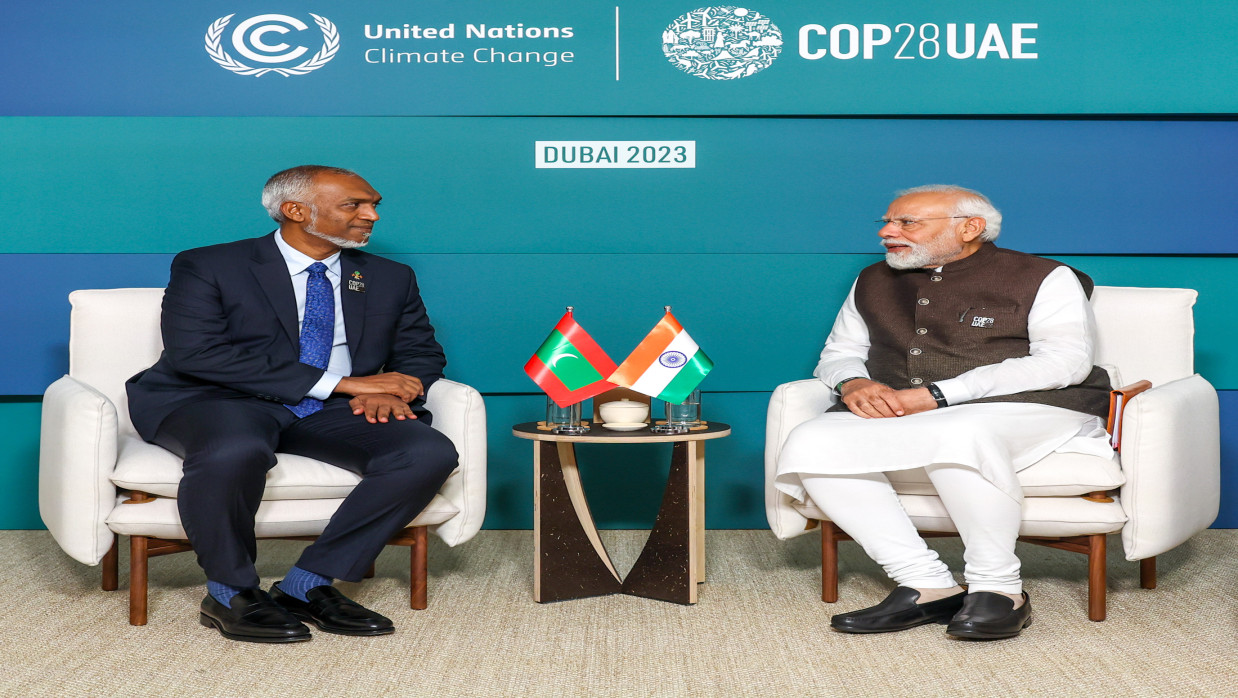
Barely a week after Maldivian President Mohamed Muizzu praised India's role in building the Greater Malé Connectivity Project, his government faced questions over its decision to award part of another major infrastructure project to a Chinese company. The apparent contradiction has revived a familiar debate: Has Muizzu genuinely moved closer to India, or is his government offering New Delhi reassuring words while continuing to deepen its material relationship with Beijing?
It's neither one thing nor the other. The reality is far more complex than either take suggests. The Maldives isn't unconditionally returning to India's fold. Nor is it handing itself over to China. Instead, Malé has been hedging its bets by continuing to court both neighbors for investment and assistance.
At the center of the controversy is the plan to relocate Malé Commercial Port to Thilafushi. Maldives Ports Limited selected China Harbor Engineering Company, or CHEC, for work on the project's first phase. Indian reports portrayed the decision as a reversal of an earlier understanding under which India and the Maldives would cooperate in developing the port. The Economic Times reported that the Chinese award represented Malé reneging on its commitment to New Delhi.
The Maldivian government disagrees. The Maldives Economic Development and Trade Ministry said the deal with CHEC followed Maldivian law and standard bidding processes. It also emphasized that no outside force would control the port's development, ownership, or operation, and that it would remain in Maldivian government hands. Under this narrative, hiring a Chinese contractor was merely a business and administrative choice, not a geopolitical slight against India.
Nevertheless, ports are rarely viewed as purely commercial projects in the Indian Ocean. Their location, financing, management, and possible future use carry strategic implications. China Harbor Engineering Company is a subsidiary of China Communications Construction Company, a major participant in Beijing's overseas infrastructure expansion. Chinese involvement in ports across Asia, Africa, and elsewhere has led Indian strategists to worry that civilian facilities could eventually give Beijing political leverage or logistical access.
These concerns are particularly acute in the Maldives. The archipelago sits near major sea lanes through which much of Asia's energy and commercial trade passes. Its proximity to India gives every large infrastructure agreement strategic significance, whether or not military use is contemplated. New Delhi consequently regards stability and friendly relations in the Maldives as central to its maritime security.
India's footprint, however, persists. Funded by an Indian grant and line of credit, the Greater Malé Connectivity Project is Maldives' single-largest infrastructure project to date. It comprises a network of bridges and causeways connecting Malé to Vilimalé, Gulhifalhu and Thilafushi. Muizzu' s commendation of the project, and of Prime Minister Narendra Modi, went beyond diplomatic niceties. The project has tangible benefits for congestion, transportation, and economic connectivity around the capital.
Relations were far less cordial when Muizzu came to power after campaigning on an "India Out" platform. His demand for the withdrawal of Indian military personnel created an impression that the Maldives was turning decisively toward China. Yet economic realities soon encouraged moderation. India remains the Maldives' nearest major neighbor, an important trading partner and a first responder during emergencies. It has also provided financial support when the Maldivian economy has faced debt pressures and foreign-currency shortages.
China offers a different but equally attractive partnership. It has the financing, engineering capacity, and political willingness to undertake large projects. The China-financed Sinamalé Bridge, opened in 2018, became one of the country's most visible infrastructure achievements. Beijing can therefore provide Malé with investment options while reducing excessive dependence on New Delhi.
The danger is that competition between India and China may encourage the Maldives to accept projects whose financial or environmental consequences are insufficiently examined. Large infrastructure developments can generate employment and growth, but opaque contracting, sovereign guarantees and poorly managed debt may burden a small economy. Thilafushi also has serious environmental vulnerabilities. Port construction, dredging and increased industrial activity require rigorous safeguards in a country whose survival depends on a fragile marine ecosystem.
Higher transparency would also alleviate domestic concerns and regional fears. Malé should reveal information regarding the project's financing arrangement, procurement methods, repayment terms, environmental impacts, and CHEC's specific responsibilities. Only then can analysts assess whether the deal benefits the Maldives or poses long-term strategic and financial risk. For its part, India must not see each Chinese contract as an inherent sign of anti-India hostility. Aggressive persuasion risks empowering nationalists and reviving opposition New Delhi believes it has quelled. India's comparative advantages remain geography, historical relations, quick disaster relief, and projects with immediate positive impact on Maldivians' day-to-day lives. China must also understand that increased commercial engagement does not equate to a strategic monopoly.
Ultimately, Muizzu complimenting India does not necessarily indicate substantive alignment, nor should it be taken as pure pretext when he simultaneously praises China. The fact that both the bridge and the port deal were approved illustrates the current administration's actual policy toward these nations: the Maldives will cooperate with India when India provides value and cooperate with China when China provides benefit. For a small nation trapped between regional hegemons, balancing is not hypocrisy. Balancing can ensure independence. If Muizzu can walk that line without losing sight of transparency, fiscal responsibility, and oversight, only then can he achieve true independence for his nation.


0 Comments
LEAVE A COMMENT
Your email address will not be published