

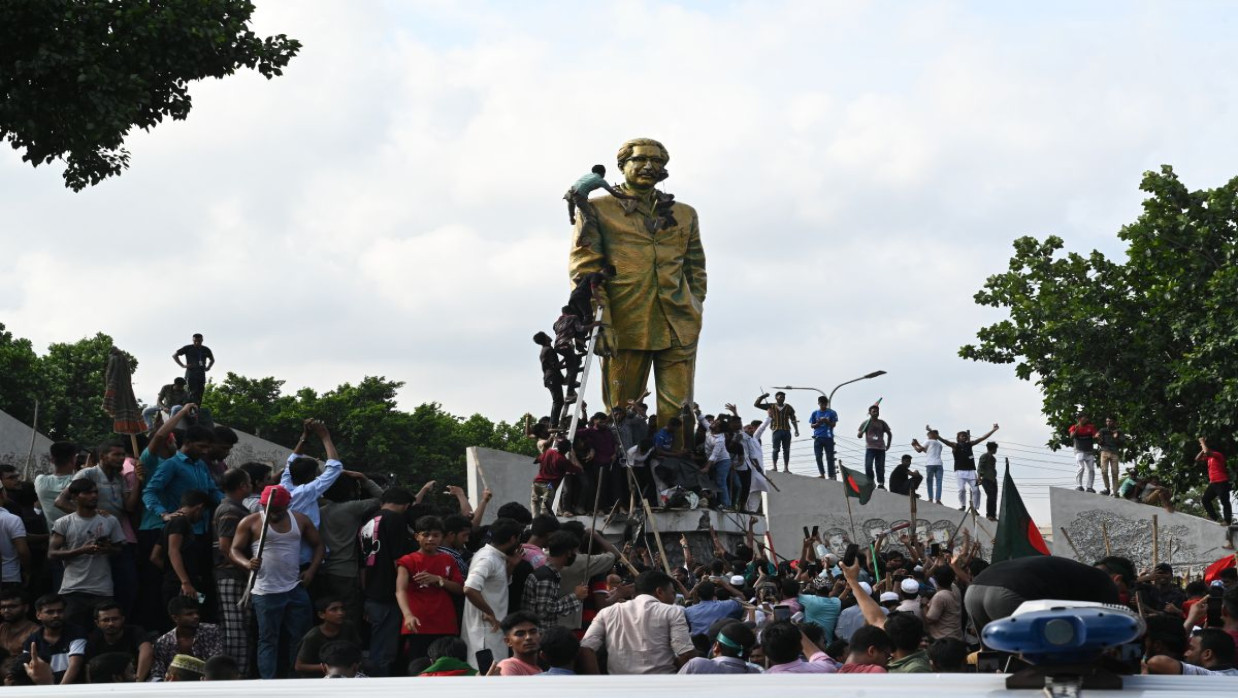
Sheikh Mujib, the undisputed leader of this new country of Bangladesh, who was held in custody by Pakistan during the entire 8 months of the civil war, returned to Dhaka where a million people waited to receive him. Mujib arrived from Pakistan where he had been held captive, via London and New Delhi. Why did he stop in Delhi? Because, India had played a vital role in the fracture of Pakistan. Mujib needed to display his full appreciation in person to Indira Gandhi, the prime minister of India, whose dynamic leadership of support for the Bengali liberation, was an essential factor in Pakistan’s demise as a two-winged state. But the icing on the cake was the massive number of Pakistani soldiers that surrendered to India, who became POW to the embarrassment of Pakistan. Pakistan had not only lost a war but also a good chunk of its territory.
Ever since the inception of Bangladesh, the Mujib family has had an umbilical cord relationship with mother India. Without India’s assistance, neither would the Sheikh family nor would East Pakistan be liberated in a matter of just eight months - a record, if one considers for example, the Algerian liberation movement from the French (130 years of colonialism, and 8 years of war), and India’ own liberation from 190 years of British rule without a formal war of Independence being waged against the Raj.
What was quite apparent was that Bangladesh with an 8 month-long struggle (active guerilla warfare) could not readily have gained independence, without ever receiving an overwhelming assistance from India. As a matter of fact, the Bangladesh Forces were so ragtag and disparate that without the formal and advanced assistance of the Indians (who trained and armed the freedom fighters), and importantly, have the Indian military itself fight the Pakistani armed forces alongside the Bangla freedom fighters, the ‘liberation of East Pakistan’ would certainly have taken a lot longer time, and also with far more casualties to boot.
The success of India in defeating Pakistan and expediting the creation of Bangladesh was primarily a result of logistics and geography. Pakistan was having to fight a war from a thousand miles away, having no air access (they would have to fly all the way around India to provide support to its forces in the Eastern Sector). Fundamentally, fighting an East Pakistani population that was totally at odds with its Western counterpart, was onerous to say the least. Indira Gandhi successfully fended off the US, which was supportive of Pakistan in this war. And, she executed it brilliantly.
This historical reference is essential to understand why India of today either subliminally or knowingly feels a sense of ownership and agency with whatever is transpiring in Bangladesh. India has materially invested a lot in Bangladesh from its inception till today. Ironically, most of what India has invested in appears to be in the Mujib family itself.
In the time span of nearly 25 years or more, between the father (Sheikh Mujibur Rahman) first, and the daughter (Sheikh Hasina) later, two landmark agreements were signed between Bangladesh and India: the father inking a 25-year Friendship and Cooperation agreement in 1972, while the daughter inking a 30-year Ganges water-sharing agreement in 1996.
Besides this, Hasina signed many trade agreements with India, facilitating India’s large commercial movement across Bangladesh, and many others that benefited India more than it did Bangladesh. The upshot of all this was a dramatic trade deficit for Dhaka vis-a-vis India (more imports, less exports). This imbalance in trade was tolerated by Bangladesh as India continued to support Hasina despite persistent evidence of voter fraud and vote-rigging in two of the last general elections in Bangladesh that Hasina won. What was also troubling was that many opposition party members were either jailed or were made to ‘disappear’. Besides, the Opposition didn't even participate in the last election that was won by Hasina. India did not flinch while knowingly ignoring the mass - scale imprisonment of Opposition party members as well as placing Mrs. Khaleda Zia in prison until she was at last released on humanitarian grounds in 2020. But, Mrs. Zia still, despite her ill health, remained under a repressive house arrest of Sheikh Hasina’s Awami League government. India’s support for Hasina, yet again, appeared to be solid but clearly unjust.
On August 5, 2024, after the massive student uprising, and subsequent killings of many students under the order of Sheikh Hasina, Hasina fled the country, and was given asylum in India, where she has lived over 2 years now.
Since Hasina’s departure, Bangladesh has had a free and fair election despite the fact the Awami League was banned from participating in it. The question of a fair election with one major party being banned, does raise troubling questions, however. Hasina was found complicit in the killings of the students, by the International Crimes Tribunal (ICT) - a domestic court in Bangladesh. Furthermore, the ICT made it unacceptable for Hasina’s party and government, ostensibly involved in the students massacre, to participate in the general election. It also sentenced Hasina to death in absentia.
For the last two years and more, Hasina has made inflammatory statements from the confines of India. In the recent past she has participated in a press conference by video (orchestrated by her supporters and tacitly by the Indian Government), again denigrating the present power structure in Bangladesh, while vowing to come back.
India insists it has no power over what Hasina does or says while tacitly supporting her bid to return to Bangladesh. This is patently false. As a host government to a fugitive convicted prime minister, it has every right to prevent her from stirring up problems in Bangladesh. It has resisted all pleas for her extradition in spite of the fact the two countries have an extradition agreement. On the other hand, India is allowing social media at home to suggest that neither the Ganges River agreement or the Teesta River accord would be vetted any time soon.
India’s amnesia is two- fold. It appears to be either oblivious of the charges against Hasina, or it considers that she was convicted by a kangaroo court. India also remains oblivious to the potential turmoil if ever Hasina returns to Bangladesh, other than as an indicted person. It also remains in amnesia as to the enormous public sentiment of aversion that India presently engenders in Bangladesh.
The amnesia is further enhanced by the fact that India is unable to accept the fait accompli in Bangladesh, namely that Hasina has been ousted and that there is no one person or party in Bangladesh that can do India’s bidding like she did. The continued acrimony over her own security, either perceived and real, and the hegemonic tendency by India, have forced Bangladesh to seek closer relationships with China, Pakistan, Turkey and other Islamic states. None of this sits well with India.
India has always viewed Bangladesh as one step away from becoming an Islamic fundamentalist state. It has accused Bangladesh for failing to protect minorities; it has exaggerated claims of minority abuse, both in the number of those killed and those harmed. (146 minorities killed : 132 Hindus and 14 indigenous). Out of a minority population of 7-8 million, mostly Hindus, the above figures hardly qualify as a ‘genocide’ that Social media in India have harped for months. This does not mean that one should condone any atrocities. Any killing should be condemned. The Government in power in Bangladesh is duty-bound to protect all minorities.
India is alarmed by the rise of the Jamaat e Islamic Party which did far better in this election cycle in Bangladesh than at any time before. And yet, it was Hasina that helped greatly increase the government-funded Madrasa education, as well as the Qawmi education system, the latter of which can proceed with graduating a student with no formal education in the areas of sciences and mathematics.
Finally it begs the question: why does India use Hasina as a bait to destabilize Bangladesh? Does it really think that she can make a comeback, run the country and do India’s bidding? Or does it want Bangladesh to collapse as a nation because it no longer cares to do India’s bidding?
The amnesia that India is displaying bodes poorly for Bangladesh and as well for India. An unstable Bangladesh is more likely to fester religious radicalism and provide more incentive for illegal immigration into India. The abeyance of the Ganges Water treaty as well as the Teesta River agreement which would divide water between the countries in 37.5%/ 42.5% (Bangladesh/ India) was never signed due to objection by the West Bengal State. Both these entities are being used by India to put maximum pressure on Bangladesh to do things India’s way.
Considering the present climate of animosity towards India in Bangladesh, foisted by India’s hegemonic tendency, India’s amnesia of the past and the willful blindness to the future, will not augur well for healthy bilateral relations. .
India if it so chooses can easily dial it down by allowing no ground for Hasina’s distorted dream of return. Being her host, India needs to explicitly tell Hasina “Enough is enough”.
Whether India will see the light is hard to say. But one can only hope that Indian amnesia and her willful blindness will be realized by the powers that be for what they are. The quicksand that India expects Bangladesh to drown into, may be the very quicksand that devours India as well.
India is a vast nation with a vast population. It has progressed in leaps and bounds over the last two decades. It is fast trying to be a global power in its own right. But in her own backyard, she has a poor relationship with every country that surrounds it. The lack of amicable relationship is driven mostly by India’s tendency to play the "Big brother knows best" role. All neighboring countries including Bangladesh want an amicable relation with India, one that is dictated by mutual respect and dignity. India has failed to do so. It behooves India to snap out of the amnesic state and face reality as it is


0 Comments
LEAVE A COMMENT
Your email address will not be published