

Over the course of its history, India has consistently adhered to a nuclear no-first-use posture, which does not need the country to possess the capability to carry out a devastating initial attack. The announcement made by India in 2003 that it would retain the option of using nuclear weapons in response to chemical or biological attacks was a significant blow to the no-first-use policy. Such an action would constitute a nuclear first use, regardless of whether or not it was a retaliatory move. Manohar Parrikar, who was serving as India's defense minister at the time, made the suggestion that India should not "constrain" itself to the no-first-use doctrine during the border confrontations that occurred in 2016. In response, the Indian government stressed that the minister's words reflected his individual position; yet, the conversation brought to light the circumstances under which India might consider the possibility of deploying nuclear weapons. Consequently, a number of analysts have expressed their concern that "India's NFU (no-first-use) policy is neither a consistent nor a reliable indicator of how the Indian military and political authorities may ultimately deploy nuclear weapons." Later, Post-Balakot crisis on August 2019, the current Defense Minister, Rajnath Singh, tweeted that "India has rigorously followed this doctrine." This statement looked to corroborate the caution that was being demonstrated. According to R. Singh, "the future is dependent upon the circumstances that are currently in place." In spite of these inquiries and the inherent uncertainties that surround India's nuclear weapons policy, it is possible that it played a role in limiting the scope and strategies of India's nuclear capabilities throughout the first few decades of its nuclear era. At the same time, although it has been believed for a long time that India stores its nuclear warheads in a separate location from its deployed launchers, some analysts have suggested that at least some nuclear bombs are co-located with aircraft on bases in underground bunkers for rapid mating in the event that it is required.
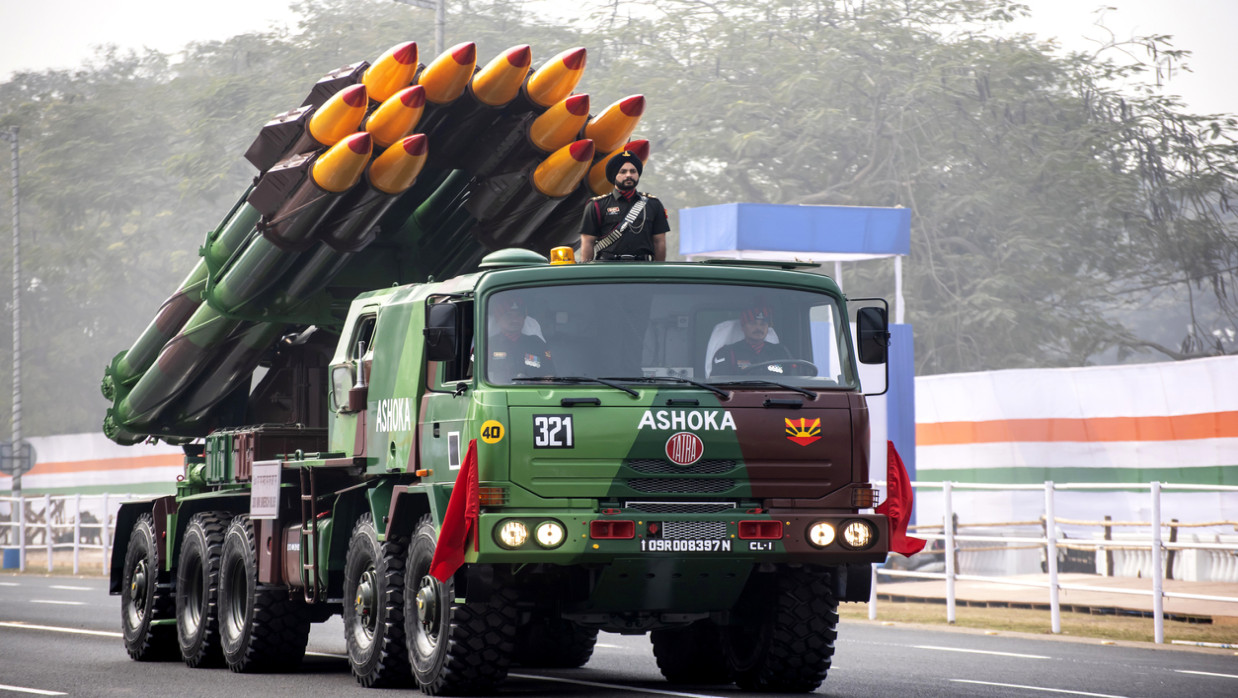
Furthermore, it has been suggested that India may be moving toward "pre-mating" some warheads with ballistic missiles in canisters for a subsection of the missile force. It would appear that the word "pre-mating" implies that the warhead is not actually paired with the missile, but rather that it is in a position that is nearly complete nearby. This is done so that the warhead can be prepared and mated on short notice if it is required. In practice, to get the warheads ready for mating, they would have to be retrieved from storage and readied in a facility that is specifically designed for that purpose. The SIPRI report 2021 also suggests that India is increasing the responsiveness of its arsenals by ‘canisterizing’ some of its ballistic missiles. Specifically, it is currently assumed that the first canistered missile, known as Agni-V, is operational, and it is anticipated that the second canistered missile, known as Agni-P, will become operational within the next year or two. More recently, the SIPRI report 2026 highlights India has approximately 12 nuclear warheads in an operational "deployed" condition within the maritime component of its nuclear triad. In particular, the SIPRI analysis indicates that India's recent actions, such as deploying missiles in canisters and executing sea-based deterrence patrols, imply a potential transition toward pairing some warheads with their launch systems during peacetime. Looking ahead, SIPRI anticipates that by January 2026, India might commence the deployment of a limited quantity of nuclear weapons on a nuclear-powered ballistic missile submarine (SSBN) doing sporadic deterrence patrols. Additionally, India has increased the number of nuclear warheads in its arsenal from 180 in 2025 to an estimated 190 warheads. Taken together, India's rapid developments in its missile arsenal and its land-based nuclear capabilities, in addition to the extension of its nuclear capabilities in the marine domain, constitute a significant threat to the strategic equilibrium in South Asia. As it is not possible for these developments to occur in a vacuum. Every new addition to India's arsenal, from canisterized missiles to sea-based patrols, will be driven by and will change the calculations of its primary nuclear adversary. This includes the installation of sea-based patrols. The ultimate determination of whether such capabilities serve as a stabilizing deterrent or as fuel for a more volatile regional balance is eventually determined by the bilateral relationship between the two parties.
India's nuclear policy and strategy have predominantly centered on Pakistan, and recent border skirmishes serve as a stark reminder that the India-Pakistan dynamic represents one of the most alarming nuclear flashpoints globally. The two nations possessing nuclear weapons participated in overt conflicts as recently as May 2025 in pretext of Pahalgam crisis. India blamed Pakistan for the incident while Pakistan denied the accusations demanding neutral probe into the incident. In February 2019, Indian aircraft released munitions in proximity to the Pakistani town of Balakot. The pre-text was again a terrorist incident in Pulwama, blaming Pakistan while rejecting the neutral investigation. In response, Pakistani jets downed and apprehended an Indian pilot, then releasing him after a week. Another incident reported in March 2022, when India inadvertently fired what seemed to be a BrahMos conventional ground-launched cruise missile 124 kilometers into Pakistani territory, causing damage to civilian assets. Pakistani officials then asserted that India failed to notify them via the high-level military hotline, and India did not release a public statement regarding the incident until two days afterward. Had this inadvertent launch occurred under elevated tensions, it is conceivable that the situation would have developed into a perilous phase. Therefore, it appears that a notable disparity has emerged between India's stated ideology of restraint and the operational capabilities it persistently enhances. The no-first-use doctrine is still officially in place, although the push for canisterized missiles, pre-mated warheads, and maritime deterrence operations indicates a strategy that is progressively focused on rapidity over moderation. This divide may solely be reconciled by potential confidence-enhancing initiatives include revived a bilateral crisis hotline and military-to-military dialogue, reaffirming the frequently overlooked 1999 Lahore Memorandum on nuclear restraint, or even formulating new engagement protocols for addressing terrorist incidents without immediate resorting to force. In the absence of these precautions, there remains a possibility that a future border conflict or inadvertent missile launch could escalate more rapidly threatening the already volatile strategic equation in South Asia.
Author’s Bio: Syeda Tahreem Bukhari is an Associate Director at the Center for International Strategic Studies-AJK, where she works on strategic stability, South Asian security and emerging regional security dynamics. She has also served as a lecturer at the University of Azad Jammu & Kashmir and is an alumna of the Near East South Asia Center for Strategic Studies (NESA), National Defense University, Washington, DC.


0 Comments
LEAVE A COMMENT
Your email address will not be published