

In the early hours of 19 October 2026, a group of about sixteen villagers set out to collect firewood near the Imphal East–Kangpokpi border, in the Khongbal Sunurok Uyok area. It was an ordinary task for rural households in Manipur, where firewood remains an essential source of cooking fuel. At around 7 a.m., suspected militants ambushed the group.
Arubam Ronil, 35, and Lairenlakpam Inaobi, 51, were killed. Four others were injured, one of them reportedly in serious condition, and officials say three people remain missing. The missing have yet to be accounted for, and their families are left in an agonising wait for news.
The attack was not a battlefield engagement or a clash between armed groups. The victims were civilians engaged in a routine livelihood activity, which is precisely what makes the incident so disturbing for communities along Manipur's fragile valley-hill boundary.
Grief Turns to Protest
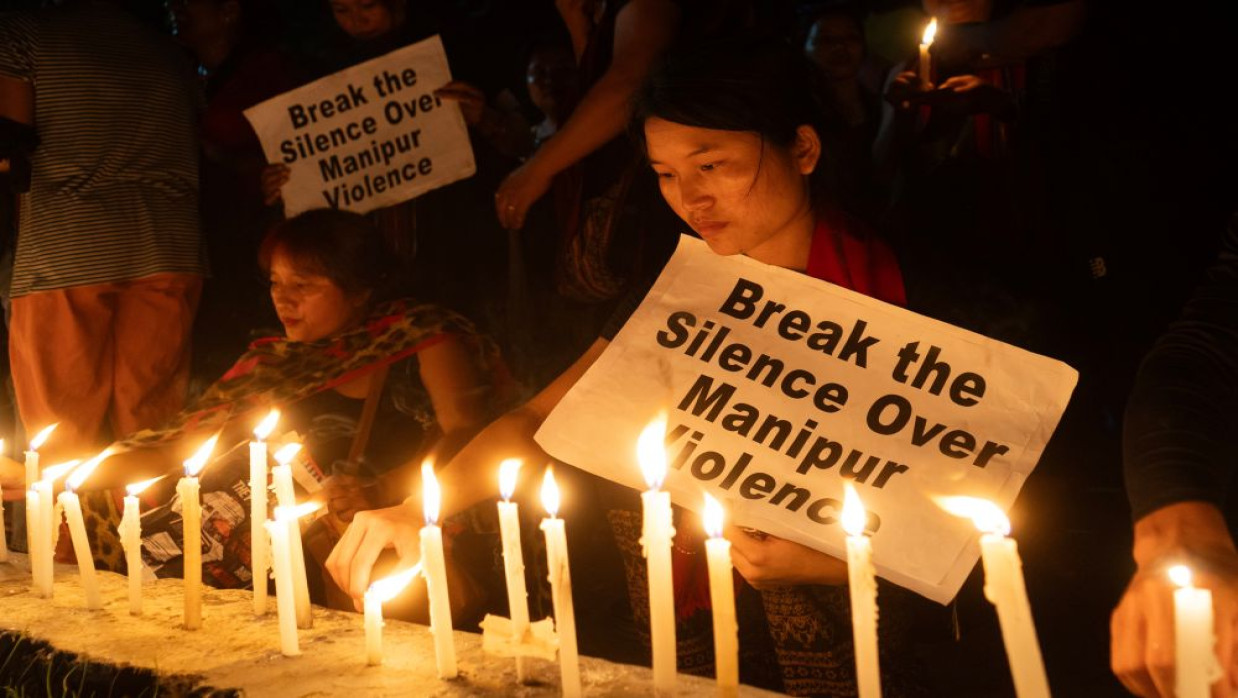
The anger of local residents was swift. They carried the bodies of the two slain men to Imphal and placed them outside the main gate of Chief Minister Yumnam Khemchand Singh's residence in Babupara. Such protests, in which families and communities place victims' remains before the seat of power, have become a recognisable form of public demand in Manipur, signalling that grief has hardened into a challenge to the state's ability to protect its citizens.
Police fired tear-gas shells to disperse the crowd. The bodies were later taken to Jawaharlal Nehru Institute of Medical Sciences for post-mortem examination. The sequence of events, from killing to protest to tear gas, reflects the cycle of tension that has marked the state for more than three years: violence, public outrage, a security response and, too often, no lasting resolution.
Weekend Violence Sets the Backdrop
The ambush did not occur in isolation. It followed a weekend of violence in Kamjong district, where at least 15 Kuki homes were torched and one Kuki civilian was reported killed. Taken together, the incidents point to a security environment in which attacks are occurring across different districts and involving different communities within a matter of days.
The Toll of Three and a Half Years
The scale of the human cost is considerable. Official figures presented in the Manipur Assembly in early September 2026 put the death toll since the conflict began on 3 May 2023 at 306 people killed, with 49 still missing as of 31 August 2026. Behind each number is a family, and in the case of the missing, a family still without closure.
Displacement compounds the tragedy. Tens of thousands of people remain uprooted, with many still living in relief camps years after the original Meitei–Kuki violence erupted. Children have grown up in temporary shelters, livelihoods have been lost, and the prospect of safe return remains uncertain for many.
A Shifting Pattern of Conflict
Perhaps the most significant development of 2026 is the changing character of the violence. What began in 2023 as a confrontation primarily between the Meitei and Kuki-Zo communities has, this year, increasingly taken the form of clashes between Naga and Kuki-Zo communities in the hill districts. Reports indicate roughly 80 or more conflict-related deaths between February and mid-October 2026, the large majority among Naga and Kuki civilians.
This shift matters. It suggests that the conflict is no longer a single dispute with two sides, but a web of overlapping grievances. Manipur's communities, including the Meitei, Kuki-Zo and Naga, along with others, are bound together by competing claims over land, administrative boundaries, political representation and identity. Armed groups operate across these fault lines, and each new episode of violence risks drawing in additional communities. The Imphal East–Kangpokpi border, where Monday's ambush took place, sits precisely at such a point of contact between valley and hill populations.
Security Deployment and Its Limits
Security forces remain heavily deployed across the state. Yet the persistence of ambushes, arson and killings indicates that a strong troop presence alone has not produced durable peace. Violence continues to find openings, particularly in remote forested and border areas where civilians must travel for work, fuel or farming, and where monitoring is difficult.
For ordinary people, this creates an impossible calculation. Routine activities such as gathering firewood, tending fields or travelling to market carry real risk. When basic livelihood tasks become dangerous, the damage extends beyond casualties to the economic and social fabric of entire communities.
Political Criticism Mounts
The state government, led by the BJP under Chief Minister Khemchand Singh, and the central government have faced sustained criticism from opposition parties, civil-society groups and some human-rights organisations. The criticism centres on three areas: the pace of political resolution, the recovery of looted and illegally held weapons, and the lack of meaningful inter-community dialogue.
Critics argue that without a credible political process, security measures merely manage the symptoms. Weapons that remain in circulation, they note, sustain the capacity for violence, while the absence of structured dialogue leaves mistrust unaddressed. Supporters of the government's approach, for their part, point to the complexity of the situation and the need to restore order before negotiations can succeed. Both perspectives acknowledge that the status quo is unsustainable.
What a Durable Response Would Require
Analysts and community leaders have repeatedly pointed to several elements that any lasting settlement would need:
- Credible investigation and accountability for attacks on civilians, so that grief is met with justice rather than only security deployments.
- Systematic weapons recovery, applied evenly across communities and armed groups.
- Sustained dialogue that includes not only Meitei and Kuki-Zo representatives but also Naga communities and other stakeholders.
- Safe rehabilitation for displaced families, with real timelines for return or resettlement.
- Protection for livelihoods, especially in border areas where civilians face the greatest exposure.
The killing of Arubam Ronil and Lairenlakpam Inaobi, and the uncertainty surrounding the three missing villagers, is a human tragedy before it is a political event. It also illustrates the central challenge facing Manipur: a conflict that has outlived its original framing, spread across communities, and resisted both security and political solutions for over three years.
The protest at the Chief Minister's residence was, in essence, a demand that the state restore the most basic guarantee of safety. Whether that demand is met will depend less on the strength of deployments than on the willingness of governments, community leaders and armed groups to move from containment to genuine reconciliation. Until then, each ordinary morning in Manipur's border villages will carry a risk that no one should have to bear.


0 Comments
LEAVE A COMMENT
Your email address will not be published