

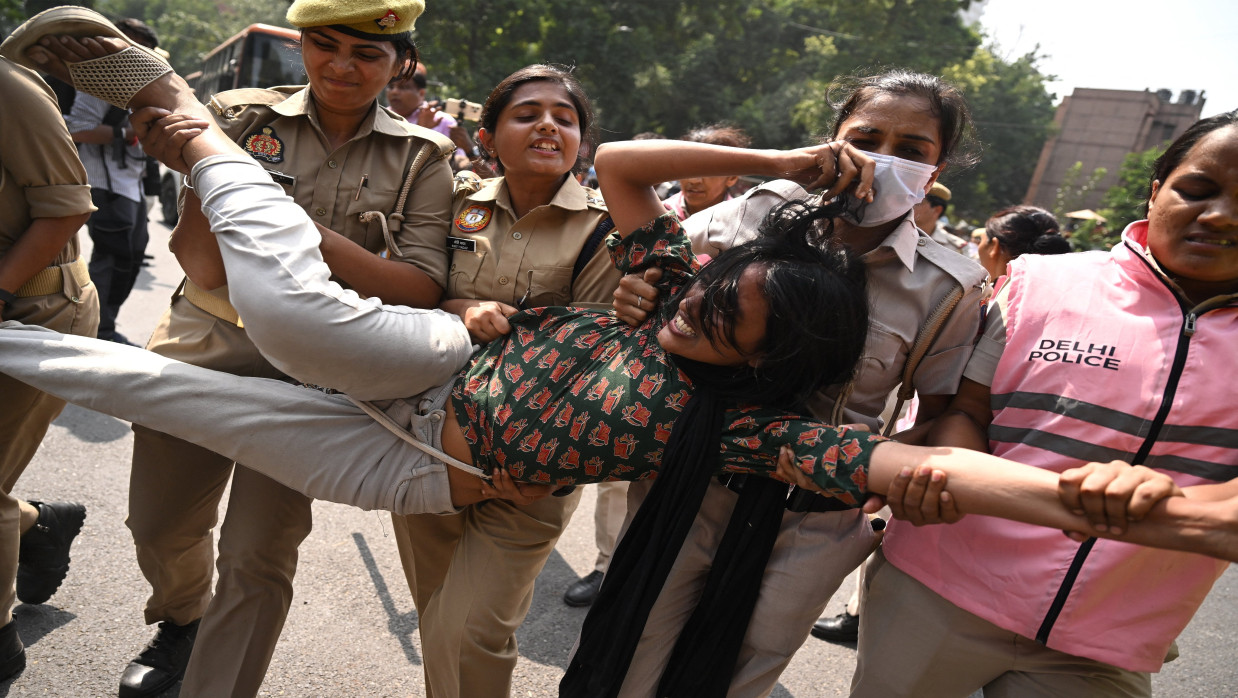
If the objective presumably was to silence protestors and even kill the cause of their having chosen to adopt this path, the concerned authorities adopted the wrong strategy. Yes, this refers to attempt made to prevent the protest on Oct 10. The demand is for resignation of Chief Election Commissioner (CEC) Gyanesh Kumar and rollback of Special Intensive Revision (SIR), which has led to deletion of a number of names from electoral rolls. The protestors want the deleted names to be restored. Despite India’s capital city having virtually turned into a fortress, with even Internet Services blocked for several hours, cancellation of transport services and thousands of policemen deployed, protestors were not refrained from moving forward. Yes, a significant number were arrested. But the objective of their planned protest was significantly served in several ways. The strength of the protest was visible in Delhi. So was participation of several leaders from different parties, quite a number of whom were detained. In addition, national as well as international media gave substantial coverage to the protest as well as those detained by Delhi Police. Protest also surfaced in other parts of the country. More than 7000 were detained across the country.
The issue is not whether the detentions were justified or not. On its part, Delhi Police had banned the protest and had imposed Section 63 in the city, as per which gatherings of four or more people, processions and/or blockades were banned. The key point as to whether in a democracy people can be prevented from voicing their protest? Certainly, they can be prevented specifically, if they are not given permission and/or if they are not of peaceful nature. But what if they are deliberately not given permission and are prevented even if they show no signs of turning violent? How does one explain detention of protestors even before they reach the protest site and are only seated inside an aircraft? What would be described illegal here- the detention, sitting inside the plane, both or none?
One has no intention to deliberate on rights and authority of Indian authorities, including the police but presumably one does have the right to question its limits. It would of course be a different case, if the same detentions were made on basis of some warrant or order. That, as per reports, doesn’t seem to be case. There is a difference between being detained/arrested at/near the protest-site and the same being done miles away. In case of police having acted within the course of law and order it is supposed to follow, the fact that detention of CJP leaders while aboard the plane has gained substantial coverage cannot be sidelined. But, wherever detentions may have taken place, possibility of the same gaining coverage would have remained.
The coverage is perhaps a mild indicator that voice of protestors has not been silenced even though they had not been granted the permission to protest. This is also a sign that to a degree Indian democracy is still fairly alive and active. It cannot yet be declared as dead or even numb. People’s strength is certainly not confined to their right to vote. They are as much responsible to ensure that this right is lived up to and not treated as scrap after the electoral season is over. They have the right, duty as well as responsibility to see that their tax-money is not wasted away.
Continuity of protests together with will-power of protestors against SIR and for resignation of CEC Gyanesh Kumar signals that Indian public’s strength is not limited to their gathering at various leaders’ functions, etc. It is not confined to their shouting slogans in praise of some leaders and parties. It cannot simply be measured by advertisements as well as media-coverage gained by elected leaders, their slogans, proposals, rhetoric and their claimed achievements.
Simply speaking, power as well as role of democracy is not confined to voters exercising their electoral right to vote. It extends to ensuring that it is exercised and that nobody is deprived of the same. Where would the elected leaders be without voters? Nowhere. The tragedy is that most leaders assume that once they are elected, once the voters have exercised their electoral right, their importance is lost till the next electoral season. In a democracy, leaders remain answerable to the whole country for what their government decides and so forth, particularly when and if electorate decides to, questions them, displays their decision to protest and so forth.
Protests at present don’t mark only the strength as well as weakness of Indian democracy. France has been witnessing protests in favor of educational reforms, which are taking place in Hungary too. Protests for better housing and other demands have surfaced in Spain and other places. USA has hardly been devoid of protest of some kind. Recent days have seen protests in New York against Immigration and Customs Ice Enforcement (ICE) violence, after a man was injured after being shot by an ICE officer. He was sitting in his car with his five-year old child. To a degree, protests may be viewed as a sign that some hope and belief in democracy is still alive. It is time, that a little more importance is given by all- the ruled and the rulers- to ensure that voice of protesters is heard and not silenced; the weight of which is not limited to the vote during elections, democratically speaking!


0 Comments
LEAVE A COMMENT
Your email address will not be published