

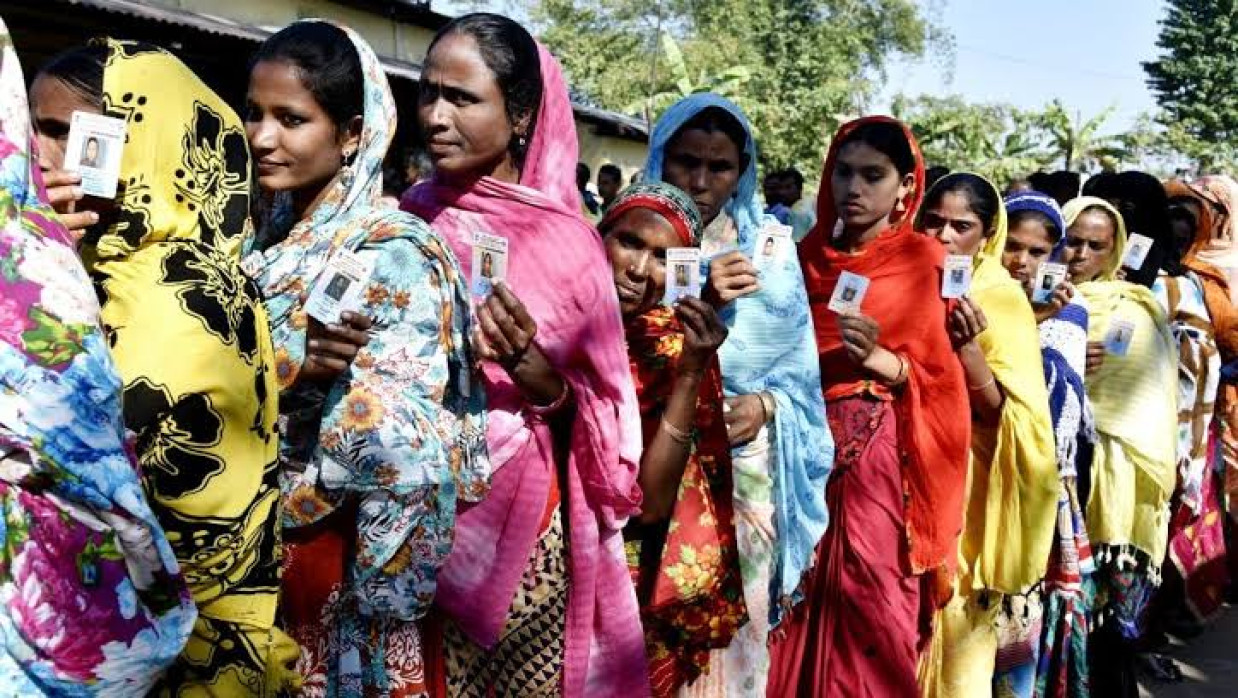
India has long taken extraordinary pride in conducting elections on a scale unmatched anywhere in the democratic world. Nearly a billion eligible citizens, enormous differences of language and geography, remote villages and crowded megacities are brought together periodically in an exercise that has helped sustain the legitimacy of the Indian republic. The Election Commission of India, or ECI, has traditionally occupied a particularly important place in this achievement. Its credibility depends not merely upon counting votes accurately but upon ensuring that every eligible citizen has a reasonable opportunity to cast one.
That is why the controversy surrounding the Special Intensive Revision, or SIR, of electoral rolls deserves attention well beyond India's partisan politics. At the center of the dispute is a deceptively simple question: Who gets to be on the electoral roll?
It's only gotten more pressing. SIR began in Bihar in 2025 and has spread to most of India. From what we know, about 130 million names have been dropped from draft electoral rolls across the country. The Election Commission states this was to ensure that the rolls were accurate by filtering out deceased, relocated, double-registered, and other ineligible voters. Many opposition parties and outside observers claim this went too far and disenfranchised valid voters.
There is a difference to be made here. Cleaning up your voter rolls isn't a bad thing. In fact, accurate voter rolls matter in any democracy. People who are dead, registered twice, or live somewhere else shouldn't be on your voter roll forever. The issue is how you remove those people from your voter rolls.
Delhi and the Scale of the Problem
It's easy to see why people are worried about the SIR.
When the draft electoral roll came out in late August 2026, it had around 4.77 million fewer people than the previous voter list of approximately 14.5 million. That meant nearly a third of voters were removed. They could apply to be added back if they felt they should be. But with so many names removed, it raised questions about what was happening.
Since then, public hearings and investigations have produced many stories claiming that certain communities were wrongly left off the list. The Indian Express reported on one such public hearing in Delhi, where over 4.7 million names were listed as absent, moved, dead, or duplicates. Many other voters have also received notices or will need verification.
For affluent citizens with passports, birth certificates, property documents, digital access and the ability to take time away from work, correcting an administrative mistake may be inconvenient but manageable. For a daily-wage laborer, migrant worker, elderly resident, poor woman or person with limited literacy, the same procedure can become a formidable barrier.
This is where an apparently neutral administrative requirement can have unequal consequences.
A person who must sacrifice a day's wages to visit an election office, obtain a certificate and return for another hearing bears a much greater burden than someone who can resolve the problem electronically from an office or home. Documentation requirements can similarly disadvantage people whose births were never formally registered or whose names have been spelled differently across government records.
The democratic question therefore extends beyond whether everyone technically faces the same rule. It concerns whether eligible citizens have a realistic opportunity to comply.
From Bihar to West Bengal
The controversy intensified during the SIR exercises associated with the 2026 state elections.
In Bihar, voters who could not establish connections with earlier electoral rolls faced additional documentary requirements. Critics argued that documents commonly possessed by poorer citizens were initially insufficient for parts of the verification process. They warned that the requirements would disproportionately burden migrants, women, Muslims, Adivasis and informal workers.
West Bengal subsequently became the most politically contentious case.
The source material for this essay cites analyses that find correlations between voter deletions and both constituency political characteristics and Muslim population shares. It also argues that introducing categories such as "logical discrepancies," including differences in names, ages, and other records, created another mechanism for additional scrutiny.
They need to be examined, but we cannot claim they were removed because of religion or assumed political ideology. They would also need to show a political motive.
But these numbers call for a public audit of the process. Voting should not just be fair. The system should let citizens understand why their name may have been removed and how they can fix any issues.
The results of the 2026 West Bengal elections heightened these concerns as a major political shift occurred. According to the Election Commission of India's official results, the BJP won 207 seats, and the All India Trinamool Congress won 80.
These should be kept separate from the debate on who was excluded from voting. There is no way to know whether those who were not on the roll would have voted, or how they would have voted. They may have even changed the outcome of some seats. Even in this paper, it states that "All we can do is count the votes that were cast. We cannot account for votes that could not be cast."
This is an essential distinction. The democratic concern does not require proving that voter deletions changed an election's winner. An eligible citizen's right to vote does not depend on whether that citizen's ballot would have altered the final result.
Trouble Inside the Election Commission
An important new dimension emerged in September 2026.
An Indian Express investigation reported that Election Commissioners Sukhbir Singh Sandhu and Vivek Joshi formally objected at least 14 times over approximately ten months to decisions and procedures within the Election Commission. Their concerns reportedly involved voter registration and deletion, changes connected with Form 6, appeals and the centralization of control over electoral-roll databases.
This development matters because criticism of the SIR can no longer be viewed solely as accusations from opposition parties against the institution administering elections. Questions have also emerged from within the three-member Commission itself.
According to the investigation, the two commissioners expressed concern about the centralization of voter-data systems and decisions they said were taken without their knowledge. Further reporting indicated that they raised concerns over the integrity and oversight of ECINet, the Commission's digital infrastructure.
But the Election Commission has argued that all steps taken were legal. Internal differences are just differences of opinion, they say. Supporters of this drive argue that the opposition is politicizing the issue.
These reasons can be weighed against the points against this. Voter rolls need regular updates. In a country as big as India, with millions of people passing away, moving from one place to another, etc., there will be inaccuracies in the roll of voters. Duplicate entries would also exist. If the EC did not take any measures to keep the data up to date, it would be at fault.
The question, therefore, is not whether rolls should be revised. It is how.
The Denominator of Democracy
A useful way to understand why voter-roll controversies differ from conventional allegations of electoral malpractice is to think of an election as a fraction.
Think of an election as a fraction.
The numerator consists of the votes actually cast. The denominator consists of the citizens permitted to cast them.
India, like many democracies, has experienced disputes involving the numerator: allegations of booth capturing, intimidation, improper counting, misuse of government machinery, and other election-day irregularities.
The SIR issue is over the denominator.
When someone eligible to vote is removed from the roll before polling day and cannot get their name back on in time. Their vote wasn't stolen. There was no vote.
Electoral rolls are a key part of any democracy. We should ask whether citizens with the right to vote were given the opportunity to vote before asking whether votes were tallied fairly.
Minorities, Migrants and the Documentation Divide
The greatest concern in the current controversy involves citizens already disadvantaged by poverty, mobility, gender, or social status.
India's extraordinary diversity complicates creating any national identity database. Names can have multiple spellings. Women often change surnames or addresses after marriage. Migrant workers move frequently. Low-income families may possess few historical documents. Birth registration was far from universal in previous generations.
A verification system built around perfectly consistent documentation can therefore produce systematic inequalities even without explicit discriminatory instructions.
Critics have gone further, alleging that Muslims and other marginalized communities have been disproportionately affected in some areas. The supplied material cites statistical analyses of West Bengal suggesting relationships between deletion rates, Muslim population shares, and previous electoral patterns.
They need to be looked into. Data should be released so we can see. Maybe numbers were higher because of immigration, deaths, or whatever the reason may be. But if that is true, the commission should be able to prove it. If they can't, then we have more discrepancies to look into.
Transparency is therefore not an inconvenience imposed upon election administrators. It is the mechanism that builds public confidence.
Technology and Centralized Electoral Power
It also creates another modern-day issue with democracy. Who has control of voting machines?
Voting is now run through massive databases and online matching systems. While these can be helpful, they can also reduce transparency.
The Indian Express investigation reported concerns within the Election Commission over ECINet and the extent to which control of electoral data had become centralized in Delhi rather than remaining with statutory officials responsible for voter registration at state and constituency levels.
It should not only be viewed as a technical issue.
When a program can flag voters or prevent them from registering, we need to know who made those decisions and why. Who can change those decisions? What paper trail will exist, and how can it be disputed?
An algorithm cannot become an invisible election official.
The Need for Corrective Safeguards
Signs suggest criticism has prompted some institutional response. Reuters reported on September 26 that the Election Commission ordered a review of its voter-roll software after reports of internal concerns. The Commission also announced procedural changes intended to make verification easier, including having local officials visit voters whose records contain discrepancies rather than requiring those citizens to appear personally at election offices.
Delhi's timetable has also been extended, providing additional time for claims, objections, and verification.
These are constructive measures because the objective of electoral administration should not be simply removing questionable names. It should create the most accurate possible register of eligible citizens.
These should be protected by establishing rules for who can be removed. These should include a list of reasons for removal and a written notice to the individual. A system should allow people to appeal their removal, with enough time before an election to do so. Audit vote-tallying programs and release statistical data with no names attached so anomalies can be found.
Democracy Begins Before Election Day
The controversy over India's Special Intensive Revision ultimately concerns more than one election, one state, or one political party.
Democracy begins long before a citizen enters a polling booth.
It begins when the state recognizes that citizen as part of the electorate.
The Election Commission of India carries an unusually heavy responsibility because it administers elections for one of the world's largest and most complicated electorates. Its task requires constant revision of voter lists, technological modernization, and protection against fraudulent registration; none of those objectives conflict with democracy.
But accuracy and inclusion must go hand in hand.
An electoral roll containing ineligible voters damages confidence. An electoral roll that excludes eligible citizens damages it just as surely.
India's democratic strength has historically rested partly on the belief that governments may change, but the machinery determining who may participate remains institutionally independent. The current controversy is therefore a test not simply of the SIR but of the Election Commission's capacity to maintain public trust.
It should not be from partisan finger-pointing or institutional cover-ups. The process should be transparent and auditable. It should use technology that third parties can verify, with an appeal process. With proper due process.
India does not need to choose between clean electoral rolls and universal franchise. A mature democracy must provide both.
The essential principle is straightforward. The voter list should never become an instrument for deciding which kinds of citizens deserve political participation. Its purpose is to identify, as accurately and inclusively as possible, every citizen who already possesses that right.
When confidence in that principle weakens, the consequences extend beyond the fortunes of the BJP, the Congress, the Trinamool Congress or any other political organization. They reach the foundation of representative government itself.
Elections determine who governs. But before an election can answer that question legitimately, another question must first be answered fairly:
Who gets to vote?


0 Comments
LEAVE A COMMENT
Your email address will not be published