

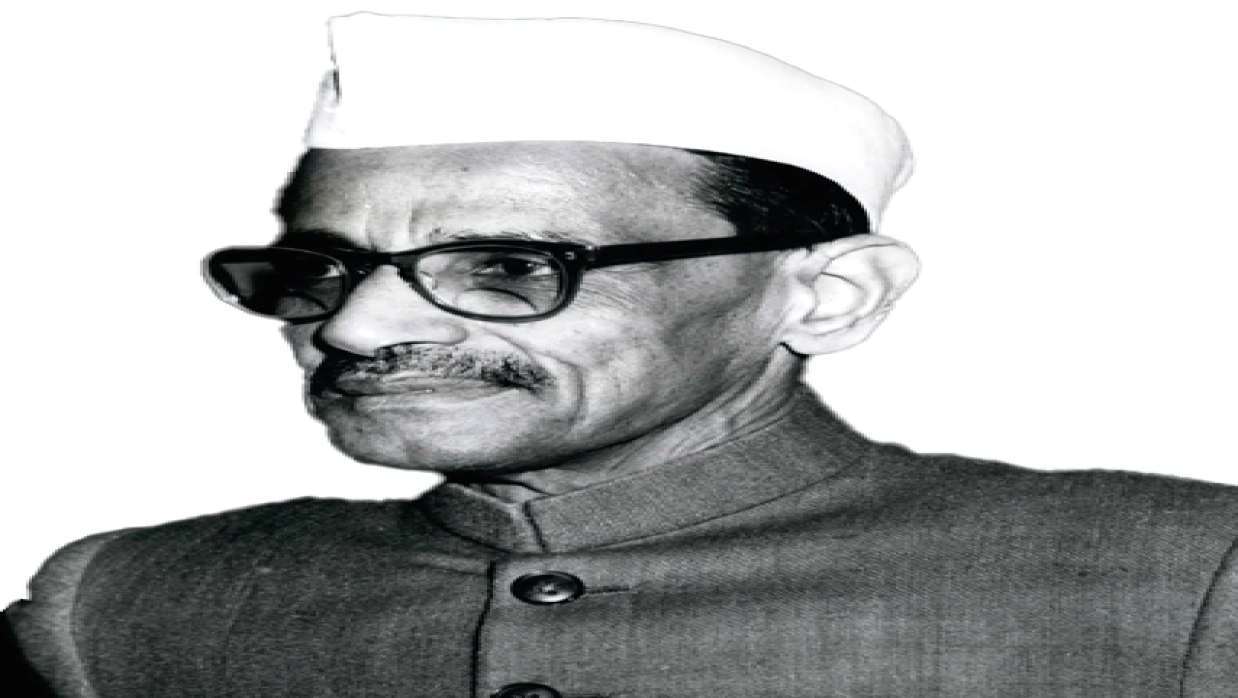
At a time when politics is seen more as a means to power, property and fulfilment of other material desires, a politician who firmly stood on the foundation of morality, selflessness and empathy for workers but could not stick to power for a longer duration is no more considered an illustration of success. The trivialised politician, Gulzarilal Nanda acted as Prime Minister of India twice, 13 days each from 27 May to 9 June 1964 (after Nehru) and from 11 January to 24 January 1966 (after Shastri) as Union Home Minister from 1963 to 1966 as Labour Minister and Planning Minister from 1950 to 1963.
Nanda was born on 4 July 1898, Sialkot, Punjab now in Pakistan in a Khatri merchant family. Sialkot was a Hindu-Muslim trading city of surgical instruments and sports goods in 1920s. Nanda grew up in a mohalla where a Hindu shopkeeper’s ledger was kept by a Muslim munshi, where Diwali sweets came to Eid house. In 1947, that mohalla became part of Pakistan overnight. His cousins, school, family house, streets — all became parts of a country with adversarial relations. He did not migrate. He was already in Ahmedabad since 1922. But he became a refugee without moving. His birthplace certificate became a foreign certificate. As Nanda lost his home in the partition, the loss developed a strong moral character in him that guided him not to own home as peoples’ faith was killed by the phenomenon of partition, he always believed state must stay away from faith and as many people were displaced by sudden declaration of partition, protecting workers who primarily became rootless became part of his morality. Nanda’s morality was not Gandhian import alone, it was Partition’s product. Gandhism gave him language of trusteeship and bread labour; Partition gave him detachment from property and fear of faith-based state. He was a refugee who refused to become a settler — in house, in power, or in ideology. That is why his morality looked saintly in politics, but it was actually survival ethics of a Punjabi Hindu who lost Sialkot.
NANDA'S PERSPECTIVE ON POLITICS
Nanda firmly believed politics without morality is a sin. This was his core philosophy and the reason he failed as politician. Nanda wrote in his diary 1963, “Politics without morality is like business without accounting. It will run for some time, then collapse. Morality without politics is like accounting without business — correct, but empty. I want both together.” For him, politics was sarvodaya, not satta. He argued industrialists are trustees of people, not owners. As Labour Minister, he told mill owners: “Profit is yours, but workers are God’s. Keep extra profit in trust for workers.” That is how ESI and PF were born. As Acting PM in 1964, he refused to sit on PM chair in Parliament — stood and said “This chair is in trust, I am only watchman for 13 days.” He told Cabinet: “If we think chair is ours, we will become thieves.”
Nanda scrupulously followed the Gandhian principle that everyone must do physical labour for personal purity and societal welfare and he was committed to this until his death which was illustrated by his personal involvement in cleaning of his own toilet even during his stint as Home Minister and in his life-long commitment to spinning of charkha one hour daily and he used to wash his clothes in Yamuna river. He wrote: “If minister never sweats, he will make policies that make others sweat more.” Nanda always believed that means were more important than ends. However, many politicians then and today would probably treat these as high moral principles which if applied to politics, power and personal gains would have to be sacrificed. Hence, they would like to laugh at these principles simply by criticising them as idealist undercutting pragmatic politics. Nanda refused to tap phones of Morarji Desai though Desai used to oppose him. Nanda said: “I will lose election, not my soul.” He refused President’s Rule in Kerala 1964 though Nehru wanted quick dismissal of the state government. Nanda said: “Dismissal by Article 356 is moral murder of federalism.” He refused to stay as Prime Minister beyond 13 days in 1964 and 1966 though Army Chief offered support. He said: “Constitution says Acting, not permanent. Means matter.” In Granville Austin’s words Nanda was the only man in Nehru Cabinet who would resign than give immoral order. On the other hand, first Prime Minister Jawaharlal Nehru and his daughter Indira Gandhi chose to demonstrate pragmatism by justifying that good end can justify bad means. Hence, they hardly saw any problems in tapping phones, dismissing state governments and nationalizing banks.
Nanda lived the Gandhian principle- service to the poorest as service to God. Nanda was donating a lion share of his earnings 1500 rupees to labour fund from his salary of 2000 rupees that he receiving as a Minister. He had no house, no car and no bank balance until his death. He died in a rented house in Ahmedabad with meagre 1500 rupees in his account. As Labour Minister, he lived 24 years in Ahmedabad labour chawl, not bungalow. He wrote: “If poor sees minister in palace, poor loses faith in democracy.” Quite contrary to his lifestyle, other leaders professing socialist ideas such as Jagjivan Ram and Indira Gandhi built bungalows. Many political leaders of contemporary period not only build and live in bungalows, their incomes from diverse sources far exceed their salaries. They would hardly bother applying immoral means to misuse public offices for private gains.
Nanda demonstrated politics is all about sacrifice and not a job. He went to jail three times in 1932, 1942 and in 1975 for his commitment to moral principles. He lost professorship but never asked for pension. In 1966, when Indira Gandhi sacked him from Home Ministry, he did not join opposition for revenge. It was only after nine years that he joined the Movement led by Jaya Prakash Narayan only when Emergency attacked Constitution. In 1977, when the Janata party won and offered him Cabinet, he refused by uttering: “I fought Emergency for dharma, not for kursi.” This shows his commitment to pure moral principles which always remained beyond material desires for power and mundane aspirations.
Nanda strengthened anti-corruption institutions through CVC and Lokpal even as the Congress wanted flexibility with business houses for elections. The Chairman of Santhanam Committee Report — Report on Prevention of Corruption (1964) K. Santhanam wrote in foreword: “This Committee was appointed at the insistence of Home Minister Nanda who wanted corruption to be studied as a systemic phenomenon, not personal.” N. N. Vohra, Former Defence Secretary, said on CVC creation that “CVC was Nanda’s child. He wanted it to have power to prosecute a Minister. Cabinet reduced it to advisory body. Nanda's idea was 50 years ahead — Lokpal became law only in 2013”. P.R. Dubhashi in his ‘Essays in Public Administration’ said: “Every anti-corruption institution in India — CVC 1964, Lokayukta concept 1966, ARC 1966 — bears Nanda’s initials. Ironically, the most honest man created institutions that declared his own party corrupt.”
Bipan Chandra stated in his work ‘India since Independence’ (2008) “Nanda's economics was Gandhian trusteeship in a Nehruvian state. While Nehru’s Mahalanobis model wanted steel, Nanda wanted employment. History chose steel, but unemployment remained — proving Nanda’s question was right, his answer was unviable”. Francine Frankel in ‘India’s Political Economy 1947-77’ writes: “In Planning Commission, Nanda was the lone voice asking ‘Where is the worker in this plan?’ He lost every vote, but his dissent notes are the only ethical record of the Commission”. K.L. Joshi in ‘Gulzarilal Nanda: A Life in the Service of People (Biography, 1997)’ writes: “He washed his own clothes as Acting Prime Minister. Not for publicity — because for 24 years in Ahmedabad mill chawls, no one washed them for him.” B.G. Verghese in ‘Water of Hope’ writes: “India remembers those who kept power — Nehru, Indira. India forgets those who kept restraint-Nanda”
Nanda as a moralist relentlessly pursued prohibition whereas the Congress needed liquor lobby money. Such a man of unadulterated morality without harbouring desires for power can hardly be found in politics. His commitment to workers was unfathomable. Nanda was the father of Labour Welfare State. He was the Secretary of Ahmedabad Textile Labour Association (1922-46) for 24 years under Gandhi, he built India’s labour laws, ESI (1948), PF (1952) and prepared drafts of Minimum Wages (1948). Nanda died at the age 99 in 1998. He had no phones and no house. When Indian government decided to award him with Bharat Ratna in 1997, then Prime Minister I.K. Gujral’s office could not initially find him and finally traced him in one room without fan in Ahmedabad. He politely asked: “Why are you giving me this award? I did nothing.”
Nanda failed as a pragmatic politician. He was sacked as a Home Minister by Indira Gandhi as the Ministry needed to use force when necessary. On 7 Nov 1966, 10,000 sadhus led by Jana Sangh and Arya Samaj under the rubric of Cow Protection Agitation attacked the Parliament. Swami Rameshwaranand marched to Parliament demanding total cow slaughter ban. The demand was close to Nanda's own Gandhian faith — he was lifelong vegetarian and cow protection supporter. He first refused to lathi-charge — He said “They are sadhus.” The crowd burnt 30 buses and tried to storm Lok Sabha. Then he ordered firing and that resulted in killing of 8 persons and Parliament lawns burnt.
Nanda was such a moralist who never understood the nuances of crude politics. He never even entertained populism at the cost of moral means. India chose Nehru in 1950s, Indira in 1970s, and forgot Nanda — because democracy remembers managers and empresses, not saints who wash their own toilets. Nanda proved you can be honest Home Minister, you just cannot remain Home Minister if you are honest. His life proves one theory of Indian politics: You can be morally great and politically irrelevant at same time.


0 Comments
LEAVE A COMMENT
Your email address will not be published