

Book review
Imprint: Vintage Books, Published: Aug/2026,
ISBN: 9789377304645 (Hardback), Length: 264 Pages, MRP: ₹699.00
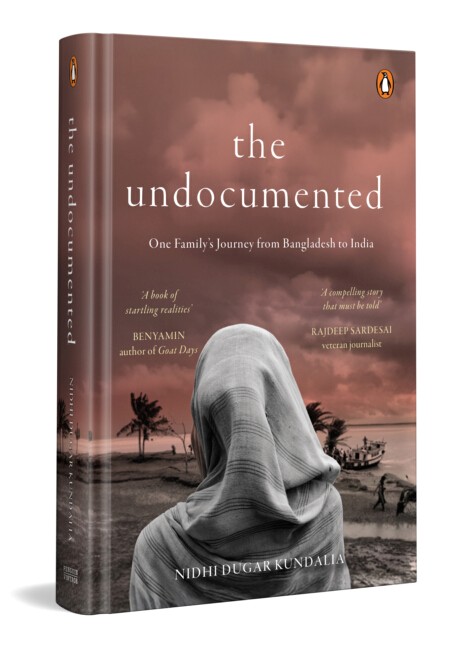
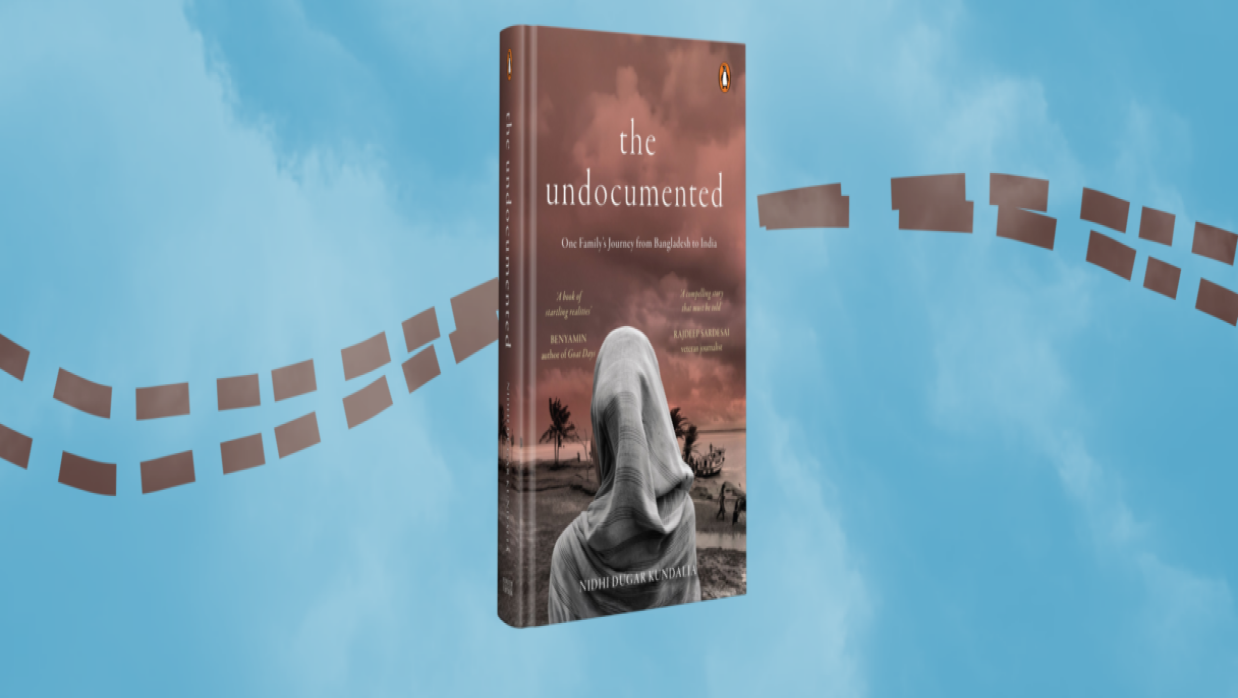
The Undocumented: Climate, Borders, and the Struggle to Belong
Climate-driven migration can feel abstract. It can look like refugee camps full of people who have nowhere else to go or numbers politicians deny. In The Undocumented, journalist Nidhi Dugar Kundalia offers another way to view climate migration. Kundalia followed Safrat, who lives on the Bangladesh side of the Sundarbans mangrove forest, and Safrat’s two children, Nur and Nabeel, for thirteen years. When Cyclone Aila flooded away everything they had left to live on, Safrat and her children joined thousands of other people who crossed into India. There, they attempted to settle in Kolkata without papers or much of a safety net. Kundalia captures migration not through heated policy debates but through the experience of people who just want to live.
When Cyclone Aila destroyed Safrat’s home in May 2009, it not only damaged the tiny house she shared with her family but also flooded her crops, salted the land, reduced access to drinking water, and left little government support. If Safrat wanted to stay in Bangladesh, she would have to accept the threat of storms and live in poverty. If she left, she risked crossing the border illegally and starting over with nothing. Safrat was left with impossible choices that Kundalia documents throughout the book.
Politicians and pundits often dehumanize undocumented migrants, labeling them as "infiltrators" or calling them foreigners, invaders, security threats. Such migrants, said one longtime resident of informal settlements in Kolkata, are not people but " politicians' Bangladeshis. That language erases what Kundalia documents over hundreds of pages: Safrat's humanity. A birth certificate or expired passport can note nationality, age, income bracket, mother tongue, or religion. What gets left out are the details that make someone individual: their loves and losses, desires and aspirations, doubts and fears. Migration often forces people to leave behind land, community, language, and former identities, knowing they could be separated from the people they love at any moment.
Safrat's family is contending with environmental catastrophe. Hazards like Cyclone Sidr in 2007 and Cyclone Aila in 2009 worsened existing stressors such as erosion, saltwater intrusion into freshwater sources, erosion of protective embankments, loss of agricultural productivity, and violent storms. Sea-level rise and subsidence also contribute to these stressors. Climate change may not be the primary cause of environmental degradation in the Sundarbans mangrove forest, but it accelerates the risk factors. Climate insecurity isn't a future threat to delta residents. It's currently making their homes less safe, destroying their livelihoods, and ripping communities apart.
Safrat, Nur, and Nabeel's struggles do not end when they arrive in Kolkata. To survive, they must hide. Safrat adopts the name Sapna when she finds work as a domestic helper. The family obscures its origins in Bangladesh and Muslim faith. Safrat, Nur, and Nabeel must regulate their language, life stories, and behavior. If authorities catch them, they could face harassment, detention, or deportation. When the government can expel people who have put down roots, there is no guarantee of safety, even in a place that grows over time into a home.
Borders look neat and precise on maps. The human geography between Kolkata and its neighboring West Bengal district and Bangladesh is more complicated. Bangladesh and West Bengal have common languages, literature, cuisine, folklore, and trans-border families. Colonialism, Partition in 1947, and Bangladesh' Liberation War of 1971 dissected what was once a continuous cultural region. Those living on either side of the border are connected by generations of intertwined lives. Clothing, skin color, and even the Bengali language cannot conclusively identify who is Indian and who is Bangladeshi.
India's politics has added to the uncertainty marginalized communities experience. The fraught implementation of the Citizenship Amendment Act, Assam's National Register of Citizens, and proposed amendments to voter-registration processes have created fear in vulnerable populations. While each of these legal tools serves a different purpose and follows a different process, together they have stoked citizenship-based anxieties. Low-income people and the displaced are at a disadvantage if identification documents serve as the primary evidence of who someone is. Documents can be lost in flooding, destroyed during periodic work migrations, filled out incorrectly, or never provided.
Kundalia doesn’t sanitize Safrat’s struggle, though she makes her fully human. The family laughs, hopes, fights, and loves over risky trips to gather food, unstable jobs that don’t pay enough, makeshift housing, and fear of staying in one place too long. Safrat dreams of her children having opportunities she cannot provide: an education for her son Nabeel and a family for her daughter Nur. Children are forced to grow up too soon, grappling with life's difficult circumstances with their mother’s help. Family relationships are strained over distance. Migration pushes on the relationships Safrat, Nur, and Nabeel fight to preserve.
Time is where Kundalia’s book truly shines. She watched Safrat’s children grow up and move on; relationships come and go, and family members pass away, move far away, or fall out of contact. We talk about climate migration in future tense too often: What if this happens? What if that? We also talk about migrants as if they always act on time, but The Undocumented demonstrates that climate migration is happening now. Border walls and drones can prevent people from crossing borders, but they cannot fix the problems that make people leave. Kundalia lets Safrat, Nur, and Nabeel ask us, the reader, to see the people within migration crises.


0 Comments
LEAVE A COMMENT
Your email address will not be published