

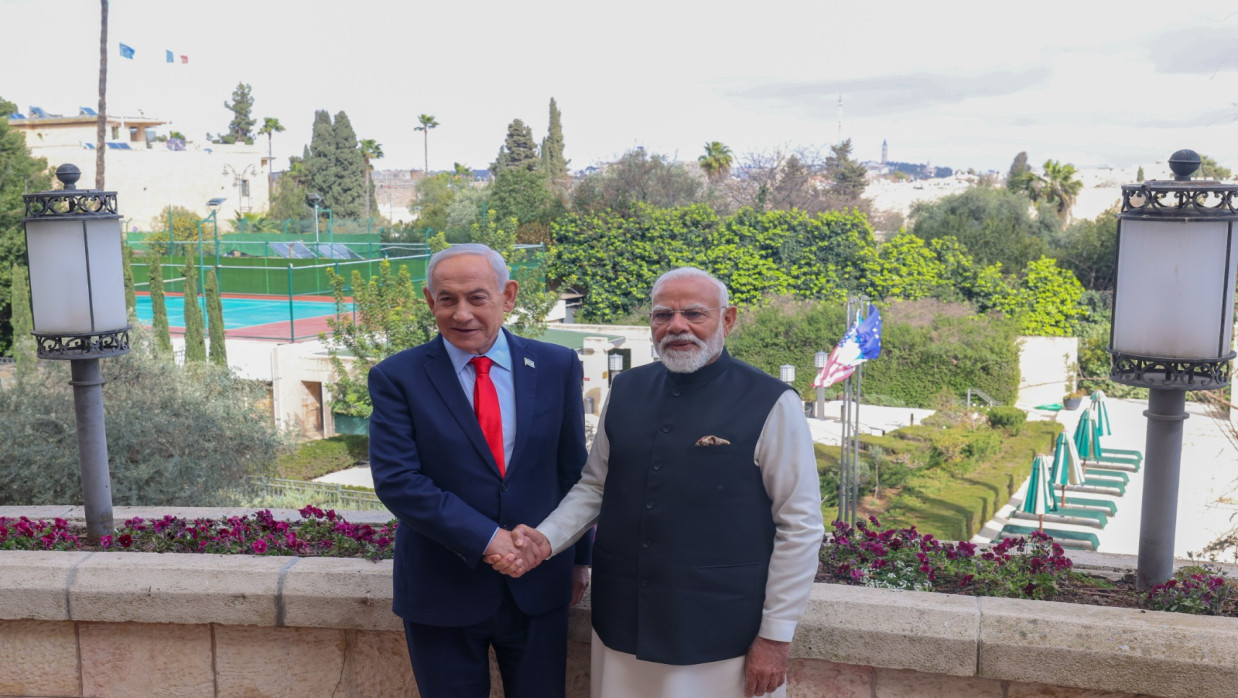
As Pakistan emerged as a significant and credible interlocutor in the U.S.-Iran conflict, many of India’s strategists and analysts openly lamented their country's irrelevance to the major geopolitical developments unfolding in the Middle East. In contemporary geopolitical discourse, India’s foreign policy has drawn criticism, including for its untimely alignment with Israel and revelation of fatherland-motherland relationship between Israel and India by Prime Minister Narendra Modi during his visit to Tel Aviv two days before the coordinated attack by nuclear-armed U.S. and Israel on non-nuclear-armed Iran on 28 February 2026. India’s diminishing influence is further reflected in Washington’s increasingly condescending attitude toward “Hellhole” India and its decision to revert the designation of the U.S. Indo-Pacific Command to the U.S. Pacific Command.
India has remained irrelevant to diplomatic efforts to end the US-Iran conflict, while Pakistan emerged as a credible mediator. Some of the strongest criticism of India's dismal diplomatic performance came from within India itself. On 26 March 2026, Congress leader Jairam Ramesh wrote on X that Pakistan's emergence as a mediator and facilitator of talks to end the war in West Asia represented "India's extreme embarrassment and a setback to its regional diplomacy." On 29 March 2026, Indian strategic affairs expert Dr Brahma Chellaney observed, "Pakistan, despite strongly condemning U.S.-Israeli strikes, has emerged as Washington's preferred backchannel to Tehran" while "India, despite tilting toward the aggressors, finds itself sidelined in Washington's diplomatic calculus." He also criticised the Indian Minister for External Affairs S. Jaishankar’s derogatory remarks on Pakistan’s mediatory role, arguing that the use of such language was “both undiplomatic and ill-judged."
Seema Guha, a senior journalist at The Federal newspaper, in her opinion piece titled India Must Recalibrate Its Pakistan Policy as Isolation Strategy Fails, also criticised Jaishankar’s foul language, stating that “Jaishankar may mock Pakistan,” however, “that does not in any way detract its image in the global community." She also stressed that the Modi government's efforts to isolate its arch enemy diplomatically have reached a "dead end" and that "Islamabad has unexpectedly re-emerged at the centre of regional diplomacy, cultivating ties across rival power blocs and positioning itself as a useful intermediary in a deeply polarised world order."
India continues to deepen its alliance with Israel, despite widespread international condemnation of Israel’s genocide in Gaza, occupation in the West Bank and military escalation against Iran. In February 2026, during Prime Minister Modi’s visit to Israel, both countries expanded their cooperation to a “Special Strategic Partnership.” The Indo-Israel partnership is a symbiotic relationship based on shared occupation playbook, genocidal tendencies and right-wing politics. While a growing number of countries condemned Israel's actions and the U.S.-Israeli strikes on Iran, Prime Minister Modi sought to strengthen ties with Israel.
On 27 June 2026, Indian Congress leader Sonia Gandhi sharply criticised the Modi government, stating that India’s current foreign policy had alienated the country from its traditional partners in Palestine, Iran and the wider Middle East. She added that India was slipping further into Israel’s strategic orbit at a time when the world is increasingly pivoting away from it. She further stated that “today we are exceptional in our continued indifference to the flagrant violation of the global rules-based order, to the suffering of our fellow peoples in the Global South, and to the abasement of human dignity that is on open display in Gaza and the West Bank.”
India’s position within the 11-member BRICS+ has also come under criticism. Despite holding the BRICS+ presidency in 2026, New Delhi failed to demonstrate leadership responsibilities expected from the chair. In his 16 March 2026 X post in reference to the U.S.-Israel air offensives against Iran, Jairam Ramesh wrote that despite presiding over BRICS+ in 2026, India "has not summoned up the inclination or the courage to put out a collective statement on the U.S.-Israel air offensives on and targeted assassinations in Iran, as well as on Iran's subsequent attacks on non-military targets in the GCC countries." He further stressed that Modi was "diminishing the value and standing of BRICS+."
By avoiding BRICS condemnation of strikes on Iran, the Modi government tried to appease Washington and Tel Aviv. Yet, this posture has not secured India the placement it covets in Western geo-economic and geopolitical forums. Despite replacing Japan as the fourth-largest economy, India has not been offered membership of the Group of Seven (G-7) and continues to attend its meetings as a guest, much to the domestic criticism. New Delhi’s refusal to join Western sanctions against Russia, involvement in heinous acts of terrorism in Canada and the U.S., human rights abuses and suppression of press freedom are issues of serious concern to international community, including India’s Western partners.
Furthermore, recent U.S. actions have unmistakably downgraded New Delhi's strategic significance for Washington. The Indo-U.S. strategic partnership came under visible strain in June 2026 when Washington refused to apologise for the deaths of Indian sailors killed in U.S. strikes on a commercial vessel in the Strait of Hormuz. In the same month, the U.S. Department of War, in a surprise move, announced that the U.S. Indo-Pacific Command (USINDOPACOM) would revert to its original name, U.S. Pacific Command (USPACOM). Interestingly, Trump 1.0 had himself renamed USPACOM to USINDOPACOM in 2018. The Pentagon claimed that it was merely restoring the Command's historical name without changing its geographic area of responsibility. However, Nazmus Sakib, a lecturer at the University of Kentucky, argued in his Al Jazeera article titled In South Asia, America has stopped asking India for permission that “names are never just names. They are signals, postures, and compressed strategies.” Renaming signals the end of an era in which India was viewed as Washington's strategic partner for balancing China in the region.
University of Southern California professor Derek Grossman, in his analysis titled Why Trump’s Pentagon Abandoned ‘Indo-Pacific,’ notes that the Indo-Pacific concept reflected a strategy centred on India as a pivotal partner, coalition-building and long-term competition with China. By restoring USPACOM, Grossman says, “Trump may be signalling that those assumptions no longer guide Washington’s strategy to the same extent they once did.” The term “Indo-Pacific”, which sought to boost the strategic importance of the Indian Ocean and strengthen ties with India, no longer appears central to Trump’s foreign policy.
India’s foreign policy and diplomatic failures have come under widespread criticism as a direct consequence of the Modi government’s short-sighted policies. As Indian political scientist Sushant Singh argues in his opinion piece titled Double trouble: India’s knots, published in The Telegraph, India’s actions reveal a “narrowing of influence, a shrinking of moral voice, and a nation that has traded strategic seriousness for hollow posturing.” By abandoning its long-cherished strategic neutrality in favour of alignment with the West and genocidal Israel, New Delhi has undermined its own diplomatic credibility, which has eroded its regional and global standing. Ultimately, India’s growing diplomatic isolation is less of a product of external factors and more of the ill-conceived strategic choices made by the Modi government.


0 Comments
LEAVE A COMMENT
Your email address will not be published