

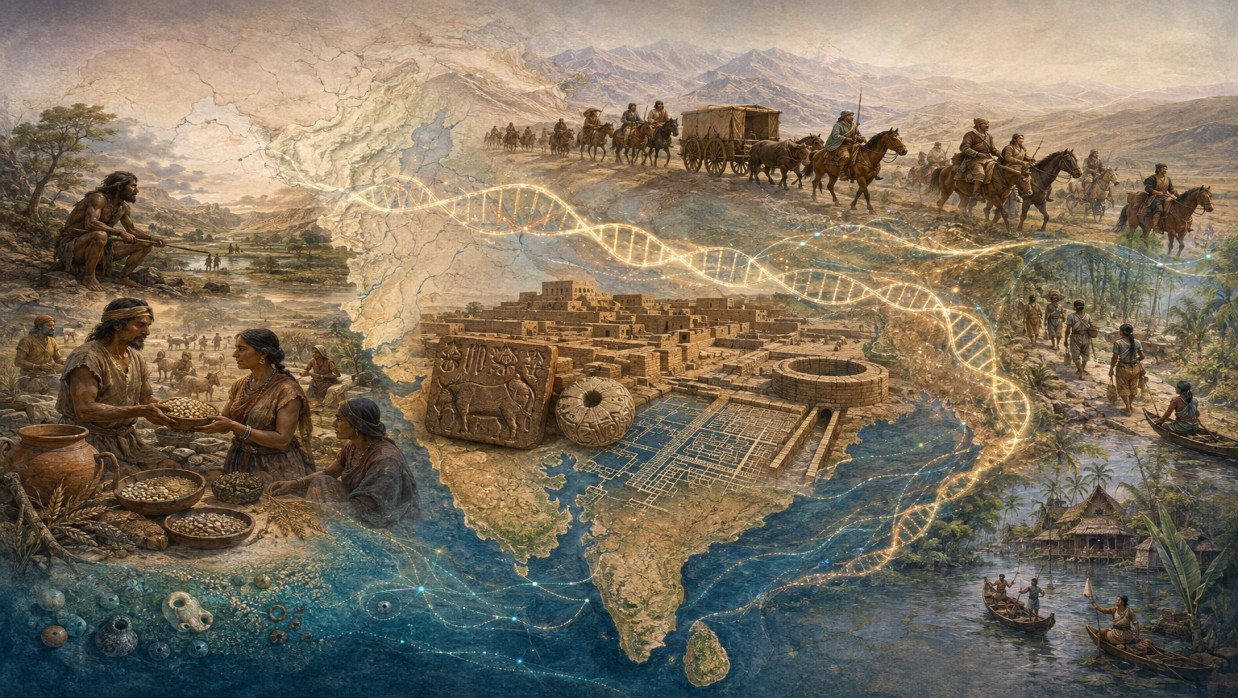
Competing political ideologies have long sought to claim ownership over the origins of India’s people. During the colonial period, writers promoted the idea of invading Aryans crushing an advanced indigenous civilization. Meanwhile, some nationalists today claim Indian civilization and the Indo-European languages originated entirely in the subcontinent. Both extremes miss the mark, according to ancient DNA. South Asia was not the product of a single population or migration event, but rather a zone where multiple ancient populations repeatedly mixed and exchanged ideas over tens of thousands of years.
The three major ancestors are the descendants of the first modern humans to populate South Asia, people related to ancient Iranian populations, and pastoralists from the Eurasian steppe who immigrated during the Bronze Age. Additionally, migrations from East and Southeast Asia introduced further diversity, particularly to Northeastern South Asians and speakers of Austroasiatic languages. These categories are merely genetic distinctions and do not exactly match any one caste, religion, language, or nationality in India today. Modern South Asian populations carry these ancestral components in widely varying proportions, alongside additional regional influences.
The First South Asians
The deepest roots of most modern-day South Asians trace back to modern humans who migrated out of Africa and arrived in South Asia about 50,000–65,000 years ago. The descendants of these peoples are traditionally referred to as Ancient Ancestral South Indians (AASI). They were hunter-gatherers before the arrival of agriculture, civilization, and the formation of South Asian nations.
Researchers have not yet recovered ancient AASI genomes. This is most likely because DNA degrades quickly in hot, humid conditions. Researchers have statistically inferred this ancient ancestry using modern and ancient genomes. Andaman Islanders have also been used as proxies because of their ancient ancestry with early eastern Eurasians. However, they are not unchanged descendants of AASI, nor representatives of ancient Indians from the mainland; their ancestors diverged and evolved separately.
Indian variation can be traced overwhelmingly to a single out-of-Africa migration wave about 50,000 years ago, according to a massive 2025 genome study. That research also indicated that India's ancestors underwent a severe genetic bottleneck before radiating into many populations. "Below India's remarkable current diversity is a deep, deep unity," the scientists wrote. (Cell)
Iranian-Related Ancestry and the Indus Civilization
The second major component concerns the ancient inhabitants of the Iranian plateau. This finding is often reduced to the claim that Iranian farmers entered India around 10,000 years ago and introduced agriculture. The evidence is more complicated.
The Iranian-related ancestry detected in the Indus region diverged from the lineage represented by known Iranian agriculturalists before farming became widespread in Iran. It therefore cannot automatically be described as the ancestry of already-established Iranian farmers. People carrying this lineage may have entered South Asia before agriculture, or farming may have developed through some combination of local experimentation, migration, and the transmission of knowledge across neighboring regions.
Between roughly 4700 and 3000 BCE, Iranian-related peoples intermixed with populations with varying amounts of AASI ancestry. These people were ancestral to those who eventually established the Indus, or Harappan, Civilization, which flourished between about 2600 and 1900 BCE. It included cities like Harappa, Mohenjo-daro, Dholavira, and Rakhigarhi, along with regional civilizations that traded, made crafts, managed drainage, and practiced urban planning.
A genome recovered from Rakhigarhi contained Iranian-related and deeply South Asian ancestry but no detectable ancestry from steppe pastoralists. It also lacked the Anatolian-farmer ancestry that accompanied agricultural expansion into much of Europe. Although one genome cannot represent the entire Indus population, the result indicates that the civilization arose before steppe ancestry became widespread in South Asia.
The Steppe Migration
The third major layer arrived after the Indus Civilization had begun to decline. Between approximately 2000 and 1500 BCE, groups possessing ancestry associated with Middle-to-Late Bronze Age pastoralists of the Eurasian steppe moved southward through Central Asia into the subcontinent.
This population wasn't necessarily just the Yamnaya migrants themselves. While partly derived from earlier steppe populations, these migrants also picked up some European farmer ancestry before entering Central/South Asia. Instead, they appear genetically closest to cultures like Sintashta and their relatives.
These migrants were unlikely to have been composed entirely of Yamnaya people. They were partially descended from earlier steppe populations, but had also absorbed additional European farmer ancestry before arriving in Central and South Asia. They are genetically closer to peoples such as Sintashta and related cultures than they are to a purely Yamnaya migration.
Steppe ancestry is not equally represented across all paternal lineages, implying that the migration was biased towards one gender, most likely males. However, the study found no evidence of complete replacement/extinction of the existing population. They mixed with people of Indus Valley Civilization ancestry, creating novel ancestry combinations that were distributed variably across northern South Asia. The largest ancient-DNA study of South Asia so far has characterized it as "not the large-scale movement of one group that sweeps across a continent, but migration and resulting mixture" instead. (Science)
Beyond the ANI–ASI Divide
Earlier genetic research described most mainland Indians as mixtures of two hypothetical ancestral populations: Ancestral North Indians, or ANI, and Ancestral South Indians, or ASI. ANI ancestry was more closely related to West Eurasians, while ASI ancestry was more distantly related to populations outside South Asia.
Ancient DNA studies have shown that neither group was ancient or genetically pure. ANI can be modeled as primarily composed of Indus- and steppe-related ancestries. ASI originated when Indus-related populations mixed with populations that had higher proportions of AASI ancestry. Modern Indians have these ancestral components in varying degrees; no major community is a pure representative of either ANI or ASI.
Geography has shaped these trends, but it has not produced an impermeable barrier. The Hindu Kush and northwestern passes were conduits into South Asia, as were the coastlines and eastward corridors. Borders between today's India, Pakistan, Bangladesh, Nepal and Afghanistan are insignificant to population processes that occurred thousands of years before those countries existed.
When Mixture Gave Way to Endogamy
Genetic data indicates extensive admixture across the subcontinent between 4200 and 1900 years ago. Thereafter, numerous populations became increasingly endogamous, marrying within their respective social groups. This development coincided with, but did not occur simultaneously across all regions, the consolidation of caste and jati boundaries.
Population endogamy preserved different proportions of ancestries within populations that lived near each other. It also created powerful founder effects with medical consequences, as certain rare diseases can reach high frequencies in small populations. The caste system wasn't responsible for India's first genetic diversity. It restricted future marital networks and maintained differences from earlier migrations.
Ancient DNA therefore tells us neither a tale of racial purity nor one of straightforward foreign invasion. It tells us of a civilization forged through cycles of migration, contact and assimilation. India’s first hunter-gatherers, Iran-related groups, Indus populations, steppe herders and subsequent migrants all helped shape its people.
The main takeaway is that migration doesn’t make a civilization less indigenous. Cultures can only put down roots through the lives we live, the languages we adapt and create, and the institutions we establish. India’s genetic history belongs to no political movement. It’s shared, complicated, interconnected, and bigger than any attempt to box it into one origin story.


0 Comments
LEAVE A COMMENT
Your email address will not be published