

Speaking before a crowd of thousands at Madison Square Garden on August 29, 20 26, Mohan Bhagwat, head of India’s extremist Rashtriya Swayamsevak Sangh, called for religious tolerance and unity. Bhagwat, who was introduced as a cultural and spiritual leader, was invited to address the audience at the “Universal Oneness Celebration” by American Hindus for Engagement and Dialogue. During his speech, he promoted tolerance, respect, civic engagement and responsibility, and emphasized the ancient Sanskrit teaching of Vasudhaiva Kutumbakam, or “the world is one family.”
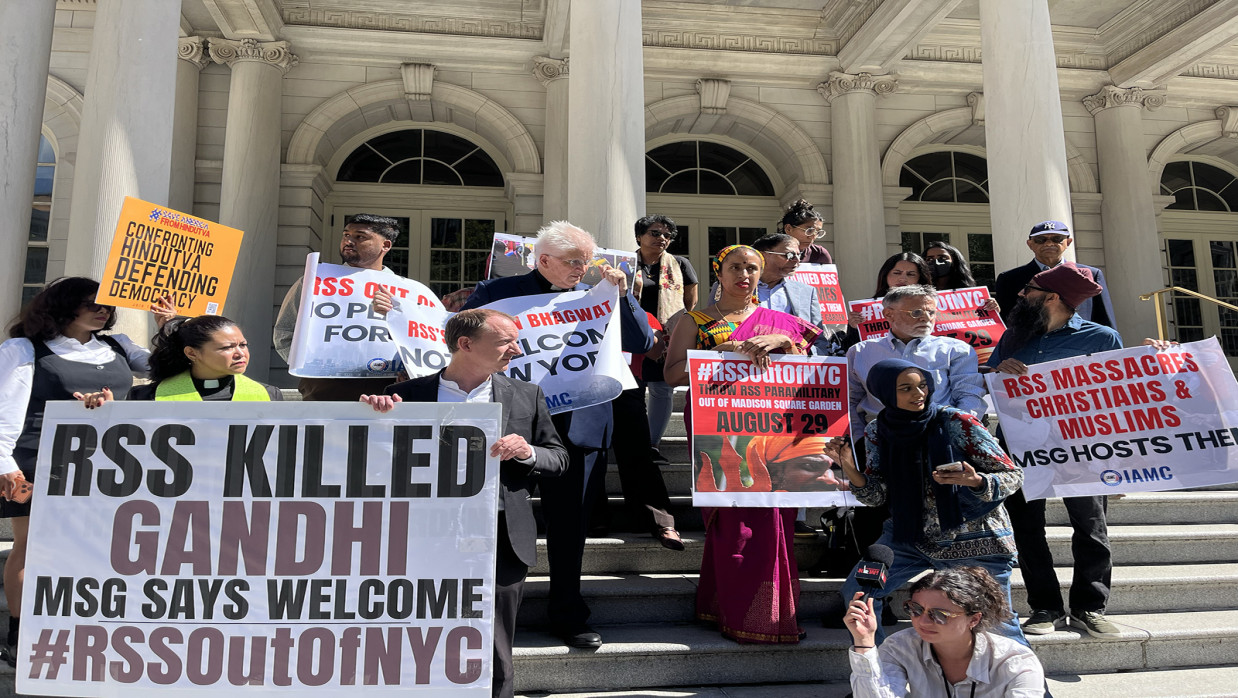
Outside the arena, however, a very different interpretation of Bhagwat and the RSS was on display. Muslim, Sikh, Christian, Dalit and civil-rights organizations demonstrated against his appearance, arguing that the language of universal brotherhood could not be separated from the history, ideology and political influence of the movement he leads.
The result was a striking contrast: inside, a polished celebration of unity; outside, a public indictment of Hindu majoritarianism. Far from resolving questions about the RSS, the Madison Square Garden event amplified them.
From Spiritual Gathering to Political Spectacle
Bhagwat’s supporters described the gathering as an apolitical celebration of Hindu civilization, volunteerism and service. The RSS portrays itself as a cultural organization devoted to discipline, education, national unity and disaster relief. Its defenders also contend that criticism of the organization too often degenerates into hostility toward Hinduism or toward Hindu Americans.
That concern should not be dismissed. Hinduism is an ancient and extraordinarily diverse religious tradition. The RSS, by contrast, is a modern ideological organization founded in 1925. Opposition to Hindutva must never become prejudice against Hindus, just as criticism of political Islam, Christian nationalism, or Jewish extremism must not be converted into hostility toward an entire faith community.
Nevertheless, the Madison Square Garden controversy was not principally about Bhagwat’s right to speak. In a democratic society, even deeply controversial figures are entitled to address private gatherings. The real question was what kind of legitimacy is conferred when the leader of an organization as influential and contentious as the RSS appears at one of America’s most prestigious venues beneath the reassuring banner of “universal oneness.”
Critics saw the event as reputation management: an attempt to introduce the RSS to Western audiences through the language of spirituality while avoiding sustained scrutiny of its political record.
The Contradiction at the Center
Bhagwat reportedly told the gathering that humanity is one despite its different religions. He also declared that a person who believes Muslims should not exist cannot genuinely be considered Hindu. Those words deserve to be acknowledged. If translated into political practice, they could offer a basis for genuine reconciliation.
But speeches must be evaluated against institutional conduct. The RSS is the ideological parent of a vast network commonly known as the Sangh Parivar, which includes organizations active in politics, religion, education and social mobilization. India’s ruling Bharatiya Janata Party emerged from this ideological ecosystem, and Prime Minister Narendra Modi spent his formative political years as an RSS worker.
Critics have contended that the movement has been accompanied by increasingly vitriolic language and abusive behavior directed at Muslims, Christians and other minorities. Indian authorities and the RSS dismiss these allegations, asserting that their programs are meant for all Indians and that Western criticism is selective, politicized or ignores violence against Hindus.
Bhagwat’s New York message therefore produced an unavoidable question: If universal inclusion is truly the RSS’s governing principle, why do so many minority communities, religious-freedom monitors and Indian civil-society organizations view its ascendancy with apprehension?
Statements of tolerance alone will not answer that question. Institutional transparency and accountability, clear repudiation of faith-based violence, and a commitment to push back on majoritarian language even when delivered by your political friends that's what credibility looks like.
Washington’s Religious-Freedom Warning
The issue became more controversial when members of the RSS were singled out for targeted sanctions by the U.S. Commission on International Religious Freedom if they were found responsible for freedom of religion or belief violations. USCIRF Chair Asif Mahmood referred to accusations that Hindu-nationalist organizations that fall under the RSS umbrella were involved in attacks on Muslims and Christians. USCIRF Commissioner Gene Mills said RSS leaders should not receive diplomatic visas or meet with high-level government officials.
USCIRF’s 2026 annual report urged the State Department to once again designate India a “Country of Particular Concern” and also recommended targeted sanctions be considered against culpable individuals and entities, including the RSS.
USCIRF’s recommendations carry political weight, but USCIRF is an independent, bipartisan federal commission that makes recommendations to the president, the Secretary of State, and Congress. It can’t impose sanctions or deny visas, or designate a country. The executive branch takes those actions under American law.
Both Republican and Democratic administrations have ignored calls to brand India as a Country of Particular Concern. Other interests, including defense and technology cooperation, trade, and growing strategic competition with China, have continued to influence how Washington engages New Delhi.
The American Network
The RSS’s presence in the United States did not begin with Bhagwat’s 2026 visit. Organizations sympathetic to Hindu nationalism have spent decades cultivating relationships with donors, politicians, community associations and public institutions.
Tulsi Gabbard's political career has become a well-known example of this trend. The Caravan reported that early donors to Gabbard's congressional campaigns included people tied to groups in the wider Sangh ecosystem, giving her campaign thousands of dollars. Gabbard subsequently attended events with some of Modi's top American boosters, pushed closer ties between the U.S. and India, and voted against a 2013 congressional resolution condemning India's religious-freedom violations.
These facts justify examination, but they do not prove that Gabbard acted under RSS instructions or served as an agent of India. American citizens have every right to donate to candidates, support India–U.S. relations and organize around political or cultural interests. Indian Americans must not be treated with suspicion merely because they favor closer relations with India.
The narrower question is: Did financial contributors, ideological affinities, and informal advisors from abroad exert enough influence over a senior official to create conflict-of-interest or counterintelligence vulnerabilities? That’s the question, answered through documents instead of incendiary allegations. Accusing Gabbard of being a “puppet” or carefully groomed asset of a foreign government asserts that conclusion without proof. Calls for accountability on the Left lose legitimacy when justified criticism is mixed with exaggeration.
Why the Exercise Backfired
Sure, bring Bhagwat and the RSS to Madison Square Garden to portray them as legitimate representatives of a harmless faith tradition. This despite inevitable worldwide news coverage, condemnation from the Mayor, boycott threats, and a lively protest right outside the venue.
The protest also highlighted the challenges of movements made up of many different groups. When protesters and New York elected official Brad Lander got into a shouting match, charges of antisemitism became part of a rally meant to decry religious nationalism. Groups that were a part of the rally distanced themselves from the heckling. All were reminded that those who seek to defend pluralism must always model it. The fight against one prejudice shouldn’t give license to others.
Ultimately, Bhagwat’s appearance did not fail because he was prevented from speaking. It failed as a reputation-laundering exercise because he was allowed to speak while critics were equally free to examine the contradictions between the message and the movement.
“Universal oneness” is a noble aspiration. But it cannot function as a public-relations slogan detached from political reality. If the RSS wants the world to accept its claim of inclusion, it must demonstrate that inclusion not only from a New York stage but through the conduct of its affiliates, supporters, and political heirs in India.
Madison Square Garden gave Mohan Bhagwat visibility. It did not absolve the RSS.


0 Comments
LEAVE A COMMENT
Your email address will not be published