

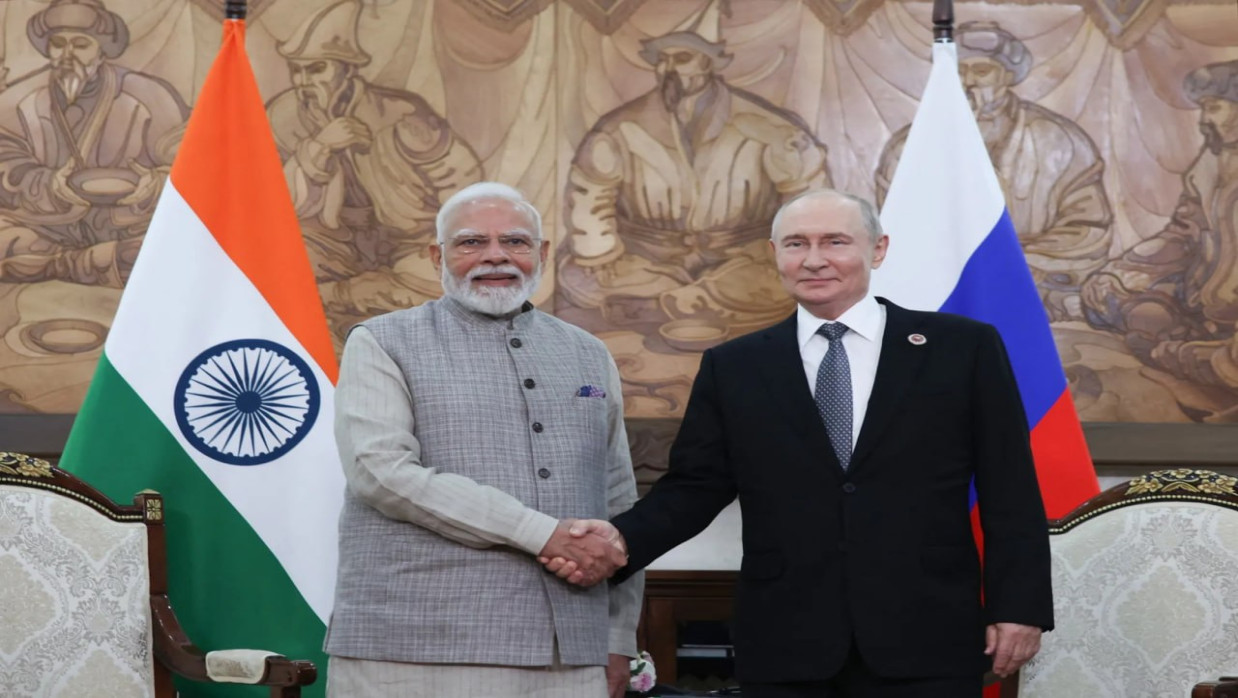
In April 2026 India announced that, in January 2025, it signed Reciprocal Exchange of Logistic Support (RELOS) military agreement with Russia. RELOS, amongst other provisions, allows the two countries to station 3,000 ground troops, naval warships, and military aircraft on each other’s territory. This unprecedented agreement is not just a competitor of the Logistics Exchange Memorandum of Agreement (LEMOA) that India signed with the US in August 2016; it is more potent, as it gives Russia military foothold in the Indian Ocean Region (IOR). Similarly, it provides India access along the coastal, East European and Southern regions of Russia.
RELOS was kept under wraps. It remained under negotiations for eight years, as reported by Aljazeera on 24 April 2026. According to Kremlin’s Presidential website, the agreement was ratified by Russia in December 2025 and came into force in January 2026. India found it opportune to announce the agreement and its details while the US was preoccupied in war with Iran. Due to the timing of the release of the news, it is being seen as India’s attempt to settle its score with the US, for the treatment meted out to it. Measures against India by Trump 2.0 included curb on purchase of oil from Russia and the imposition of heavy trade tariffs (25%+25%) that were later reduced. President Trump also dubbed India as a “HELLHOLE” and labelled Indian diaspora in the US as “gangsters with laptops.” India has also been described as a “good actor” for refraining from purchase of Russian oil when ordered to do so.
According to the Kremlin, the purpose of the agreement is to “define the procedure for the deployment of military formations, port calls by warships, and the use of airspace and airfield infrastructure by military aircraft of both parties.” The Presidential website elaborated that the “RELOS establishes a framework for logistical cooperation between the two militaries, marking a notable development in their longstanding defence relationship.” This agreement primarily focuses on four specific areas: (i) Personnel and Hardware, allowing each country to station up to 3,000 troops, along with five warships and 10 military aircraft, on the other's territory; (ii) Technical Services that allow for refuelling, repairs and maintenance. It could facilitate support for Russian-origin equipment that forms a large part of India's arsenal; (iii) Infrastructure Support which includes naval access, port facilities and basic supplies such as food and water, while air operations are supported by air traffic control, navigation assistance and aircraft security; and (iv) Joint Operations, which will enable cross-training as well as cooperation on Humanitarian Assistance and Disaster Relief (HADR) missions.
Andrey Kortunov, Director General of Russian International Affairs Council (RIAC), talking about RELOS in Moscow on 23 April 2026, underscored that “it gives both sides unrestricted access to the partner's infrastructure and provides for reciprocal limited military presence on each other's territory.” He added that the agreement “enhances power projection and military outreach capabilities for the two sides.” The pact marks a historic shift for India, as it is the first time that New Delhi has allowed a foreign military to station personnel on its soil.
When India signed four Foundational Agreements with the US, it was viewed as historic shift in India’s stance towards global power politics and its relationship with the US. These include General Security of Military Information Agreement (GSOMIA) signed in 2002; Logistic Exchange Memorandum Agreement (LEMOA) signed in 2016; Communications Compatibility and Security Agreement (COMCASA) signed in 2018; and the Basic Exchange and Cooperation Agreement for Geospatial Intelligence (BECA) signed in 2020.
The signing of these agreements was considered as bringing India and the US closer, giving India technological, real time digital data and informational edge over its neighbours in the region. For the US these agreements provided greater inroads into the Indian defence establishment. At the same time these agreements opened up India’s defence market for the sale of US weapons. The US also granted India Strategic Trade Authorization Tier 1 (STA-1) status in July 2018, which gave India license-free access to sensitive US military technologies. Under its “Indo-Pacific Strategy” the US projected India as the “net security provider” in the region and a counterweight to China.
While GSOMIA, COMCASA and BECA agreements are technical and informational in nature, LEMOA covers physical aspects of cooperation related to joint exercises along with related financial settlement and logistic support. It however does not include stationing of military forces and offensive weapons in each other’s territory. Thus, it is exclusively logistical in nature. Unlike LEMOA, RELOS, is not constrained to provide exclusively logistical support. It includes deployment of potent tri-service combined armed forces in each other’s territory, with no restrictions on stationing offensive military assets.
RELOS carries global implications for the US as the agreement provides Russia a significant long-term military presence in the IOR, including naval and air assets. It is an unprecedented development in the IOR’s power matrix. Through RELOS, Russia can directly project power in a geopolitically and geo-economically significant area dominated by the US and other Western and regional naval powers. Presence of Russian forces and its strategic assets in IOR will create a dilemma for the US, NATO and allied states in the region, when seen in the backdrop of Russo-US rivalry, developments in the Middle East and Western support for Ukraine.
The agreement is equally significant for India, as it offers an opportunity for New Delhi to establish military presence beyond IOR. Under the agreement, scope of reciprocal deployment for Indian forces extends from Arctic Ocean and Northwestern Europe to Bering Strait and Pacific Ocean. It can also establish military presence along the northern periphery of Central Asian states and thus compensate for the loss of Ayni Air Force base in Tajikistan, where India stationed its forces from 2002 to 2022. More importantly, it will act as a symbolic display of India’s “Strategic Autonomy” and keep India’s geopolitical and geostrategic options open for accruing maximum benefits by pitting global powers against each other.
RELOS agreement is a clear indication of India’s decision to remain aligned with Russia. The decision is already having serious impact on bilateral strategic relations between the US and India and the US Indo-Pacific Strategy. In June 2026 the US announced redesignation of US Indo-Pacific Command (USINDOPACOM) to US Pacific Command (USPACOM). Secondly, on the sidelines of Shangri-La Dialogue on 31 May 2026, the US Secretary of War, Pete Hagseth met with the Defence Ministers of SQUAD member states (US, Australia, Japan and Philippines). However, no Quad meeting was planned in spite of the fact that Indian Defence Minister Rajnath Singh was also attending the event, nor any bilateral ministerial level meeting was held between the US and India.
The introduction of Russian factor to the IOR, a region already in the grip of global geopolitical and geo-economic contestation, will render a new dimension to the IOR and South Asian region. Regional countries, including Pakistan, must therefore microscopically monitor further developments as RELOS is implemented and its implications begin to unfold for the region and beyond.

0 Comments
LEAVE A COMMENT
Your email address will not be published