

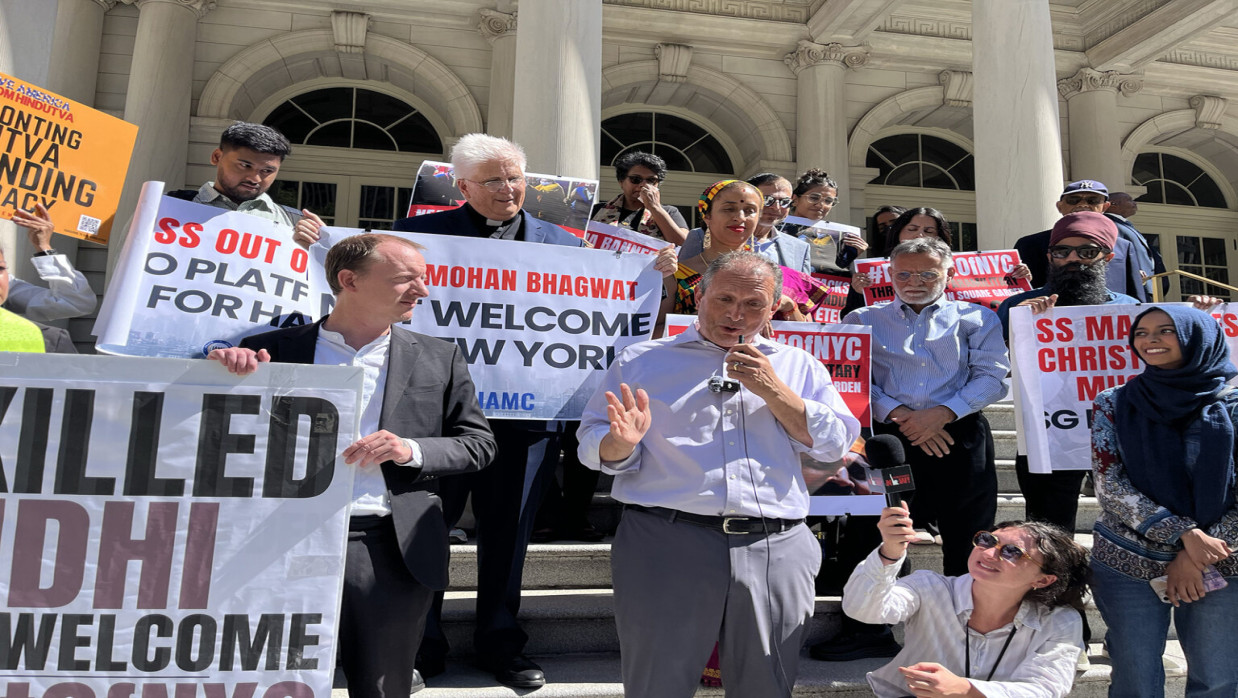
The planned appearance of Rashtriya Swayamsevak Sangh chief Mohan Bhagwat at Madison Square Garden on August 29 has transformed an Indian diaspora event into a broader debate about religious freedom, political ideology and the international reach of Hindu nationalism. Bhagwat is expected to address the "Universal Oneness Celebrations," organized by American Hindus for Engagement and Dialogue as part of the RSS's centenary outreach.
But outside the hall, another message is emerging. A consortium of civil rights, interfaith and minority groups is planning to protest the event, saying that rhetoric of universal oneness cannot be divorced from the RSS' political clout and track record in India. The contretemps highlights how ideological battles playing out within India are increasingly spilling into Western democracies via diaspora organizations, lobby groups and political alliances.
From Spiritual Gathering to Political Rally
Advocates frame Bhagwat’s visit as an apolitical event centered around Hindu culture, volunteerism, and universal peace. The RSS claims to be simply an organization focused on “social discipline, education, and contribution to society at large,” such as rebuilding after natural disasters. Many argue that criticism of Bhagwat and the RSS often veers into bigotry against Hindus themselves.
Opponents have a decidedly different take. They argue that the RSS is the epicenter of Hindutva ideology, which aims to prioritize India’s identity as a Hindu nation above all else. They add that the RSS wields massive political power in India through its affiliation with BJP, the current ruling party.
The dispute, therefore, is not merely over whether Bhagwat should be permitted to speak. It concerns what legitimacy is conferred when the leader of an intensely controversial movement appears at one of America’s most prominent venues under the banner of universal oneness.
The USCIRF Intervention
Amplifying the controversy, officials with the U.S. Commission on International Religious Freedom recommended imposing targeted sanctions against members of the RSS leadership if American investigations find them guilty of freedom of religion or belief abuses. Mahmood, Chair of USCIRF, cited reports that "organizations linked to the larger RSS family may have been involved in attacks on Christians and Muslims". Commissioner Gene Mills stated that RSS leaders "should not be afforded diplomatic courtesies and certainly should not be granted high-level meetings with officials". However, USCIRF is an independent federal body that advises the executive branch of the United States government. It may assess violations; it may recommend sanctions, visa bans, or other diplomatic measures, but it cannot implement them itself. The administration would have to take those actions separately, under American law. USCIRF has consistently recommended labeling India as a "country of particular concern" CPC for committing what the commission claims are severe, ongoing violations of religious freedom. To date, neither the Bush nor Obama Administrations agreed with the Commission's recommendation. Realpolitik, including defense ties, trade, technology, and containing China, continues to shape White House policy toward India.
India Rejects the Criticism
India's Ministry of External Affairs has dismissed USCIRF as biased, agenda-driven and lacking in credibility. New Delhi maintains that the commission fails to appreciate India's pluralistic traditions, constitutional institutions and record of coexistence among its religious communities.
The RSS's American defenders have responded similarly. HinduPACT accused USCIRF and advocacy organizations of treating Hindu political and cultural self-assertion as extremism. Supporters also emphasize the RSS's charitable activities and argue that a large, complex organization should not be judged solely through accusations involving associated groups or individual members.
Fair enough. Accusations of complicity must be based on facts, and punishments should target culpable individuals rather than implicating groups. Hinduphobia has no place in responses to Hindus.
But calling out complaints of anti-Hindu discrimination will not excuse providing answers to verified questions regarding hate speech, sectarian divisiveness, and mob attacks on religious minorities. Critiquing Hindutva ideology does not automatically equal targeting Hindu beliefs. Doing so only harms constructive efforts to hold bigotry accountable.
Free Speech and Public Accountability
Calls to cancel the Madison Square Garden event raise another difficult question. American principles of free expression protect controversial political and religious speech. Unless legal grounds exist to deny entry or prohibit an event, Bhagwat and his supporters are entitled to present their views. Equally, Sikh, Muslim, Christian, Dalit and Hindu critics possess the right to protest, challenge the RSS's record and ask public officials to avoid appearing to endorse it.
The constructive democratic impulse is neither coercive muting nor triumphalist cheering. It’s tough-minded public examination. If speakers from the rally platform want to talk about “universal oneness,” let them talk. But they should have to answer the question of how that squares with Indian Americans who live in fear of majoritarian impulses. Those who want punishment should be able to point to individuals, behavior, and facts with specificity.
Bhagwat’s presence here reminds us that Indian diaspora politics is no longer limited to Diwali celebrations and longing for mom’s cooking. It has brought South Asia’s ideological battles into America’s civic sphere. Let the celebrating happen at Madison Square Garden, and the protesting happen on the sidewalks. But the larger question lingers far beyond NY boundaries: Can pride in our cultures come without denigrating equal citizenship? Can nationalism stay relevant without weaponization?


0 Comments
LEAVE A COMMENT
Your email address will not be published