

By turning smartphones into tools of public accountability, the Cockroach Janta Party has put the condition of India’s government schools at the center of a growing political movement. Yet the reported killing of a volunteer’s father in West Bengal illustrates the dangers that arise when citizen scrutiny collides with partisan power.
From Satire to Political Mobilization
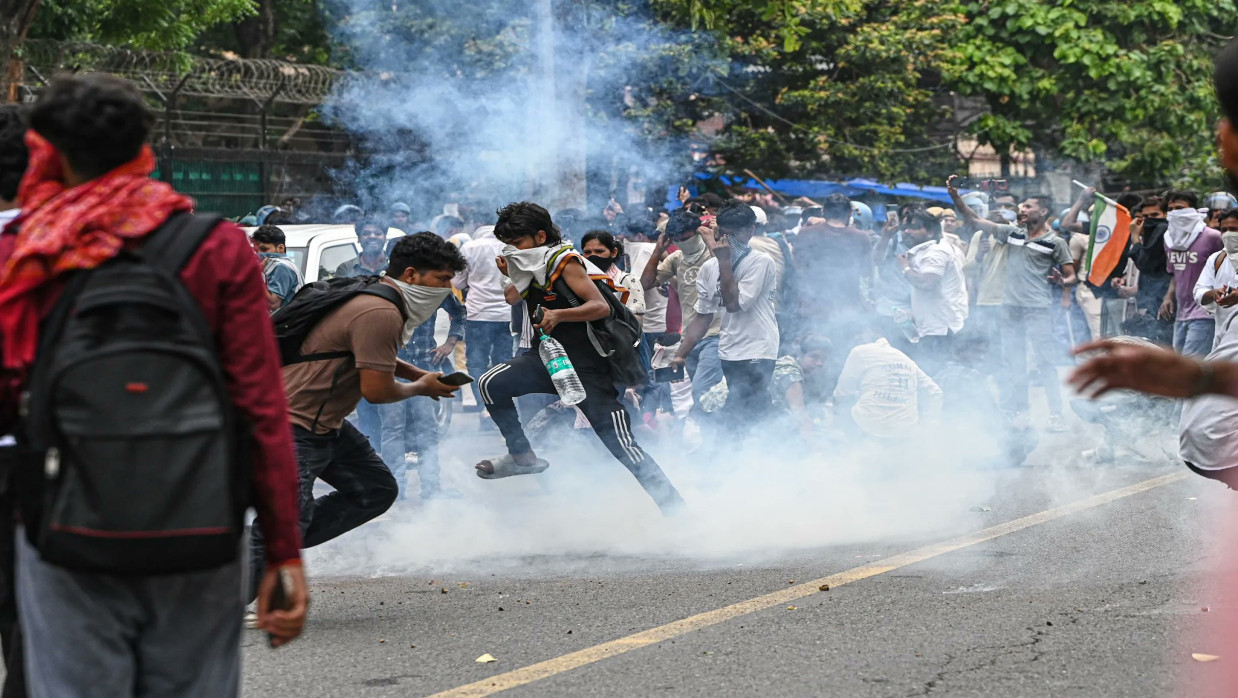
India’s cockroach-controlling Janta Party, known as CJP, formed just like so many populist outsiders across history have, needling politicians like angry toddlers. It only looked like “a bunch of internet trolls lashing out with snark, memes, and teenage rage” until they started making a difference. CJP rallied against technical errors in national testing services and organized enough popular dissent to create weeks of demonstrations that ultimately led to Education Minister Dharmendra Pradhan’s resignation in July 2026.
Giving the movement what so many online-only protests never see: tangible success. Proving that decentralized youth can force accountability when enough people care to keep the pressure on.
The CJP has now redirected that momentum toward a more fundamental problem through its “School Thik Karo,” or “Fix the Schools,” campaign. Launched around Independence Day, the initiative asks parents, students, and other citizens to visit government schools, examine their basic facilities, and publish what they find.
People have been asked to photograph classrooms, latrines, drinking-water facilities, benches, windows, and buildings. Videos of classrooms without doors, roofs with water dripping from them, broken desks, toilets without hygiene supplies, and walls with holes have surfaced online. If numbers hide truths, the camera exposes them.
The Smartphone as an Instrument of Accountability
The campaign’s strength lies in its simplicity. It requires no central office, professional investigators, or elaborate political organization. Almost anyone with a smartphone can conduct a rudimentary inspection and share the findings.
CJP convenor Abhijeet Dipke launched the initiative in his native village of Santuk Pimpri in Maharashtra’s Hingoli district. During a visit to a Zilla Parishad school, he documented what he described as dirty toilets, broken windows, inadequate seating and other deficiencies. He also questioned why public money could fund ceremonial banners and political displays while rural schools remained neglected.
That analysis also helps describe the campaign’s moral authority. Voters aren’t questioning if governments spend money on education. They’re questioning how budgets can claim to reflect public priorities when schools operate without water, sanitation, safe structures or enough desks for every child.
“There should be schools, but even schools should have drinking water,” said New Delhi's Chief Minister Arvind Kejriwal at a news conference last month.
Economist Jayati Ghosh praised the campaign’s announcement as an opportunity “to give the schoolchildren of our country a voice in the public sphere” and to highlight the poor implementation of the Right to Education Act. “Will become a big force for accountability on provisions of RTE,” said former diplomat Navdeep Suri.
These statements matter because they link finger-pointing on Twitter to broader issues of governance and democratic accountability.
Beyond a Viral Moment
But still, the campaign must prove itself on its big test. Visibility doesn’t necessarily lead to systemic change. Videos of clogged toilets can rack up thousands of hits and still remain clogged. Citizen anger can evaporate as quickly as it materializes, particularly when distracted by the next big scandal rocking the nation.
"If School Thik Karo" should be posting more than grisly photos - it should be leveraging the information it uncovers to create bottom-up pressure for change. Ideally, every deficiency listed would lead to an official complaint being filed, a response from the relevant department being issued, a timeframe for fixing the problem being established, and follow-up photographic proof being made available for public scrutiny.
Organizers will also need to implement checks and balances to prevent false or misleading claims. Document conditions meticulously, allow school administrators the opportunity to explain, and hold the proper people accountable. Headteachers should not be held accountable for failing sewage systems if budgets and contractors are determined at a higher level.
India’s enormous federal system also means that responsibility is dispersed among the Union government, state governments, district administrations, municipalities and village bodies. Effective activism must identify not only what is broken but also which institution has the legal and financial responsibility to fix it.
The Tragedy in Bankura
The campaign took a darker turn in West Bengal’s Bankura district. According to CJP and family accounts reported by several Indian news organizations, 25-year-old volunteer Shaik Abdul Hafeez visited a government school he had formerly attended and documented its condition as part of the campaign.
Hafeez alleged that a group subsequently confronted his family at their home. His father, Sheikh Mohammad Mafik, reportedly suffered severe head injuries while attempting to protect him and died in hospital on August 15.
The CJP has alleged BJP connections to this death. BJP officials have denied the incident was politically motivated. Police and courts will determine the allegations and motives. It’s worth saying both: Twitter commentary does not prove political ties, motivation, or individual guilt.
Still, the killing is beyond disturbing. If true, this act was committed against a citizen for confronting officials himself or his son about the state of a public school. It was not only politically motivated violence. It was an attack on democracy’s oversight function. No one should fear retribution for asking why children do not have safe, adequate classrooms.
Reports say Hafeez will not seek monetary compensation; his family’s primary request is a quality school built in his father's name. He wants a quality school constructed in his father’s name and the guilty punished. That’s what will give this tragic situation moral force: Accountability plus dedication to the common good.
Education and India’s Youth Crisis
The movement is gaining attention because it links school neglect to a broader crisis facing India’s young population. Examination irregularities, unemployment, expensive private education and the deterioration of public institutions have created deep frustration. Millions of young Indians are promised opportunity through education but encounter an unequal system in which family income, geography and social status heavily influence their prospects.
India is not alone. Youth-led movements across Bangladesh, Sri Lanka, Africa and other regions have demonstrated the political consequences of combining economic insecurity with declining confidence in established institutions. A generation equipped with smartphones can compare official promises with lived reality almost instantaneously.
Youth movements are not inherently cohesive or progressive either. Divided and co-opted by political parties or derailed by communal and ideological polarization, their long-term value will depend on whether rage can be converted into organization, concrete demands for policy reform, and fraternity that cuts across religion, region, and class.
Repairing Schools and Democratic Trust
“School Thik Karo” should not become another arena for clashes between rival political parties. A school's condition is not an ideological abstraction. A broken roof, unusable toilet, or contaminated water supply harms children regardless of their religion, caste, or their parents’ political allegiance.
Its most important role, then, may simply be to remind citizens that they have both the right and the duty to examine our public institutions. Public shaming must be paired with transparent inspections, grievance redressal mechanisms, time-bound accountability for repairs, and disclosure of how education budgets are spent.
If nothing else, the movements’ cameras have documented what our governments have refused to fix. Now we must decide if Indian institutions will treat this oversight as civic engagement, or as a political affront. A healthy democracy should embrace school monitors. If calls for classrooms and clean toilets invite backlash or bullets, the failure is no longer educational; it’s democratic.


0 Comments
LEAVE A COMMENT
Your email address will not be published