

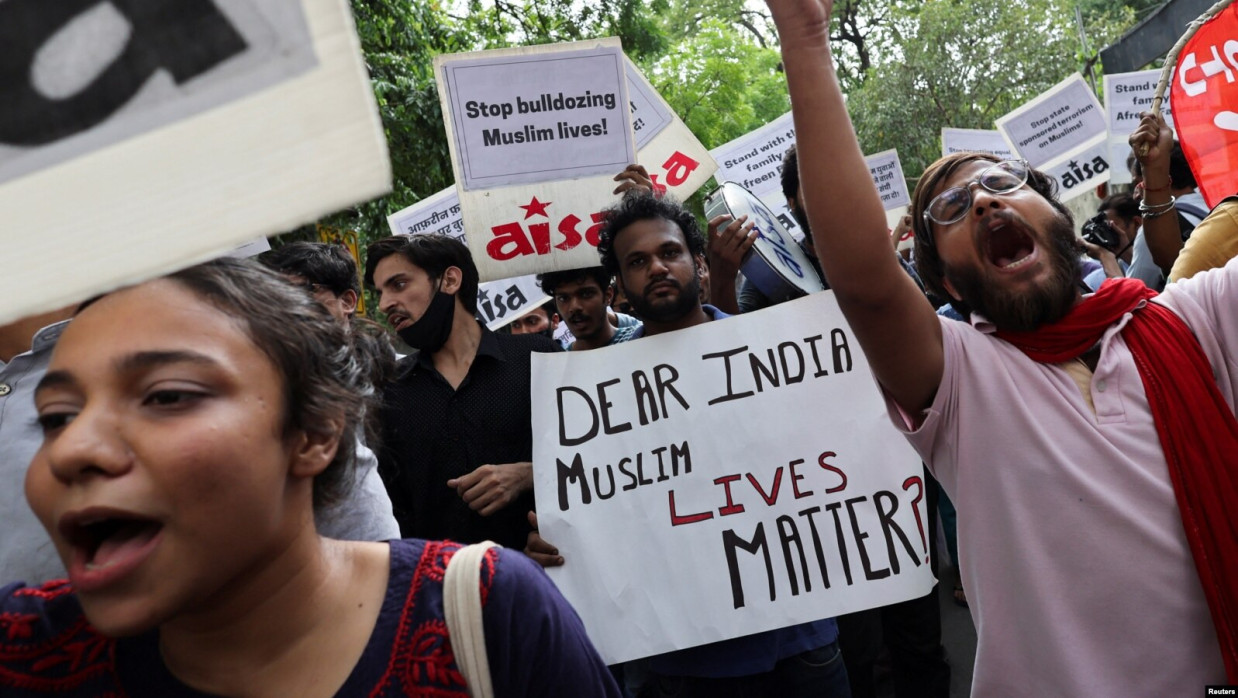
India’s treatment of religious minorities has become an increasingly important international concern. Once widely celebrated as a successful example of secular democracy in a deeply diverse society, India is now facing serious questions about whether majoritarian politics are weakening its constitutional commitment to religious equality. The growing influence of the Rashtriya Swayamsevak Sangh (RSS), its relationship with the ruling Bharatiya Janata Party (BJP), and recurring attacks against Muslims, Christians, and other minorities have placed India’s human-rights record under renewed scrutiny.
The United States Commission on International Religious Freedom (USCIRF) urged Washington to levy targeted sanctions on perpetrators of egregious violations of religious freedom in India. USCIRF recommendations warrant serious consideration not as an assault on India or Hinduism, but instead for individual accountability and preservation of India’s greatness.
The RSS and the Rise of Majoritarian Politics
Established in 1925, the RSS describes itself as "a volunteer cultural and social organization working towards national discipline, national service and Hindu unity." Headquartered at the center of a vast network of Hindu nationalist organizations popularly known as the Sangh Parivar ("family of clans"), the RSS has seen many of its members rise to political leadership, including Prime Minister Narendra Modi and other senior BJP leaders who cut their political teeth in the RSS.
The link to the BJP is thus neither accidental nor merely historical. The RSS provides much of the ideological ballast, organizational rigor, and foot-slogging mass following behind India's ruling party. Hindu nationalism's core RSS belief that India is, at its heart, a Hindu nation has steadily shifted from political fringe to mainstream dictate.
Proponents of Hindutva claim it promotes nationalism rather than religious dominance. Detractors of Hindutva say that it creates a two-tier society where some people are considered naturally native to India and others, especially Muslims and Christians, are branded as foreigners whose citizenship can constantly be challenged. As such, minorities can be citizens but still be seen as culturally inferior.
Such an outlook is difficult to reconcile with India’s constitutional order. The Constitution guarantees equality before the law, prohibits religious discrimination and protects freedom of conscience, belief and worship. India was not established as a state belonging exclusively to one religious community. Its democratic legitimacy rests upon equal citizenship in a country of extraordinary religious, linguistic and ethnic diversity.
A Pattern of Institutional Pressure
The problem extends beyond incidents of communal violence. Religious minorities increasingly face pressure through legislation, policing, administrative decisions and inflammatory political rhetoric. Anti-conversion laws in several states have been used disproportionately against Christians and interfaith couples. Cow-protection measures have contributed to an atmosphere in which Muslims involved in cattle trading or the meat industry may face intimidation and vigilante attacks.
Citizenship policies have also created apprehension among Muslims, particularly when the Citizenship Amendment Act is considered alongside proposals for citizenship verification. Demolition campaigns, restrictions on religious gatherings and the use of security legislation against activists have reinforced concerns that law enforcement is not always applied impartially.
Christians have reported disruptions of worship, attacks on churches and accusations that ordinary charitable or missionary activities constitute coercive conversion. Sikhs, Muslims and minority-rights advocates have also expressed concern that political disagreement is too readily portrayed as disloyalty to the nation.
The USCIRF’s 20 26 Annual Report determined that the status of religious- freedom conditions in India merited placing it on its “country of particular concern” list. It urged targeted sanctions against those it held responsible for egregious abuses, including visa bans and asset freezes.
USCIRF stands for United States Commission on International Religious Freedom. An independent bipartisan Commission. USCIRF’s views do not necessarily represent those of the policy of the United States government, nor are they legal findings of guilt. However, India can no longer write off continual allegations from such a body as hostile interference in its internal affairs.
The Case for Targeted Sanctions
Sanctions must be specific and based on solid evidence linking individuals to specific offenses. Sanctions should not be applied against communities or organizations where not all members have been involved in abuses or facilitated them. Until now, membership in the RSS has been treated as sufficient evidence to sanction someone. Assigning responsibility for human-rights abuses should be based on individual actions. Did someone order attacks, persecute others, assist in policies that discriminate against individuals, or protect abusers from punishment?
Targeted sanctions offer several options. Members of Hindu extremist groups can be banned from entering the United States, their assets frozen, or they can be prohibited from accessing the American financial system. Targeted sanctions would be far better than economic sanctions, which would punish ordinary Indians and restrict legitimate trade and strategic ties.
The objective should not be to punish India. Rather, it should signal that senior political office, or membership in certain ideological organizations, will not absolve anyone of accountability for gross human-rights abuses. Accountability must be a two-way street. By castigating adversaries for offenses it turns a blind eye to among allies and friends, Washington loses all moral authority.
India will undoubtedly invoke sovereignty and reject foreign intervention. Sovereignty, however, does not eliminate international concern when a state has voluntarily accepted human-rights obligations. Criticism of Hindutva does not constitute opposition to Hinduism. Hindu traditions are internally diverse, and many Hindus remain among the strongest defenders of secularism, pluralism and minority rights.
Strategic Partnership Must Not Mean Silence
The U.S. sees India as a counterweight to China, a partner in ensuring security in the Indo-Pacific, and a partner in expanding commercial and tech cooperation. All of these are legitimate interests. But balancing China shouldn’t come at the price of turning a blind eye to religious persecution. Partnerships between democracies can’t be based on convenience alone.
India has never drawn its strength from religious homogeneity. India’s strength has come from its ability, flawed though it often is, to embrace multiple faiths, languages and cultures under one constitution. If India allows majoritarian politics to overwrite equal citizenship, it will fray the social fabric of this nation and its reputation as a democracy.
Ultimately, external pressure can’t save Indian pluralism. Indian courts, civil society organizations, journalists, the political opposition, and Indian citizens themselves must be the heroes of this story. But outside voices can support the many Indians who are peacefully fighting to protect Indian democracy and constitutional values.
India today has a choice: to double down on silence or start closing the distance between its Constitution and reality. A robust democracy shouldn’t fear introspection. It should safeguard minorities. Hold accountable those who preach violence. Ensure that no Indian citizen feels their dignity dependent on their religion.


0 Comments
LEAVE A COMMENT
Your email address will not be published