

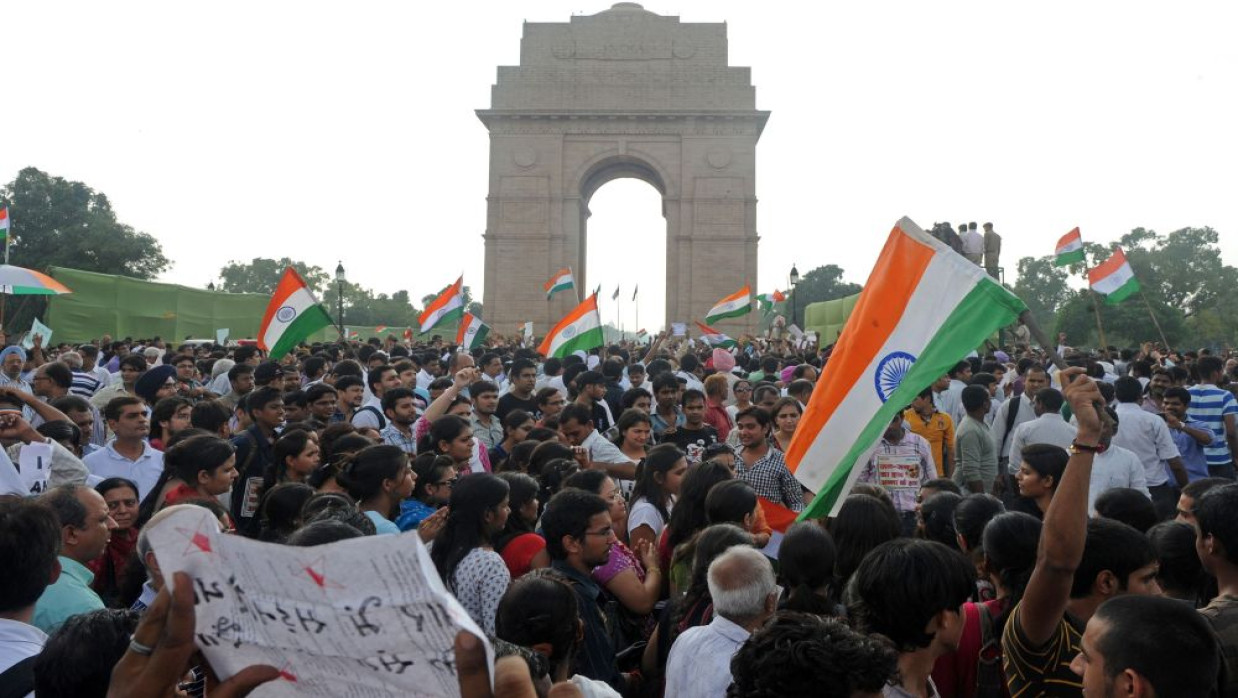
India’s democracy is contested, a competition between political parties. Instead, the crisis centers on competing visions of Indian nationhood: Will India remain a pluralistic constitutional republic, or will it more forcefully assert itself as a Hindu majoritarian state? Heightened religious polarization fueled by increasingly dehumanizing political rhetoric, discriminatory policies, and politicized narratives of Indian history has prompted experts on genocide prevention to conclude that India now displays many of the known warning signs for atrocity risks.
Gregory Stanton, the founder of Genocide Watch (not “World Genocide Watch”), has written that Muslims in India are experiencing multiple processes that he associates with early stages of genocide. Classification, discrimination, dehumanization, organization, polarization, and persecution are six processes that Stanton identifies as precursors to mass killing. Warning that such processes have been set in motion is not the same as proving that genocide is inevitable, or that India is on the brink of “the largest genocide in human history.” There is not sufficient publicly available evidence to make that case. But Stanton does not mean we should ignore his warning. Preventing genocide requires recognizing danger before killing begins.
India’s fractured past is often called upon to explain its fractured present. But history must be handled gingerly. South Asia was not inherently divisible before the arrival of the Muslims. In the third century BCE, Ashoka's Mauryan Empire held much of South Asia together. So too did the Gupta Empire, as well as numerous powerful regional kingdoms after them. Equally, however, the subcontinent has often been made up of rival states whose kings married into each other’s families, waged war, and spoke for regional concerns.
India’s fractured past is often cited as an explanation of its fractured present, but history should be handled delicately. South Asia wasn't always divided before Muslim rule. The Mauryan Empire (especially under Ashoka) once unified much of South Asia during the third century BCE. The Gupta Empire and various powerful regional kingdoms also developed significant spheres of political and cultural influence. However, the subcontinent was also often made up of many competing states that regularly forged alliances, waged wars, and protected regional interests.
Muslim dynasties played a key role in consolidating much of India. The Delhi Sultanate, and especially the Mughal Empire, built large bureaucracies, revenue-collection systems, militaries, trade connections, and cultural centers. The polyethnic empires of the Mughal emperors governed citizens who practiced different religions and spoke numerous languages and dialects. The Mughal Empire expanded upon Islamic political traditions, but was not a theocracy. The Mughals required Hindu administrators, Rajput princes, traders, warriors, and brokers.
Akbar's policy of accommodations stands as one of the finest examples of the principle in practice. He employed people of all communities in his government and court. He looked beyond religious authority for his empire's legitimacy. Later Mughal rulers continued these efforts, albeit inconsistently. This was also true of the policies practiced by other Muslim rulers in the region. As such, Indian Muslim history cannot be seen as a thousand years of Islamic rule demarcated by periods of religious persecution. Muslim influence on Indian society has been significant. They influenced the development of administration, architecture, language, commerce, law, music, and helped politically unify much of the region.
Another shift came with colonialism. British officials categorized people by their religion and caste identities more sharply than before. Colonial administrators solidified communal identities through censuses and the institution of electoral politics. At times they actively encouraged differences to better control the region. Partition in 1947 illustrated the dangers of mass movements formed around religion.
The British perfected the strategy of “divide and rule”. They used religious differences, as well as caste, regional, and ethnic divisions, to establish and maintain their dominance over the subcontinent. By conducting censuses, granting separate electorates, practicing selective political favoritism, and dividing people along communal lines, colonial officials led people to think of themselves as members of competing religious groups rather than citizens of a shared society. Hindu-Muslim relations had never been idyllic prior to colonialism, but Hindus and Muslims had lived side by side for centuries, creating shared traditions of language, music, food, trade, governance, and daily social interaction. While the British were not responsible for communalism per se, they took existing fissures and made them official, politicized them, and exacerbated them. Communalism gradually undermined faith between communities, created competition for political dominance, and sowed the seeds of hatred that would later erupt into riots and the brutal partition of the subcontinent in 1947.
Modern Hindu nationalism gets its strength from a distorted view of this past. Muslims are reduced to foreign aggressors. Centuries of Hindus and Muslims living together, influencing one another through trade, cultural exchanges, intermarriages, and jointly creating new institutions are discounted. Bollywood movies, television shows, political rhetoric, and social media propagate these simplistic myths. If you can convince people that an entire community has been historically treasonous or innately dangerous, then bigotry can be dressed up as nationalism.
Current concerns center on incidents of communal violence, Islamophobic hate speech and violence, citizenship challenges, halting of religious practice, mob attacks, and demolition drives. In its 2026 report, Freedom House classified India as "free" with respect to its multiparty electoral democracy and political institutions. Freedom House's report added that there was discrimination against and increasing persecution of Muslims, rising censorship, and "increased pressures on journalists, civil society, and dissent" against the government. Nor can we broadly say that Brahmins as a caste dominate India's economy, media, judiciary, military, bureaucracy, and politics. Accurate though it may be to criticize caste privilege and call out relative disproportionality in representation in these institutions, and while upper castes certainly do dominate certain spaces, such statements collectively vilify an entire caste. These statements therefore reproduce the same framework of sweeping culpability that leads to communal violence in the first place. We must look at who has amassed power in India through political patronage, corporate influence, caste networks, partisan allegiance, institutional capture, and the weakening of checks and balances.
India will not suffer genocide. India still has constitutional guarantees. It has elections, courts, opposition parties, independent media outlets, civil-society organizations, and millions of Indians who value religious pluralism. In fact, these are India’s first line of defense against atrocities. Democracies can come under threat, however, when dehumanization is tolerated, and state institutions fail to treat minorities equitably.
Pakistan, Bangladesh and India’s other neighbors clearly have reasons to keep a close eye on what is happening around them. But their responsibility should not be framed as interference or communal rallying. They should promote human rights, credible historical scholarship, responsible journalism, and people-to-people contact, and protect minorities within their own borders. South Asian history should teach us not that one religious community promoted unity and another violence. It should teach us that plural societies survive only when power is accountable, citizenship is equal, and no religious community is painted as treasonous.
References:
Genocide Watch, “Risks of Muslim Genocide in India: Dr. Stanton Interview,” June 22, 2022. Genocide Watch. Anita Joshua, “India at Risk: Genocide Warning,” January 20, 2022. The report quotes Stanton as saying that early warning signs were visible but that extermination had not begun. Genocide Watch. Gregory H. Stanton, “The Ten Stages of Genocide.” The framework includes classification, symbolization, discrimination, dehumanization, organization, polarization, preparation, persecution, extermination, and denial. Genocide Watch. Genocide Watch, “Dr. Stanton Notes Early Warning Signs of Genocide in India,” January 28, 2022. Genocide Watch.


0 Comments
LEAVE A COMMENT
Your email address will not be published