

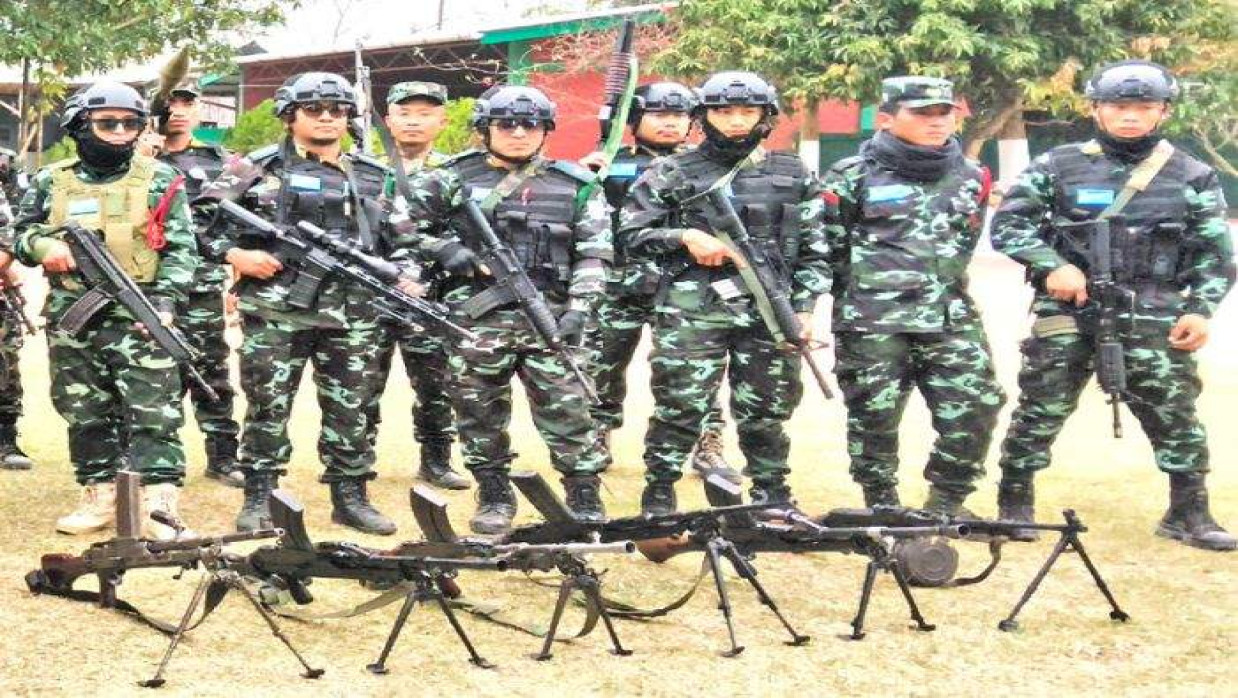
The emergence of the National Socialist Council of Nagalim–Isak-Muivah’s Eastern Flank represents one of the organization’s most serious internal ruptures in decades. By announcing a “provisional government” following an emergency meeting on July 21, 2026, the Myanmar-based faction challenged the authority of the NSCN-IM leadership at Camp Hebron and introduced dangerous new uncertainty into the already prolonged Naga peace process. (Hindustan Times, July 25, 2026)
The Eastern Flank claims it wants to prevent the Naga political movement from “another surrender” and to stop its ideals from being abandoned. This rhetoric matters. It implies that there is not just a fight over individuals and organizations but also over whether NSCN-IM leaders have given away too much during talks with New Delhi. (The Economic Times, July 23, 2026)
A Peace Process at an Impasse
The Government of India and the NSCN-IM have been under a ceasefire since 1997. The signing of the Framework Agreement on August 3, 2015, raised hopes of an early political solution. Subsequent talks reportedly produced considerable consensus on administrative and political questions but failed to reach agreement on two principal demands: a separate Naga flag and a separate Naga constitution. (Government of India ceasefire announcement; Prime Minister’s Office on the 2015 Framework Agreement)
New Delhi has balked at accepting either demand in a manner that would imply sovereignty outside the Constitution of India. The NSCN-IM, however, regards the flag and constitution as indispensable expressions of Naga identity, sovereignty and political history. These differences made it impossible for the government to meet its October 31, 2019 deadline for concluding the negotiations. (Nagaland Tribune, October 23, 2025)
The stalemate has generated frustration within Naga society and among the organizations involved in the negotiations. The Working Committee of the Naga National Political Groups appeared committed to reaching a final settlement within the Indian Constitution. On the other hand, NSCN-IM had consistently stated that it would be humiliating to settle for less than its core symbolic issues. The Eastern Flank is now attempting to imply that the Hebron leadership is willing to settle for such a deal. (The Economic Times, August 4, 2025)
The China and Myanmar Dimensions
The faction’s location makes the development especially important. Naga insurgent organizations have historically maintained sanctuaries and supply routes across the India–Myanmar frontier. During earlier phases of the Naga insurgency, some fighters also received political support, weapons or military training from China. (Journal of Strategy and Security study on India–Myanmar border insurgencies; Columbia International Affairs Online analysis)
That is a history India cannot afford to forget. New Delhi cannot rule out the possibility of China exploiting a fractured Naga movement amid wider regional instability. Nevertheless, there is no conclusive evidence in the public domain demonstrating that China created, directed or instigated the Eastern Flank. Strategic suspicion should not be presented as established fact.
Myanmar’s instability creates a more immediate concern. Weak governance and continuing armed conflict along the frontier give insurgent organizations opportunities to regroup, recruit and establish relationships with other armed movements. A faction operating beyond India’s direct administrative reach may consequently be more difficult to monitor or bring into negotiations. The long-standing use of remote areas of Myanmar as insurgent sanctuaries illustrates the practical difficulty of policing this frontier. (Asia Times analysis of insurgent sanctuaries in Myanmar; International Crisis Group on Myanmar’s continuing instability)
A Renewed Security Challenge
The split also creates the risk of conflict between rival Naga factions over territory, resources and political legitimacy. Even limited violence could damage the fragile ceasefire environment and attract younger militants who believe that decades of negotiations have delivered little.
The security situation has become more grim post the attacks and suspected blasts. Central security forces have been put on high alert. The Union Ministry of Home Affairs has handed over the probe into the July 13 blast at Khopanala, on the outskirts of Chümoukedima town, to the National Investigation Agency, citing the seriousness of the incident and the possibility of national security concerns. One Assam Rifles personnel was killed and four others injured in the blast. (Nagaland Tribune, July 28, 2026; The Economic Times report)
Yet no publicly acknowledged evidence has firmly linked the Khopanala explosion or any of the other recent attacks/explosive discoveries to the newly formed Eastern Flank. It may have increased government suspicion, but suspicious timing isn't proof of guilt.
New Delhi will have to resist viewing the crisis through a counterinsurgency prism alone. Heightened border intelligence and better security preparedness will be needed, but they will not be a substitute for continued political outreach. The longer the talks remain deadlocked without achieving a final settlement, the greater the opportunity for disgruntled commanders, factional rivals and outside interests to exploit the uncertainty.
The Eastern Flank might prove too fractured or remote ever to become a permanent force. For now, its emergence lays bare the weakness underneath the Naga ceasefire settlement. It's a reminder that an incomplete peace process doesn't just go into suspended animation. In the absence of tangible political movement, it can begin to fissure, and those fissures can lead to conflict.


0 Comments
LEAVE A COMMENT
Your email address will not be published