

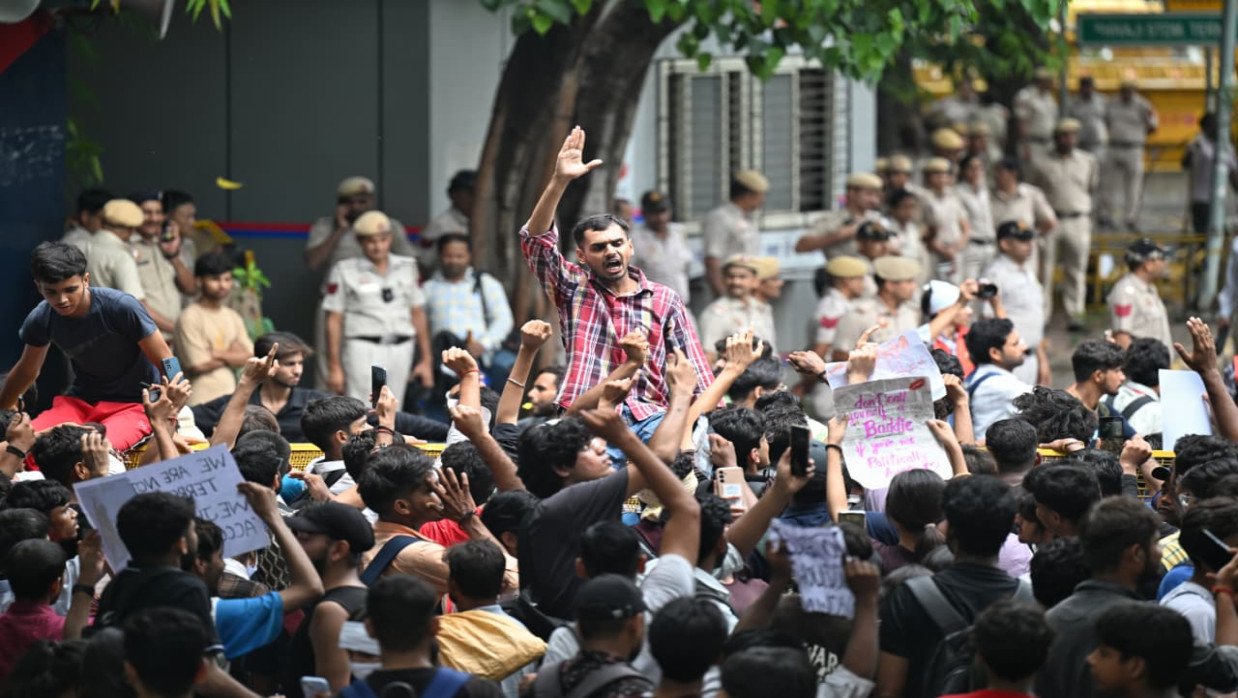
Every mass movement transforms politics. Occasionally, it also transforms journalism. India’s ongoing Cockroach Janta Party (CJP) protest may ultimately be remembered not only for challenging the Narendra Modi government over examination irregularities and youth unemployment, but also for revealing a fundamental shift in how Indians consume and decide whether to trust the news.
Started online as a satirical movement, the movement has evolved into a student-powered demand for accountability over question paper leaks and failures in the education system. Protesters have gathered in multiple cities, most prominently at Jantar Mantar in New Delhi, which has become the face of the movement. Most recent protests have seen students and unemployed youth protesting decreasing job opportunities, administrative apathy and government crackdown on dissent.
Television cameras remain present, while prominent anchors continue debating the movement from their studios. On the streets, however, the center of journalistic influence appears to be shifting.
Independent reporters, YouTube channels and digital creators have become some of the protest’s most visible narrators. Armed with smartphones, portable microphones and internet connections, they livestream demonstrations, interview participants and document confrontations with the police as they unfold. Their coverage is immediate, personal and often largely unedited.
At times, the difference with portions of establishment television has been remarkable. Reporters for certain networks have allegedly faced anger and jeering from protesters. It comes amid years of built-up resentment toward news outlets viewed as having cozy relationships with politicians. Journalists not affiliated with mainstream media have sometimes received invitations to join protesters. Journalist Munazza Fatima Obaida expressed a sentiment shared by many in a viral post on LinkedIn. Seeing independent journalists report on the protests despite having limited platforms and risking their own safety made her realize why she got into journalism, she wrote. More telling was that her career goal was not just to become another recognized face on corporate television. Ms. Obaida said she wanted to be respected by the public by reporting truthfully, fearlessly and responsibly, no matter where.
That aspiration symbolizes a generational change. For decades, Indian journalism students commonly regarded employment at a major newspaper or television network as the highest measure of professional success. Increasingly, younger journalists appear to believe that credibility can be built independently, one report, livestream, and audience relationship at a time.
Technology has made this possible. Smartphones and affordable high-speed internet have weakened the institutional monopoly over news gathering and distribution. A determined reporter can now reach millions without a television studio, printing press or large newsroom. During the CJP protests, audiences have been able to watch lengthy interviews and continuous footage instead of depending exclusively on edited television packages.
But citizen media shouldn’t be romanticized. Nonprofit doesn’t automatically equate to “objective.” Bloggers/influencers can become victims of groupthink, harassment from fans, clickbait, or social media incentives that reward outrageous content. Most citizen journalists don’t have lawyers on retainer, or editors, or fact-checkers.
The real contest, therefore, is not between mainstream and independent journalism. It is between reporting that verifies and reporting that merely amplifies.
Traditional organizations still possess extensive reporting networks, institutional memory and investigative resources. Independent journalists bring agility, proximity and a more direct relationship with their audiences. The emerging media environment will probably combine both.
The CJP movement nevertheless marks an important moment. It suggests that journalistic authority is no longer automatically granted by a newsroom’s name or an anchor’s prominence. It must be earned through accuracy, transparency and courage.
The future of Indian journalism may belong neither exclusively to television networks nor to digital creators. It will belong to those who earn the public’s trust and continue earning it every day.


0 Comments
LEAVE A COMMENT
Your email address will not be published