

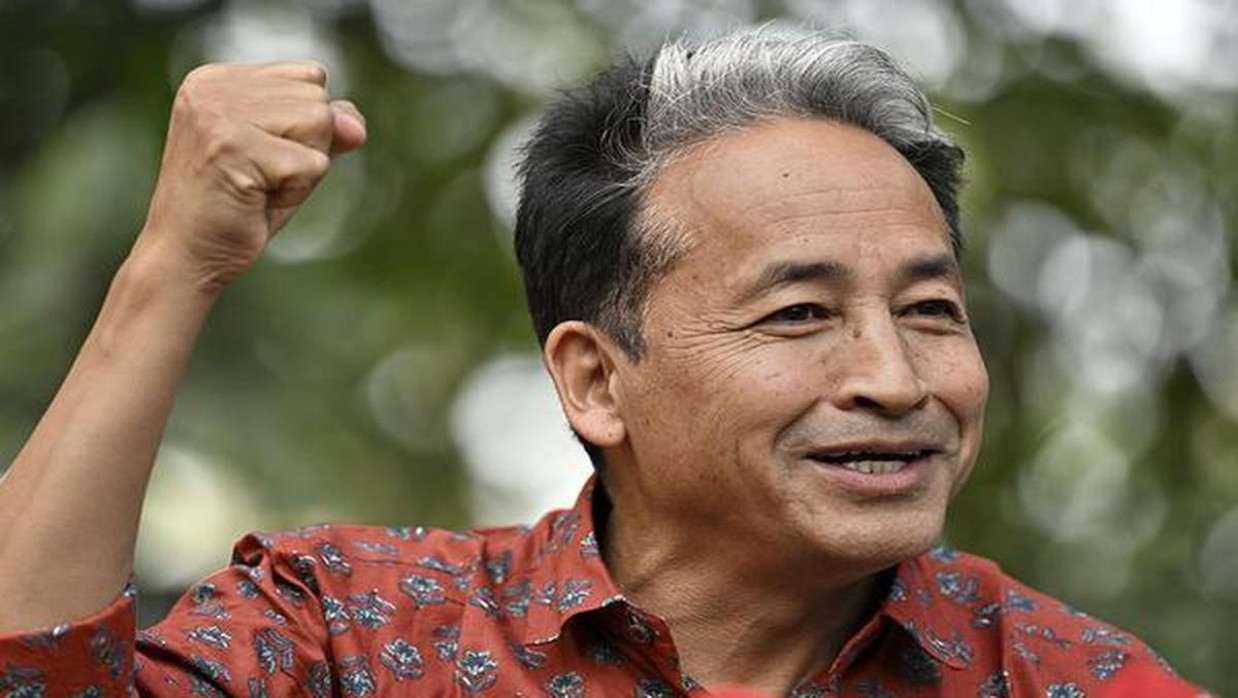
History has a funny way of choosing its heroes. Some become icons because they have political power; others are remembered for challenging political power. Sonam Wangchuk in modern India is very much of the latter kind.
Wangchuk has always demonstrated the primacy of service over rhetoric in patriotism’s definition. Education reformer, environmental activist. He has worked to reform education in Ladakh, and to promote sustainable development in one of the world’s most fragile ecosystems – not for politics, but out of deep commitment to people. His recent rallies for constitutional safeguards and greater protection for Ladakh’s ecology have reaffirmed an age-old truth: true national service often requires challenging the state, not blind glorification of it. Countries are seldom remembered for military victories or diplomatic successes. Instead, it recalls the way they treated those who dared to speak up for justice, environmental protection and democratic accountability. This difference is more important now than it has ever been.
A test of patriotism
Sonam Wangchuk became an international sensation for his creative educational projects in Ladakh inspiring millions after the release of Bollywood film 3 Idiots. But his greatest accomplishment is more than innovative classrooms. He showed that development in the highlands is not merely a copy of metropolitan ways. It has to respect the geography, the culture, the natural boundaries. Wangchuk has been a long-time advocate of solar-powered infrastructure, passive solar architecture, artificial glaciers called "Ice Stupas" and community-based innovation. But these were not merely technological experiments; they showed how local knowledge could be used to tackle the global problem of climate change. Climate change is a growing threat to the Himalayan region and Wangchuk’s theories are capturing the attention of environmentalists, researchers and governments around the world. His art is a form of soft power no diplomatic offensive can create.
When citizens address global challenges, they do more to improve a country’s global image than any public relations campaign ever could.
External Strength Depends on Internal Strength
India has emerged as a stronger player on the world stage. It is deeply engaged in the G20, BRICS, the Quad and a slew of Indo-Pacific initiatives. It seeks to be a leader in the Global South and project a responsible democratic power. These aims are quite legitimate. But international credibility is not just a matter of foreign policy, but also of domestic administration. The world's leading democracies have clout because people believe in their own institutions. Civil liberties, environmental governance, federal collaboration and public engagement all go a long way to international credibility.That may make up for domestic shortcomings for a time, but not forever. A government that seeks to build the international order must also demonstrate that it respects dissent, protects vulnerable ecosystems and responds constructively to peaceful civic movements.
Internal governance is a competitive edge
In a democracy, listening is a must. Disagreement is characteristic of democratic societies. Activists, academics, journalists and civil society organisations often expose uncomfortable truths. Strong democracies are resilient, and can be friendly even when governments may not agree to their requests – and that’s what distinguishes them from fragile democracies. Many reformers throughout history have been seen as inconvenient at first before being seen as visionary. In particular environmental issues are often brushed aside as an obstacle to progress. But climate change has shown time and again that ignoring ecological warnings is more expensive economically and socially.
Listening is not a weakness
It's showing faith in institutions. Climate Challenge is Local. Before it is Global. India has pledged ambitious renewable energy targets and global leadership on climate action. It is right to point out that industrialized countries have a greater historical responsibility for global emissions. But at the same time, climate leadership means protecting ecological hotspots at home. The Himalayas are Asia’s water tower, supplying river systems originating in these mountains that provide water to hundreds of millions of people. Hence, the consequences of glacial retreat, loss of biodiversity and water scarcity are much more far-reaching than Ladakh. Wangchuk’s voice is a reminder to lawmakers that climate action starts with local people on the front lines of environmental change. Ignoring these views is a threat to the long term ecological resilience.
Ladakh is a frontier of strategy, and more
India often views Ladakh through the prism of national security. Border tensions with China have rightly increased the strategic importance of the region. Policy discussions are about roads and tunnels and military logistics and infrastructure. Ladakh is also one of the world’s most sensitive environments. Rapid tourism, increasing infrastructure, changing weather patterns, depletion of ground water resources and unplanned urbanization are exerting tremendous pressure on local ecosystems. Such challenges affect the livelihoods of local communities directly, and often receive less national attention than geopolitical developments.
With Wangchuk’s campaign, Ladakh’s future is set to be at the heart of ecological sustainability and democratic representation. It is not to be viewed as a threat to national security. It acknowledges, rather, that environmental and human security ultimately contribute to strategic security. Ecology is fragile and no military can defend the nation from this if it is not resilient.
How Nations Are Judged by History
Governments are rarely remembered for anything but the exercise of authority. Instead, it recalls how they treated scientists, reformers, environmentalists and ordinary citizens who wanted positive change. They stood for ideas larger than politics and so figures like Mahatma Gandhi, Nelson Mandela and Václav Havel came to represent the moral strength of their communities. The outcome of Sonam Wangchuk’s role in that historical heritage will depend not only on his persistent efforts but also on the institutions’ response to peaceful democratic engagement. A country is not measured only by its economic growth, its military might or its diplomatic successes, but also by whether it can live with critical voices without fear.
India’s most vital strategic asset
Economic growth, technological progress and international partnerships are certain to determine India’s rise. But its greatest strategic asset is its democratic past, and the diversity and dedication of its people. Governance must continue to include public engagement, responsibility for the environment, and constitutional discourse if this strength is to be preserved. The argument over Ladakh is thus not restricted to one region. This is about the larger theme of how India balances strategic objectives, sustainable development and democratic accountability.
If India is to be seen as a global power, it needs to realize that global perception starts with national trust.
Sonam Wangchuk will be remembered not just for his protests but for always putting public service before personal comfort and environmental responsibility before political gain.Likewise, history will not just remember India for its influence abroad, but also for the compassion, openness and confidence it displays towards people who dedicate their lives to improve the country from within. True global leadership begins at home.


0 Comments
LEAVE A COMMENT
Your email address will not be published