

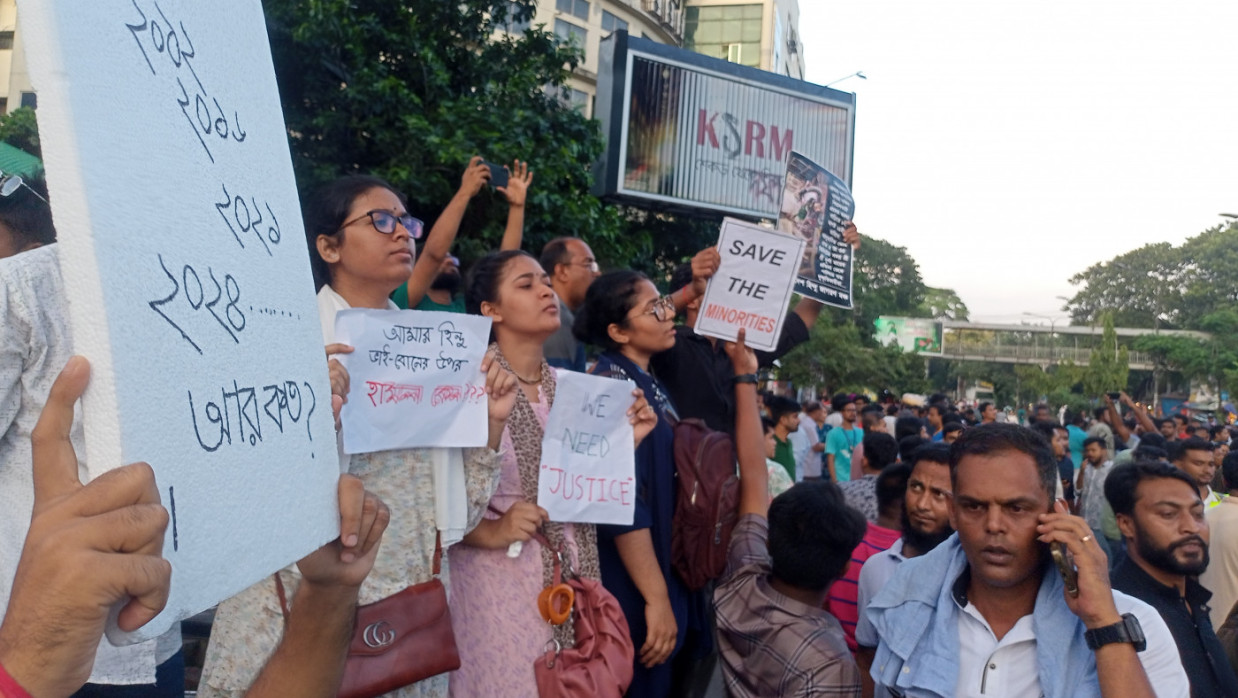
Few things draw such ire from governments as talk of human rights committed by others. States release statements lambasting crackdowns on protesters or members of minority communities across borders, purporting to speak on behalf of these victimized groups. Sometimes, such statements and attempts at moral leadership are warranted and helpful, particularly when they’re grounded in principles of universality and equality. More often, detractors will call foul when they perceive hypocrisy between how governments treat others abroad versus those at home.
India. With over a billion residents, it is the largest democracy in the world. However, in recent years, India has attracted increasing international criticism for its human rights record at home, just as New Delhi regularly publishes statements on rights concerning minority groups in neighboring countries like Bangladesh.
From the crackdown on freedom of expression and India’s treatment of Muslims to backsliding on democratic norms, advocacy groups and some foreign governments have begun sounding the alarm on India’s rights record. Dutch Prime Minister Rob Jetten’s recent remarks about press freedoms and minority rights in India have shed new light on the phenomenon: Can a country speak out on behalf of minorities' rights in other countries while its own citizens face grave challenges at home?
India's Concerns About Minorities in Bangladesh
Last month, when news surfaced about the alleged burning of Hindu images and idols in Bangladesh, India’s Ministry of External Affairs said it “took note” of the reports with “concern.” “We expect the government of Bangladesh to act against those who indulge in such extremist acts and to protect all minorities and their interests,” MEA spokesman Ranadhir Jaiswal told reporters in June 2026.
Such admonitions aren’t new. New Delhi has long believed it has a stake in the well-being of Hindus living in other countries. After all, when shared history, culture, and religion transcend international boundaries, inflammatory incidents like mob violence against minorities inevitably turn into bilateral issues.
But minority rights are everyone’s responsibility. All countries have an obligation to ensure their citizens, regardless of religion, are treated equally under the law and live without fear of persecution. When attacks happen against Hindus in Bangladesh and Pakistan, Muslims in India, or any other religion in any other country, governments must promptly look into the allegations and prosecute those responsible.
However, India’s frequent interference comes with a follow-up question from many: Isn’t India itself guilty of turning a blind eye to violations against minorities within its own borders? Secondly, if questioned about these violations, Indians become aggressive towards the questioners.
International Concerns About India's Minority Rights Record
In recent years, critics have increasingly focused on India’s treatment of religious minorities. Hindus and Muslims make up the majority of India’s population, but Muslims have faced discrimination for years. Increasing international concern over the treatment of Muslims in India has been surfacing over the last decade.
Accusations include Hindu-Muslim riots, contentious citizenship laws, anti-conversion laws in certain states, interference in religious activities, and selective enforcement of law against Muslims. Rights groups have claimed minorities in India, particularly Muslims, have felt unsafe in recent years.
This criticism has also come from outside government organizations. At a meeting with Prime Minister Narendra Modi last week in the Netherlands, Dutch Prime Minister Rob Jetten reportedly told Modi he was worried about the rights of religious minorities in India as well as Indian media freedoms. “More and more Europeans ask themselves whether India still is the country that proudly defended democratic and pluralistic values,” he said.
These remarks are becoming common from Western leaders. Even as their governments continue to partner with India on economic and strategic grounds, many Western democracies have raised concerns about democratic erosion and religious freedom publicly.
India has pushed back hard against these criticisms. Indian leaders claim that India is still a free country with a large Hindu majority that offers equal rights to people of all religions under the constitution. New Delhi points to increasing minority populations as proof that minorities in India continue to flourish.
The Question of Press Freedom
Criticism has also centered on issues related to press freedom and minority rights.
Freedom of the press is one of the many tools that fight human rights violations. It is essential to shed light on various injustices and forms of discrimination while supporting minority voices. Reporters also hold Governments accountable for their actions. Given the contributions of these freedoms to transparency and accountability, declines in press freedom often raise questions about these other issues as well.
RSF's 20th World Press Freedom Index ranked India 157th out of 180 countries surveyed, a decline from its last assessment. India's continued decline has raised global concerns.
Critics of India's current climate have voiced their concerns about journalists facing judicial harassment, intimidation online, and increased censorship when covering topics that may be viewed as politically or religiously sensitive. Multiple news outlets and journalists have claimed that publishing articles critical of the Government can lead to government inquiries, prosecutions, and other challenges.
India has pushed back against claims of restricted press freedom, noting that it has thousands of newspapers and magazines in various languages, as well as thousands of television channels and online news portals. Government officials also claim that "ranking systems do not take into consideration India's unique socio-political environment."
However, many international organizations continue to voice concerns about press freedom in India.
Democracy, Majoritarianism, and the Challenge of Social Cohesion
India is defined by its Constitution as a secular republic with a diversity few countries can match. With over 1.4 billion citizens across hundreds of languages and numerous religions, India has often boasted itself as the largest democracy in the world.
But detractors claim a shift toward majoritarian politics has threatened India’s pluralism.
Majoritarian politics is a system in which the cultural norms of the majority community overlap with those of the state. Majoritarian politics can help parties win elections, but risk alienating minorities.
The argument cuts both ways because India has traditionally banked much of its soft power on its identity as a plural democracy. If minorities do not feel wholly welcome or safe, can democracy itself still function?
But proponents of India’s government say that harping on minor sectarian issues insults the majority Hindu population and paints nationalism as bigotry. Democratic ideals still exist in India, they say, and political opposition should not be conflated with oppression.
The conversation becomes fraught when you consider both sides of the argument.
International Responses and the Limits of Accountability
Oddly enough, what I find interesting about all this is how little it seems that other countries want to put pressure on India.
There are a few reasons for this.
Firstly, India has one of the biggest economies on Earth and is seen as a prime investment destination. You've got multinationals around the world drooling over India as the next big market.
Secondly, India has geopolitical value to many Western governments as a partner in countering Chinese influence in the Indo-Pacific.
Thirdly, India has massively scaled up its tech and manufacturing capacity in recent years, creating vast opportunities for bilateral partnerships across sectors ranging from semiconductors to defense production.
That Tata deal with ASML only happened last week. And the Netherlands recently returned some ancient Indian artifacts to great celebration in the Indian media. Friendships are Trumpisms.
Meaning that, despite all this, many governments are still trying to walk the line between upholding human rights and maintaining strategic and business interests with India.
The problem with walking that line is that it often ends up being hypocritical. Countries that are slapped around for minor human rights violations that are dwarfed by what countries like India are accused of will often get off easy.
The Need for Consistent Standards
This is not just a problem in India. Human rights do not work if double standards are applied.
We cannot loudly criticize abuses happening next door while turning a blind eye to them at home, and then avoid charges of hypocrisy. Nor can we act as human rights rules apply to some big, powerful countries and not others.
Only by standing up for human rights everywhere will we send a strong message that they are based on principles, not politics. That applies to protecting minorities, whether they’re Hindus in Bangladesh, Muslims in India, Christians in Pakistan, Rohingya in Myanmar, or elsewhere, just as much as it does to standing up for media freedom against whatever government wants to silence criticism.
Human rights are not a bargaining chip. They are a duty owed to all people.
Conclusion
India is both a democratic giant with enormous potential, a vibrant economic power, and a cultural mosaic flexing its muscles on the world stage. But as it expands its presence and influence globally, it also faces growing criticism from other countries over issues related to minority and journalist rights.
In recent weeks, we have seen a war of words between the leadership of the Netherlands and India over the treatment of Muslims in India. New Delhi has denied most of the allegations. But as long as countries like the Netherlands, the United Kingdom, Germany, and others continue to raise these issues, the discussions are unlikely to go away.
What matters at the end of the day is not what countries say about their human rights records, but how they treat all minorities at home. If countries are serious about promoting and protecting minorities abroad, they will have to hold themselves to the same standard at home.


0 Comments
LEAVE A COMMENT
Your email address will not be published