

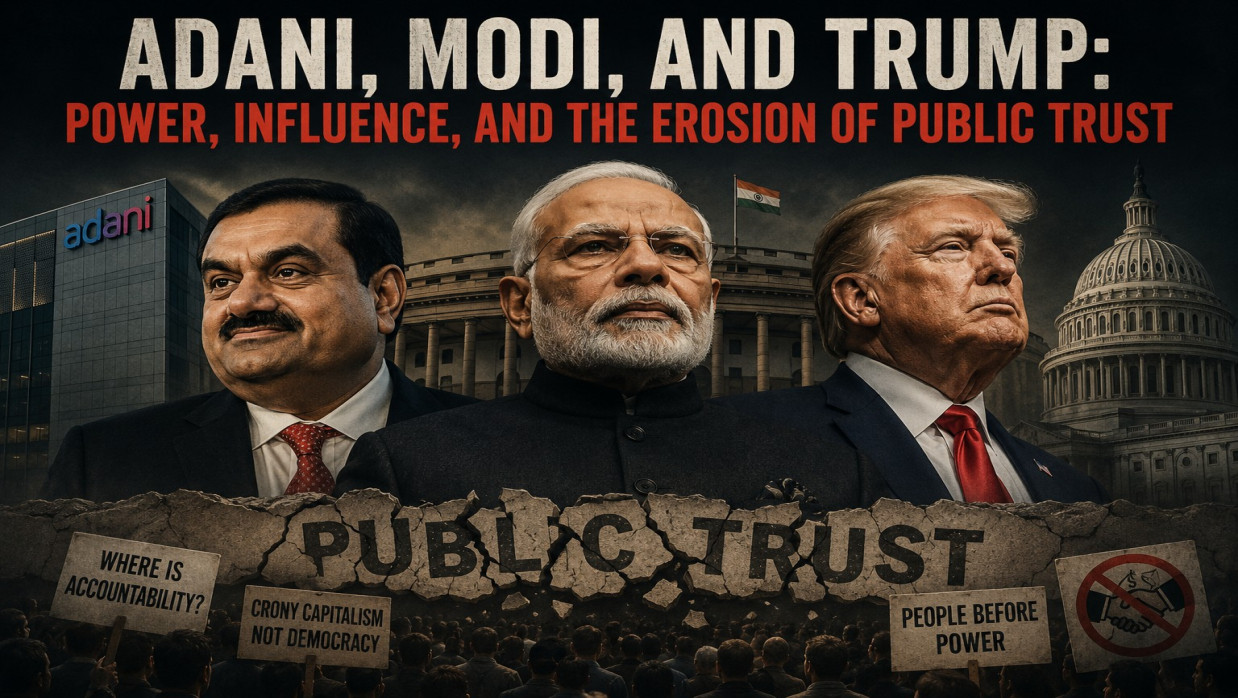
Money in politics has been a defining feature of democracies worldwide. From Washington to New Delhi, there have always been discussions about the relationships between tycoons and politicians, which, in turn, have shaped how people view governance, accountability, and the justice system. Indian Billionaire Gautam Adani is currently at the center of such a debate. Having risen to prominence with Prime Minister Narendra Modi and now facing legal troubles in America, he has raised questions about the impact of wealth in democracies.
Discussion around Gautam Adani isn't about his future; it is about the future of institutions and whether wealthy individuals can use their power to dictate political decisions, manipulate regulators, and get favors from governments. More importantly, will people continue to have faith in systems if they feel honesty and transparency are no match for rich politicians?
The Rise of Adani and the Modi Era
Gautam Adani's rise from a regional businessman to one of the richest men in the world has closely mirrored Narendra Modi's career trajectory. As Modi climbed India's political ranks from Chief Minister of Gujarat to Prime Minister of India, the Adani Group rose to prominence across sectors, from ports, airports, and energy to logistics, mining, and infrastructure development. Both men's supporters have credited this growth story with India's economic metamorphosis.
They say India's large-scale infrastructure projects require gamblers with deep pockets willing to invest in the country and the risks that come with developing a nation. From their perspective, Adani is ushering in a new wave of Indian industrialists who will compete on the international stage and help India become an economic superpower. Critics of both men, however, have had a different perspective. They claim Adani's rise was greased by access to politicians, policies, and government favors. India's opposition parties and civil society activists have frequently asked if the line between state and business has been crossed.
Whether there has been concrete evidence of collusion is debatable and remains both a legal and political issue. However, there certainly appears to be a marriage between corporate might and political power in today's India.
The American Legal Controversy
It became a global issue when U.S. authorities brought charges against Adani and several firms. Federal officials alleged that Adani and several others had committed bribery and fraud related to energy projects in India, and also charged them with defrauding investors. Adani has denied any wrongdoing, claiming that the allegations were without merit.
The scandal has taken another turn as the Justice Department has sought to dismiss the criminal charges. Political pressure began soon after in Washington. Senators Elizabeth Warren and Richard Blumenthal, both Democrats, have openly questioned the Justice Department's actions. Both have sent requests for information to the department.
Questions have been raised about Adani hiring Attorney Robert Giuffra, who has previously worked for President Donald Trump. Some have asked whether politics played a role in the government's decision. Additionally, questions have been raised about reports of Adani's potential future investment in America.
So far, many of these questions do have answers. The Justice Department has not publicly stated that political pressure played any role in its decision. Additionally, the courts have yet to issue any definitive rulings on many of the issues surrounding the scandal.
One thing that many Americans can agree on is the damage that news like this causes. Institutions once thought immune to political pressure are now viewed with a healthy dose of skepticism.
The Challenge of Institutional Credibility
"The worst that can happen from such episodes is often not a judicial verdict, but diminishing faith."
Judiciary systems only work when people have faith in them. We believe judges are impartial, district attorneys weigh evidence, not politics, and government regulators apply the rules equally, whether you're rich or poor.
When influential figures seem to get preferential treatment, even if they are later shown to have done nothing wrong, trust erodes. Often, perception can be tantamount to fact.
This isn't something unique to India or America either. Voters globally are starting to feel like our governments exist not to serve the average citizen, but powerful business interests. Call it whatever you want: campaign finance, lobbying, corporate greed, regulatory capture- it's happening everywhere.
The Adani row has become emblematic of this debate over money and power in the 21st century.
Business, Politics, and Democratic Accountability
There will always be tension between governments and large corporations. Democracies need big business, just as big business needs democracies. Infrastructure, energy independence, new technology, foreign investment—you name it. These are all made possible by a symbiotic relationship.
But democracy also needs to guard against these relationships becoming too incestuous.
This is the fear that elected officials come to rely too heavily on big business for donations, and big business comes to rely too heavily on government for contracts, licenses, and regulatory favors. It's a vicious circle. And when that happens, we, the people, can't hold anyone accountable.
Big money in elections is a particular problem in nations where it costs a lot to run for office and political fundraising lacks transparency. It's a common complaint among those critical of Indian politics that corporates have too much say these days. The retort is that this is true of almost every democracy and that everyone should be innocent until proven guilty.
We don't know enough about India to say whether that's true. But what's true for India is true for America, and everywhere else. There has to be a happy medium between the necessary relationship businesses have with our government and the quid pro quo that occurs when businesses become too successful.
Lessons for Democracies
The Adani-Modi-Trump controversy has shone a spotlight on a global tension playing out. Democratic institutions around the world are finding they must work even harder to prove their independence amid unprecedented concentrations of wealth.
Taxpayers are starting to demand answers from our governments as to why they do what they do. Why aren't laws against corruption upheld? Why don't we all play by the same rules? Democracy starts to break down when it can't deliver what we want.
If the claims about Adani turn out to be true or false, the damage to our faith in democratic institutions has already been done. At the very least, this controversy exposes the ugly side of public concern over wealth's role in politics.

0 Comments
LEAVE A COMMENT
Your email address will not be published